
LOST 046: First Do No Guam
We are so back. Unpacking the TV show LOST — Season 5: Episode 6
You've got your LOST shades on, and the worst days are gone.
Previously, On LOST: Oh boy. Here goes. Oceanic Flight 815 crashed on LOST island. Survivors survived, at least for a while. Turns out LOST island is a dimensional and spiritual hub containing massive quantum energy upon which live gods and monsters, at least one of whom (The Adversary) believes Itself to be locked in a cosmic argument over the worthiness of human beings, and at least one of whom (The Island) appears disinterested in that argument, but more interested in progress, human and otherwise, in the manner of a scientist conducting an experiment. Anyway, as part of that argument/experiment, there have been a lot of human beings drawn by destiny and/or chance to the island, and due to the massive quantum energies there tends to be a lot of contention over control of the island, and that contention gets bloody sometimes, and it gets bloody confusing sometimes, and that's where I come in. Anyway some of the humans from the Oceanic crash managed to escape the island, which is no easy task, since it is a sort of dark-moon pocket dimension moving around the Earth through both time and space. Now these escapees are being told by lots of island-aware people that they have to return to the island in order to fulfill their destinies, and, to varying degrees, most of them have begun to believe that might be true.
Let's blaze on.
Subscribing to The Reframe is free.
It's tough but fair. Subscribe now for free and never miss an essay. Or, if you really like these LOST recaps and want to support them with filthy lucre, the options are multifarious.
OBSERVATION & BELIEF
Wait. What? Observation and belief? That's right, kids. I'm not just crossing the streams; for now and maybe for good, I'm collapsing them.
We're well into Season 5 now, and I've mentioned more than once that this season has had enough plotstuff to accomplish that the whole character-centric episode structure has begun to diminish and fade. The next two episodes are significant exceptions, as we take a deep look at the two characters who have driven the "observation vs. belief" dialectic, namely: Man of Science Jack, and Man of Faith Locke. These next two episodes reference each other in ways that I think are mostly confusing on first watch, but become much more satisfying on second watch, so I'm just going to unpack all the little mysteries as if we've all already watched both, which we probably have, isn't that nice? This approach is going to work better if I just recap what we see and talk about the questions it raises and what I believe it means, instead of bifurcating those sections. This merging is mirrored within the narrative; in these episodes we'll see our Man of Science come to the end of his ability to trust his belief in his rationality, and our Man of Faith come to the limits of his belief in his destiny, and for both men it's because their beliefs no longer square with what they've observed.
Today I'm focusing on the Jack episode, for the very good reason that it was broadcast first.
Time to pour one whisky, one Scotch ... and one LOST.

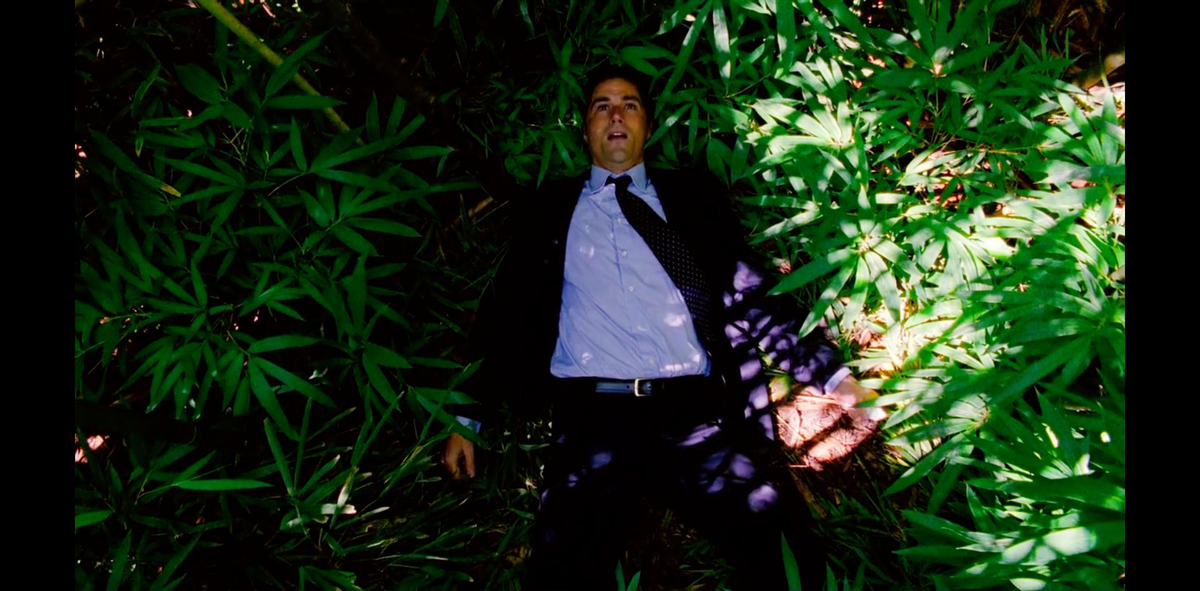
Episode 6: 316 (Jack): This is the one where the Oceanic Six (Jack, Kate, Sayid, Sun, Hurley, hey wait that's only five) and their frequent frenemy, Ben Linus (hey! there's the sixth), return to the island. We learn this fact right off rip, as we see a perfect recreation of the series' very first image: Jack's eye opening in extreme close-up. The parallel continues as we cut to an overhead shot: Jack's wearing a suit, lying in a bamboo forest. Is it the same bamboo forest as he found himself in after the Oceanic crash? I think so, and I think I know why, too ... but I'll save that for some other time. For today I'll just say we'll see Jack supine in the bamboo forest again, and if you know, you know. Yes, Jack's not only back on the island, he's back in the exact same way. Hell, he's on his back in the exact same way.
The similarity extends to Jack's method of arrival. He was on an airplane, in other words. By the end of this episode we'll learn it was Ajira Flight 316, so there is the episode title and the answer to the mystery of "where did the Ajira Airlines water bottles that Sawyer & Co. noticed during their time-displaced adventures come from?" If that question was burning in your heart, feel the sweet relief of fulfillment, my lovelies.
We soon learn that Hurley and Kate are there too. It's not certain yet that Sayid and Ben and Sun have returned, as well, but let me deflate that party balloon and just tell you that yes of course they have ... though they're not all in the same when. Ben and Sun are in what roughly translates to "present day" relative to Earth—2007 or thereabouts. The rest are in the groovy 70s, baby. These facts won't come up in this episode, but it's a great time for me to come back to my observation that when you come to the island, when you arrive is perhaps a chancy thing.
Also, when Jack awakens, he's holding a scrap of paper that says "I wish." The rest is left to our imagination. Cryptic, no? It's Locke's suicide note, which Locke addressed to Jack. It says, simply "I wish you'd believed me." We'll find that out next episode, and more on that then.
The rest of the episode is going to be a build-up to the question "will these characters get back to the island?" which would have potentially been suspenseful if the episode hadn't started by answering the question (speaking of deflated party balloons). But then we wouldn't have had the nifty parallelism here in the cold open. These are the tradeoffs writers need to make.
Oh well. The rest of this episode will take place ...
Off-Island 2007: We begin right where we left off—in fact with a repeat of a scene we watched last episode, so I'll repeat my commentary. Ben and the Oceanics enter the outer sanctum of Eloise Hawking, with Desmond in tow. Eloise points out that Ben was meant to collect everyone. Ben snits that this was the best he could do on short notice. Hawking honestly doesn't seem too concerned, contra all her previous "then God help us all" posturing. That's interesting.
"Let's get started," she says, and brings them into her inner sanctum, the pendulum room from episode whatever, which Hawking now confirms is indeed, as it appears to be, a former Dharma station. There's a lot of interesting stuff happening in this room. As previously glimpsed, the pendulum is a stylus of sorts and is making asshole-shaped scratches in the floor as it swings, and the floor is a map of the world, so it's created a bunch of big asterisk-assholes in various locations. There's a blackboard with a bunch of very complicated-looking equations written upon it in very neat handwriting. There are a bunch of old-timey computers in big cabinets with the blinky lights and a big board with flip numbers flipping to show the latest stock prices on the island, or more likely the latest geographic coordinates of the island. There's a picture of the island from the U.S. Army circa 1954, labelled TOP SECRET.
"They [the Dharma Initiative] called it [this station] the Lamp Post," Hawking informs them. "It's how they found the island."
Oh boy! This is the hot shit! Let me spend about half this entry breaking down this one scene, because it is proof text for a whole lot of the beliefs I've been sharing with you.
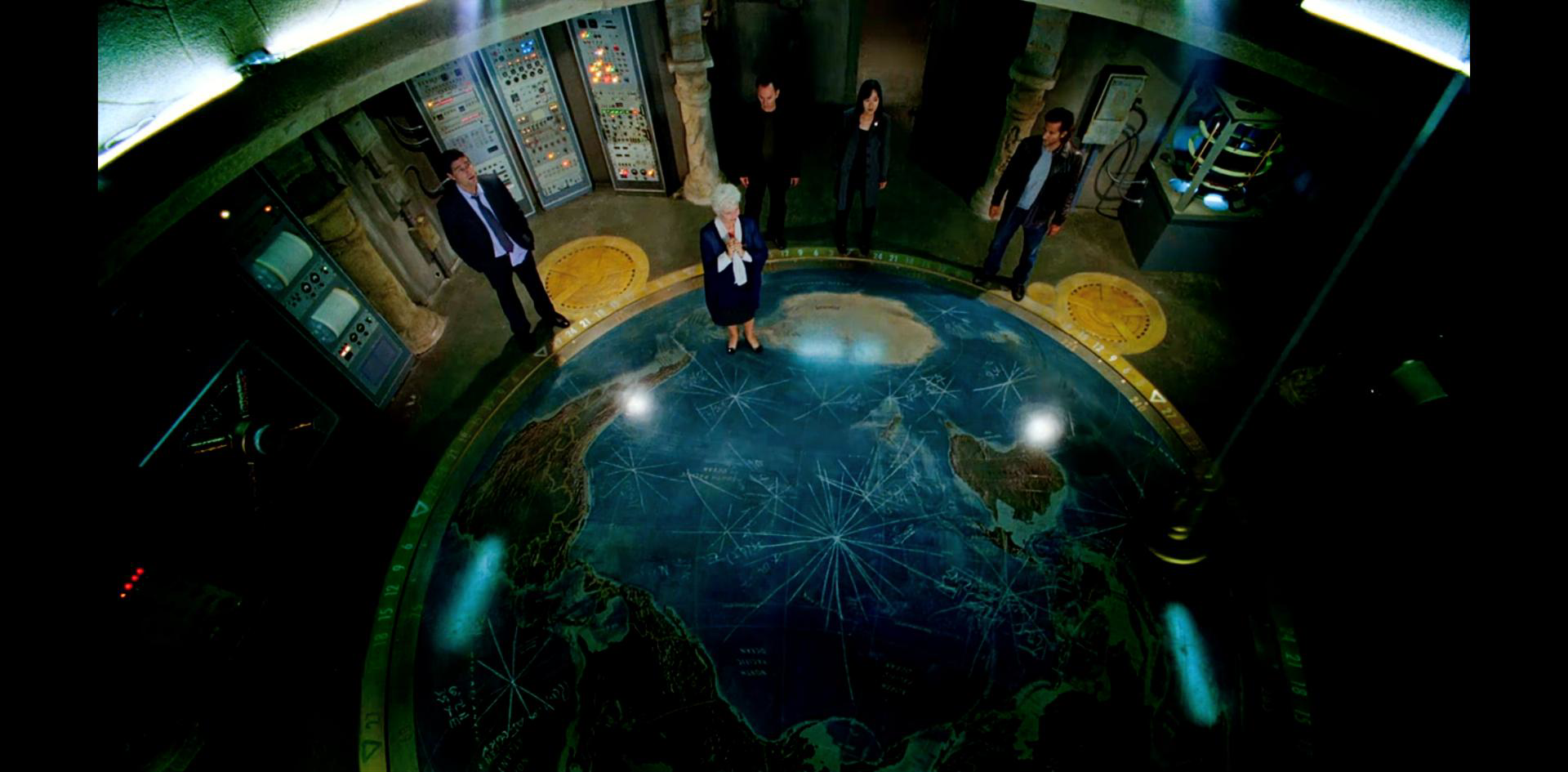
Hawking goes on to explain that the Dharma Initiative constructed this station over one of those pockets of unique energy we've heard about from time to time, which she claims all connect to each other all over the earth, and which I believe to simply be a point of confluence in the island's orbit around the earth; a place where the island's unique energy draws near to earth. If you've seen how Howl's moving castle works in the movie Howl's Moving Castle, then you have a decent idea of how I think about it. In case you don't: The castle has a door with a switch. Depending on where the switch is set, the door will open on one of however many locations. If the switch is set to a location, you can open the door and walk into Howl's moving castle, or leave Howl's moving castle and walk out to that location. If the switch is not set to that location, that same door will open onto nothing but an empty courtyard. So with the island: For each pocket, sometimes the island is there, sometimes it ain't. The island doesn't have a switch; it has an orbit. Except ... The Adversary had a switch installed. The wheel.
Let's do a bit more island work. As I've stated many times, I believe that the island moves in an orbit around the earth ("always moving"). As I've stated only a few times, I believe that this orbit probably makes up all possible orbits that could be made; in other words, the sum total of the island's orbits describe a sphere roughly the size of planet Earth. As I've maybe never stated before, I believe that the reason the Earth exists at all is because the island orbits there, and it accumulated matter as a result of that orbit. That last belief isn't all that important, it's just a fun way to think about it, and it also establishes the island as superior to the Earth, in terms of temporal existence and cosmic importance, which I think is appropriate to the story, so it's what I think. Here's another rather unimportant but fun belief: I believe we see the island performing only a few of the orbits, because in the 4 8 15 16 23 42 version of reality we are observing, only certain possibilities and certain orbits present themselves.
I also believe that the island's interaction with the Earth is dimensionally adjacent, by which I mean that, by some quantum mechanism or another, the matter of the island and the matter of the Earth do not interfere with one another. This belief is just a practical matter, since an object the size of the island moving around the Earth would create massive disruptions if its matter interfered with the matter of the Earth, and it doesn't create massive disruptions. I believe that much of the island's orbit occurs beneath the surface of the Earth, but that there are places where it draws near, or peeks above, and these are where these "pockets of unique energy" are found. I believe that whenever these points of confluence occur on the Earth's mainland, the island tends to remain beneath the surface of the Earth, and remains inaccessible, whereas on the sea, which is naturally enough at sea level, the island is more frequently accessible, and sometimes sits atop the sea like a billiard ball in a saucer of milk. I believe this mostly because the island does not seem to scoop people up from the mainland, but it does seem to scoop people up from the sea. I also believe this through observation, because Oceanic 815 was some 40,000 feet in the air when it broke apart, yet this event seemed to occur only a couple thousand feet up at most when observed from the island.
Moving on ...
Hawking informs the gathered Oceanics that Dharma's founders knew the island was out there. I suspect (given the context clues here at Lamp Post) they knew it in part because they had detected pockets of energy, and in part because they were a part of the post-WWII U.S. forces who discovered the island, or a group that had been brought into that project. She next explains that the problem was that Dharma wasn't sure where it was, until a "very clever fellow" and his team figured out a series of equations (we're invited to understand that it's the very equations replicated on the blackboard). These equations would predict, "with a very high degree of probability," where and when the island would be, based on the assumption that the island was "always moving" through time and space. So there's the idea of the island being in a strange orbit around the earth, all but stated in so many words.
What we didn't know the first time we watched, but we do know the second time through, is that this "clever fellow" is almost certainly Daniel Faraday, and that Hawking, Faraday's mother, has been in possession of all of Faraday's notes since the groovy seventies, courtesy of time-travel shenanigans. More about that whole relationship soon enough. ("Almost certainly" because there's a bit of a timing issue. We'll see that Dharma is already in operation on the island when Faraday arrives. My belief is that pre-Faraday, Dharma had figured out how to get to one or two locations and needed to sort of wait around to catch the island as if it were the world's biggest bus. Post-Faraday, they could actually send precise and automated food-drops. The alternatives I see are either that the writers made a mistake—which is certainly possible but not as fun—or else that the "clever fellow" Hawking mentions is somebody we never see or hear about—which is certainly possible, but makes for a worse story. Pick your poison.)
The equation is also, I believe, how Ben Linus and his faction were able to get on and off the island. Ben tells Jack that he didn't know about the Lamp Post, but everyone pretty much immediately assumes that this is a lie. I assume it is a lie, too (Michael Emerson seems to play it that way), though I believe it's likely—based on the dynamic we see between Hawking and Ben—that Ben didn't have access to the Lamp Post until very recently. However, we also know that Ben was in thrall to/cahoots with The Adversary. Through that relationship, I believe Ben had access to the equation, and I believe he had access to knowledge about how to move the island so that certain underlying assumptions were no longer correct in the calculations of other people (like Charles Widmore and perhaps Eloise Hawking) who had access to the equations ... until Desmond turned the failsafe key at the end of Season 2, which reset the island's location and/or provided Widmore & Hawking, et al with a solid point of reference that made the equations useful again, and which created the state of extreme vulnerability for Ben that we've seen him dealing with ever since.
So that's what I believe about that.
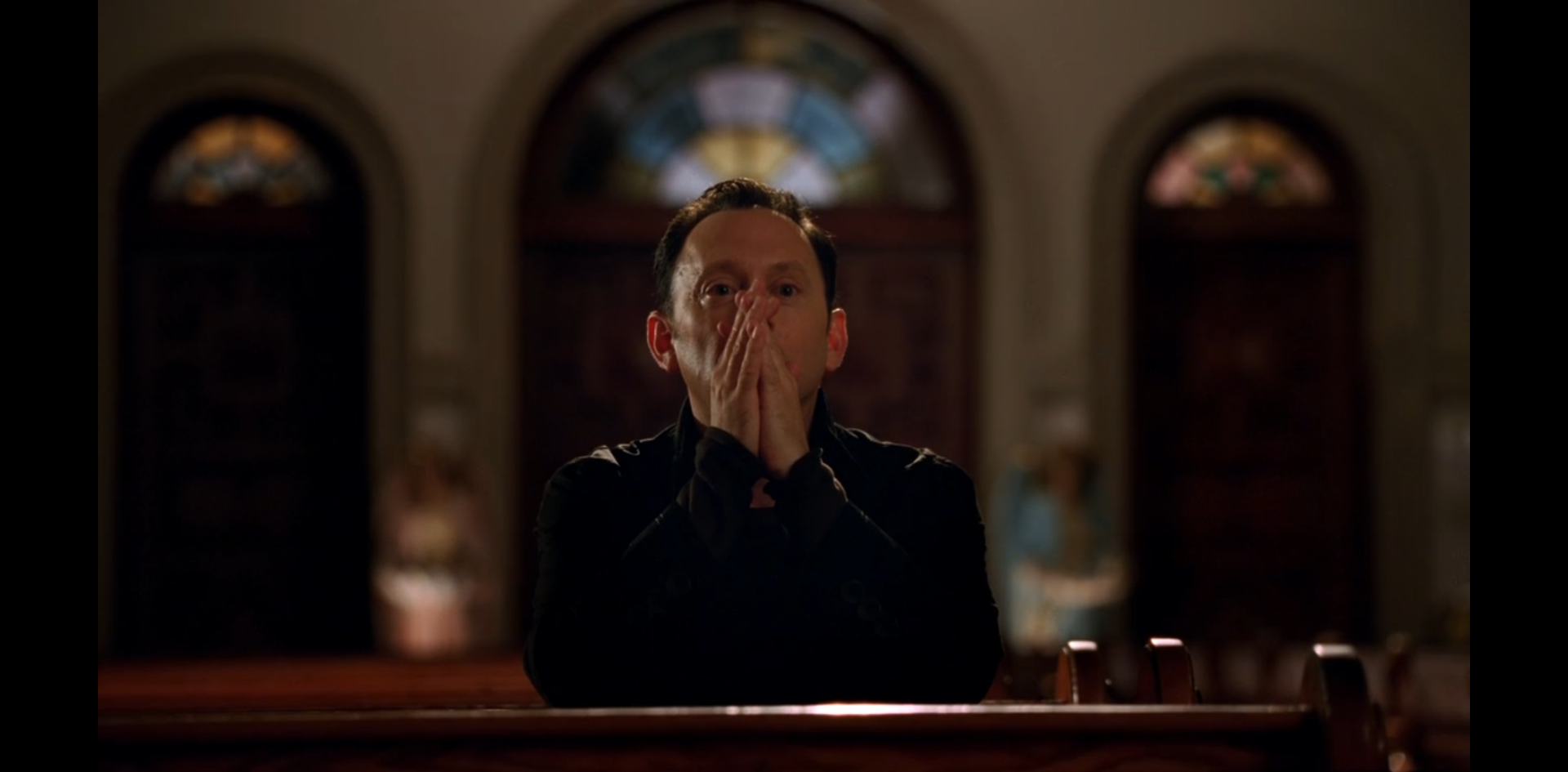
Before we leave this scene, I'm just going to say it: The Lamp Post is ridiculous if you think about it. Is the pendulum really necessary? The computers have the data, and readouts. The pendulum is just an extremely unwieldy way of rendering it. Do they buff out that map of the earth when they want new calculations? Do they just replace the floor? Let's face it, the Dharmites were dramatic bitches, and so is Hawking, she of so many dramatic pauses and portentous glances. The reason for all this is obvious, I hope: Atmospheric nonsense can make for good TV.
And I believe dramatic effectiveness was the same reason Hawking brought them all down there. Please understand that doing that wasn't necessary at all. This meeting could have been an email. The computers in the room have made the calculations based on Faraday's equation, so Hawking now knows where the island is going to be, and there's a flight—Ajira 316—that is going to cross paths with the island during that window. They just need to buy a ticket on the airplane. But the dramatic set really makes the mystery pop. Them's just the breaks, kids.
Moving on. Desmond (remember him?) finally realizes that all of his friends are actually planning to go back to the island and loses it. Hawking is known to him, after all. It was her advice that led him into the worst regret of his life; breaking off his engagement to Penny, and setting himself on his course toward the island. Des tells the gang to not do anything Hawking suggests or believe anything she says. He delivers his message to Hawking: Your son Daniel Faraday and all his friends are in trouble, you have to help (remember, time-jumping Faraday incepted this into Desmond's mind). I've already talked about how this message really doesn't do anything to actually help Faraday & Co., and what I think Faraday may have actually been up to in delivering the message. So let's move on. Des does. He scarpers.
Hawking's got one more bit of info for everyone, which is why it is that they all have to be on that flight, as has been stressed so very many times. "If you want to return, you need to recreate as best you can the circumstances that brought you there in the first place," is what she says. "That means as many of the same people as you are able to bring with you." And if we can't? Jack wants to know. "All I can tell you is that the result would be ... unpredictable," Hawking intones.
I believe this is all Pure D bullshit. But hold on a sec; there's a bit more.
After the commercial break, Hawking has some information for Jack's ears only. For one thing, she has Locke's suicide note, which was addressed to him. Jack hadn't been aware Locke was a suicide, and he makes his blinky Jackface about it. Hawking has no time for those feelings; very practically, she points out that, since Jack was travelling with a corpse last time (Jack's father Christian), Locke will be able to be a proxy for that part of "recreating the circumstances" etc. To this, she adds a kicker: Jack needs to give Locke's corpse something of Christian's.
My friends, I don't know what the hell to make of this. Neither does Jack.
"Stop thinking of how ridiculous it is, and start asking yourself whether or not you believe it's going to work," says Hawking. This sums up the entire ethos of this show as succinctly as I can imagine.
Let me jump forward a bit. Jack will follow Hawking's instructions: He's going to put his dad's shoes on Locke's corpse, and Jack and the rest of them will wind up back on the island. Does that mean that putting the shoes on Locke "worked?" That's up to you. I guess the question is: Do you believe that returning to the island depended on recreating the circumstances of the flight? I don't. I believe it would have "worked" with or without the shoes.
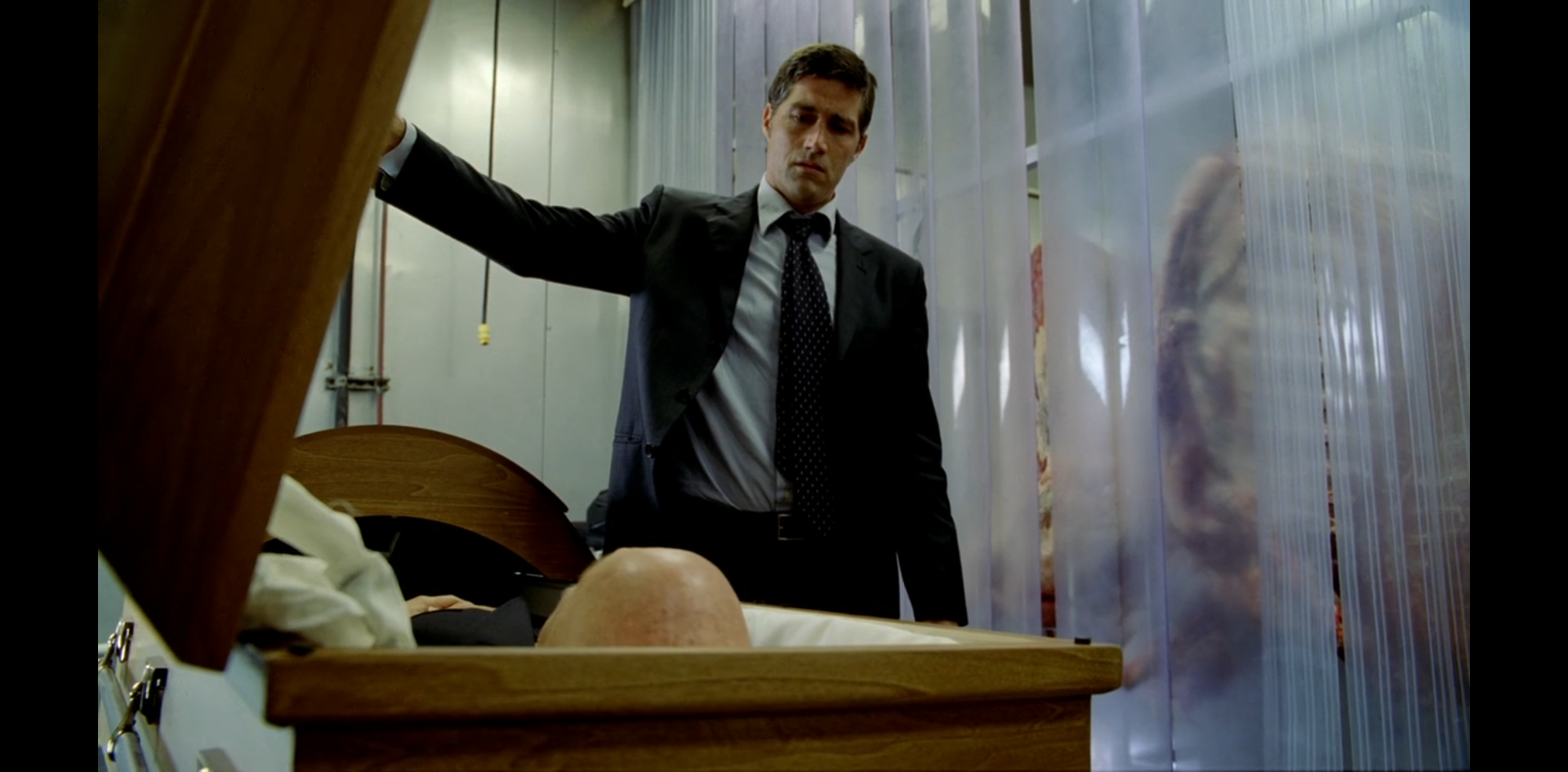
In any case, the circumstances aren't all that well recreated. Aaron isn't on board. Walt isn't on board. Most of the Oceanic 815 passengers aren't on board. In this very episode we're going to spend about 2 minutes specifically devoted to the fact that Jack's dad wasn't wearing nice shoes in the coffin. And recreating exact circumstances isn't how people wind up back on the island anyway, as we've been able to observe a great many times. If it is in an accessible place and you know where it is and you go there, you'll wind up there.
Some may point out that Jack and many others wind up back in the 70s, which speaks to Hawking's warning of unpredictable results. Here's what I know: Eloise Hawking knows exactly who is going back to that island, and she knows that they are going to wind up back in the groovy seventies. She knows that, because she was there as a younger woman, and met them then, and ever since then, she has been in possession of Daniel Faraday's journal, which has told her much of the rest. The Oceanics returning to a different time isn't an unpredictable result; from Hawking's perspective, it is very much the expected result. I think Hawking is making these "it has to be all of you" pronouncements because doing so might help these matters take their course, but the reason she doesn't seem too concerned that Ben wasn't able to gather everyone is because she already knows they will all be gathered somehow anyway ... which, as we'll soon see, they are.
So yeah. Pure D bullshit.
So why is Hawking saying all this about recreating circumstances?
Here's how I read it. First, Hawking knows a lot about what will happen, and she knows a lot about how it will happen, but unlike the version of her that Desmond encounters in what I think is the Sideways, she doesn't know everything. She's guessing to a certain extent, and on some topics she's guessing a lot, and hiding that fact behind a lot of portent and drama.
I think another factor here is that Hawking was not just on the island, she is a former island leader. As we'll see soon enough, the events of the 70s led her off-island on a different mission, but for 20 years she was on the island, and among the most trusted inner circle of the Jacob-worshippers who congregate around Richard Alpert, née Ricardus. I believe she may be aware that Jacob is looking for a replacement, and that Jack is a leading candidate. She may be setting him a test of faith to prepare him for that moment. There's certainly a lot of faith talk in this episode to support this reading.
Finally, as I've pointed out many, many, times, even people who are aligned against The Adversary have been influenced by It, often without being aware of the influence. John Locke's corpse returning to the island is the hinge upon which The Adversary's long game depends. Without that, It's plan falls apart, so in this "recreate the circumstances" thread, I detect The Adversary's influence. Something whispered in Hawking's ear decades before, perhaps, by an entity who operates with a broad view of time, who knows already the role Hawking will play, and knows that it will be advantageous if she believes that Ajira Flight 316 must include a corpse. It could have come to Hawking in the guise of somebody deceased that she knew and trusted. Based on what we know, it would have been possible and entirely characteristic of The Adversary to appear to Hawking as Daniel Faraday, for example.
OK now we've gotten through the important stuff, let's burn off the rest of the episode. Sun leaves. Ben also leaves, because he's only got a few hours left to murder Penny Widmore—which he promised Charles Widmore he'd do, in revenge for Charles having Ben's daughter killed.
Jack goes to a nursing home to visit his grandfather. (Who? I cannot stress enough the degree to which Jack's grandfather has not been in this show and will not be in this show again.) But we're going to burn 5 minutes on this dude because he has Jack's dad's shoes. Anyway, the actor is good, and the way he plays it makes you think maybe he's island-aware, which would be neat, but it doesn't matter.
Next, Jack returns to his apartment and finds Kate, who has given up Aaron somehow and doesn't want to talk about it. Something to discover in a Kate episode, I bet! Then Jack and Kate mack on each other. Okee doke.
In the morning, Jack takes a call from Ben, who sends Jack on an errand to pick up Locke's corpse. Ben would do this, but he's been badly beaten about the neck, head, face, and chest, as Ben often is. He's also wet and at what appears to be a marina, which should make us all very concerned for Penny and Desmond. Something to discover in a Ben episode, I bet!
Jack goes to Jill the Butcher and gets Locke, where he bestows upon those dead-ish feet the dad-ish shoes. He then goes to LAX and puts Locke's body on the plane. Putting a corpse that has been recently stolen from a funeral home onto an international flight seems a lot easier than it should be, because it seems like it should be impossible, especially on less than 24 hours' notice. Let's move past it. The funeral home belonged to Eloise Hawking and thus didn't report the theft, OK? Ben already made the arrangements, OK? Good? Sheesh, you people I just made up and your complaints I just made up, I swear, you're impossible.
Kate appears, ready to trek. Jack gives her his very softest smile.
The guy behind Jack offers condolences for his dead friend. Jack, unable to recognize when a new character, possibly named Caesar, is being introduced, nods confusedly.
Sun appears, and reminds Jack that she's on her way to find Jin, in case you forgot. Jack nods very Jackly.
Sayid appears, in the custody of a young and pretty and determined-looking lady who we have never seen before; since we don't know her name, let's call her "Ilana Verdansky" for now. Who is she? How did Sayid end up in her custody? Where did he get that dope purple shirt? Something to discover in a Sayid episode, I bet! (What authority does a Russian foreign national have to arrest an Iraqi foreign national and transport him to Guam? Hey, shut up!)
Hurley is already there. He bought up all the remaining tickets so nobody has to die in what Hurley assumes will be another plan crash. Aw, he's the best dude. Why does he have a guitar case? What made him change his mind about going back to the island? Something to discover in a Hurley episode, I bet!
You know who isn't worried about people dying in another plane crash? Ben Leaping Lizards Linus, that's who. He appears with his beat up face and his arm in a sling, just before the plane doors close. He has the seat next to Jack—isn't that just the way with the late arrivals?—and when Jack asks him about the fate of everyone else on the plane, Ben, who seems genuinely surprised by the question, says "who cares?" Dang, Linus. That's cold. Jack makes Jackface.
Sayid becomes increasingly concerned and angry and resigned with every familiar face that boards the airplane as he starts to understand that he's going back to the island, and while I feel for him, it's a pretty funny bit.
The plane takes off. The pilot gets on the intercom as pilots do. It's Frank Lapidus!
Jack asks the flight crew to alert the pilot to the presence of a friend.
Out comes Lapidus. He quickly clocks the presence of Ben and pretty much every Oceanic 815 survivor, and delivers one of my favorite lines of the whole series.
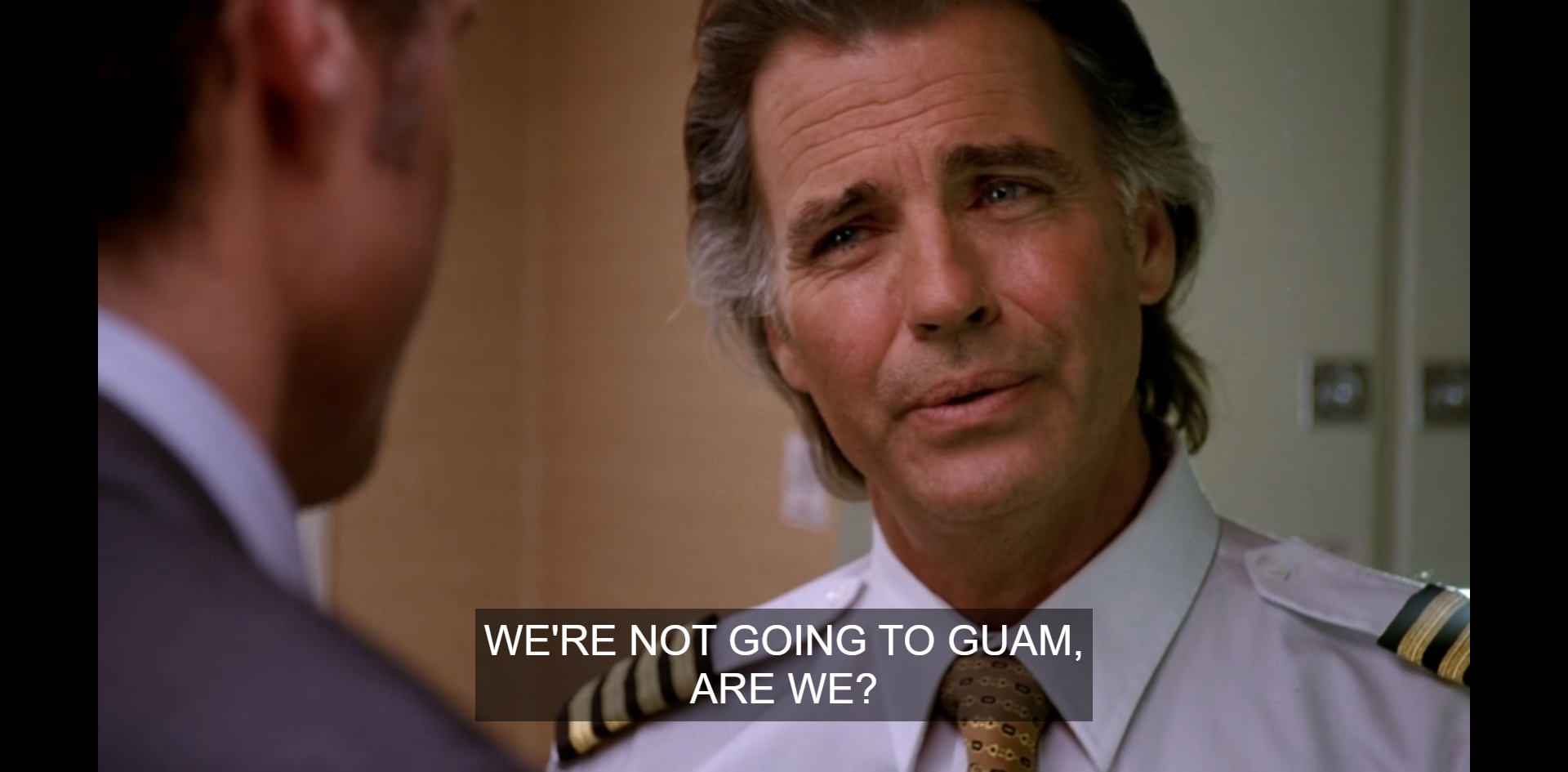
No, dude. We're not.
End of Episode 6.
L O S T
Next Time: A Boy Named Suicide
The Reframe is totally free, supported voluntarily by its readership.
If you liked what you read, and only if you can afford to, please consider becoming a paid sponsor for as little as $1/month. If you'd like to be a patron of my work, there's a Founding Member level that comes with a free signed copy of my upcoming book, Fighting in the Dark, and thanks by name in the acknowledgement section of any future books I publish.
Patreon fan? Have at it.
Looking for a tip jar but don't want to subscribe?
Venmo is here and Paypal is here.
A.R. Moxon is the author of the novel The Revisionaries (2019) and the essay collections Very Fine People (2024) and Fighting in the Dark (2026), which are available in most of the usual places, and some of the unusual places. You can get his books right here for example. He blesses the rains down in Africa.
Comments ()