
The Magician's Hands
Consequences and repair aren't a dichotomy but a continuum; forgiving unforgiveable acts in our moral Scam Economy.

Be ye duly warned: I'm not going to exactly spoil the hell out You Can See Anything, the hit documentary about Elizabeth Holmes from directors Nathan Fielder and Lance Oppenheim, but I am going to discuss it without much concern about exposing incident and theme. If you are unaware of aspects of this movie and would like to preserve that unawareness, I recommend bookmarking this essay for later.
Whoa! What a wave! What an electoral tsunami! There's genuinely a lot to celebrate, and I genuinely think we should celebrate. Here's a good round up of all that goodness. Today, I've got something else on my mind.
A few weeks ago richest man in the world and dead-eyed mass murderer Elon Musk unveiled a flying car to the delight of shareholders and 47 year-old adolescent men and market/tech insiders. You can easily go see the video if you haven't seen it already. It made the news. Musk's acts of mass-murder also have made the news, but it's usually framed as a question (Did he really kill millions of people with his illegal DOGE chainsaw massacre of government programs and government foreign aide? Yes. But, on the other hand ... did he? Yes. Well, OK, but did he mean to? Yes. Well, OK, but does he realize he meant to? And is it really polite to say so? Isn't it a distraction? Isn't it a condemnation?), and the mass murder doesn't get mentioned when he's doing things like announcing flying cars. I guess being a mass murder is only situationally relevant, applicable to questions of geopolitics but not applicable to whether he should continue being the world's wealthiest individual and enjoy massive government contracts that give him influence over geopolitics and all our lives, or whether or not we should all gather to ooh and aah over the mass murderer's latest magic trick. More on that later, maybe.
The only problems with Musk's flying car demonstration were that a) the flying car didn't fly, and b) it wasn't a car. It was a driverless car-shaped shell designed to perform one very specific maneuver—a midair backflip and landing from an inverted position upon one half of what appeared to be a loop-the-loop track from a 1980s Hot Wheels playset. This is a scenario that drivers find themselves in exactly zero times unless they are doing stunts for Tom Cruise movies, and the engineering required to make something that appears to be a car do something that appears to be controlled falling exactly one time for exactly 2 seconds means the interior of the shell is so filled with compressed air canisters that no passengers could fit into it anyway. Business and technology journalists, many of whom gave Musk the "Flying Car!" (or "Flying Car?") headlines he clearly sought, would have done just as well to watch old videos of me playing "got your nose!" with my kids and then issue headlines stating that I may have invented teleportation.
The car-resembling shell was made to look like the 2nd-generation Tesla Roadster, which is a car that does not exist and seemingly never will. The G2 Roadster was announced by Musk in 2017, which is a decade ago if you factor in daylight saving time, and he promised it would be available in 2020, which was 6 years ago, or the average lifespan of a wild kangaroo—so bad news for any kangaroos who put down their credit cards for preorder. Musk kept this claim up until around July of 2020, when he pushed out the deadline, the first such pushout of many. All along, Musk has made exceedingly grandiose pronouncements about the capabilities of this car that doesn't exist, and announced increasingly impressive redesigns of a car that has never been designed in the first place.
This is standard behavior for Musk, who makes grandiose pronouncements he never follows through on as a core part of his business strategy, but what do you say we let him off the hook for it? Almost everyone else lets him off the hook for it, including journalists and shareholders and government regulators. Increasingly, it's standard behavior for Tech CEOs in particular, and CEOs generally, and presidents of countries, too. It's no longer necessary to actually make a product; just make the pronouncement about the product, and media will report it breathlessly, and up goes the stock, and up goes the value of the Musk portfolio. When the actual product never materializes, the stock can take a hit, but intrepid CEOs need not fret; all that's needed is to make a new, more grandiose pronouncement about improvements to the thing that doesn't exist yet, or even something new and innovative—the Next Big Thing That Isn't to replace the previous Next Big Thing That Never Was. It's a shell game made out of shell games, a casino rigged to play itself using everyone else's money without their consent. It's the scam economy, and in the United States, the land of the rubes and the home of the marks, scams are seemingly the only remaining product still being manufactured. The president of the United States has his own crypto coin, which he has used to bilk his worshippers. You can go online these days and place a largely unregulated bet on whether or not he'll start another war—which could become a very lucrative bet, if you're somebody with influence over the matter, for example if you happen to be in the war room. This is the world we live in. How could the world's richest man be anything other than a huckster who promises and never delivers? How could his lies and other crimes do anything other than make him increasingly more obscenely wealthy?
Musk gets name-checked in You Can See Everything by an engineer working for the new start up Elizabeth Holmes and her boyfriend/partner Billy Evens founded. (Oh yeah. Holmes and her partner have started up a new medical device company. Nature is healing!)
The question being put to the engineer by Fielder is the alleged central question of the film, namely: How aware was Theranos founder and CEO Elizabeth Holmes about the fraud her business perpetuated? The engineer muses that these days, tech CEOs like Musk will often start by making claims that aren't actually true but ... and that's when Evans, who was lurking at the door, shuts things down.
This wasn't the story Evans (and, I presume, Holmes) wanted told.
It makes me wonder: Can you see everything? Magicians display want they want seen in order to make you think they're showing you everything. In the movie, you can even see Evans' pee-pee—Evans seemed to want us all to see it, in fact—but you can't see the conclusion of his employees' thought about CEO lies. We are left to wonder: How would the engineer's sentence have ended?
"... but they genuinely don't care about truth and nobody ever calls them on it?"
"... but it makes the stocks go up, so who gives a shit?"
"... but by the time anyone realizes, they already have the money?"
Any of these answers would have been perfectly honest. In the scam economy, you can sell futures without any consequence. What's out of bounds is glancing back, even for a moment, to remember the actual claim. These magicians never need to make good; they're all flourish and flash; they'll tell you they made the rabbit disappear without showing you the rabbit.
In the scam economy, you can sell only your confidence, which, if you happen to be a man, makes you a confidence man—a phrase that could really use a handy sort of abbreviation, like a "fidence man" or something. A fidence man can do whatever he wants as long as he doesn't hurt the investors' returns. If the fidence man hurts the investors' return, he might have to do something drastic to distract them and avoid consequence, like claim he's invented a flying car, or take a chainsaw to the United States government, murdering millions of people along the way. The only crimes in the scam economy are Number Goes Down and Big Man Is Forced To Pay.
If a fidence man happens to be a woman, it also doesn't matter who gets hurt, but if she hurts the investors' returns, she probably doesn't get to "invent" a flying car. She probably has to go to prison. Just ask Elizabeth Holmes.
It's not the end of the essay! It's only a quick reminder that The Reframe is me, A.R. Moxon, an independent writer. Some readers voluntarily support my work with a paid subscription. They pay what they want—as little as $1 a month, which is more than the nothing they have to pay. It really helps.
If you'd like to be a patron of my work, there's a Founding Member level that comes with a free signed copy of one of my books and thanks by name in the acknowledgement section of any book I publish while you are a subscriber.
You Can See Everything is in my opinion very good, by the way. It's what you'd call a rich text. Like most rich texts, it's open to varying interpretations, and risks varying misinterpretation as well. It often anticipates the interpretations and often even the misinterpretations, and often slyly comments upon them, and interrogates its own vulnerabilities and biases, questioning its own version of reality even as it presents it to you. It presents Elizabeth Holmes ("Liz" as she wants to be known in this new more vulnerable iteration) as an unblinking human maze of mirrors, wherein the mirrors are lies reflecting both truths and other lies, wherein it's impossible to know where the truth begins or ends or even enters the picture, or if even she can tell anymore, or if indeed she ever could.
Earlier I said that the main question that Fielder claims to be investigating is how aware Elizabeth Holmes is of the fraud her company committed. This was a bit of a magician's trick of my own on you. (Gotcha!) The real question Fielder claims to be investigating is how capable of awareness she is, which Fielder demonstrates by showing Holmes the classic skit by Bud Abbot and Lou Costello, Who's on First?, which Holmes claims (plausibly enough I suppose; it's famous but it's old and she doesn't strike one as a fan of classic comedy) to have never heard of. Holmes laughs at the skit, but when asked what is funny about it she's unable (it seems) to perceive the central ambiguity that creates the misunderstanding that drives the comedy. She even unable (it seems) to understand that there is a misunderstanding at play at all. Evans leaps on this. Yes. This is how she is. She simply cannot comprehend anything is other than it seems to be.
The film's central scene arrives not long after that. With the components of the fraudulent Theranos equipment arrayed before them on the table, Fielder connects her claims that the machine can perform any medical test to her seeming awareness check failure watching Who's on First? Is it possible, muses Fielder, that it's not that by saying the machine "can" perform any medical test with a single drop of blood, Holmes was telling investors that the machine was able to perform any medical test right now, but simply that it could conceivably be able to perform any medical test, if the correct technology, which was not yet developed, were conceivably developed?
Holmes (and Evans, who came along shortly after the Theranos collapse) are very happy to let us know that yes, this is possible, and in fact is exactly the case. It's not just that she's not a liar; she's actually the most unbelievably truthful person that has ever lived. Why, she doesn't even care about money! She just became a billionaire by whoopsies while pursuing her truth so hard!
OK. Let's say so. Let's grant that to them. She's not a liar; she's an unbelievably truthful person—made all the more unbelievable by the fact that what she actually did, if you poke into the case, was lie and lie and lie and lie and lie and lie and lie. But let's not look at the facts; let's watch the magician's hands instead and believe the claim.
The claim means that Elizabeth Holmes, who was the very public CEO of a major tech company, which for years made false claims about actual medical tests that actually misdiagnosed actual human beings and caused actual pain and harm, and which for years engaged in fraudulent practices in support of those lies, not only did not realize that this was going on, but did not and still does not understand that investors are interested in actual capabilities of the tech, or why that would or should matter. The film doesn't really dig into this implication, even though it lays it bare. It leaves it to us to figure it out.
Do we figure it out?
Is "Liz" Holmes incapable of recognizing truth from lies?
I suppose it's possible.
It's possible, I suppose, to be a person unable to realize, even after dozens or hundreds of attempts, that Lou Costello isn't comprehending that the guy on first base's literal name is literally "Who." It's possible, I suppose, to be a Bud Abbot who invariably selects the most ambiguous possible way to phrase your point, who never changes your explanation of what the name of the guy on first's name is (What's on second) no matter how many times your explanation clearly fails. It's possible, I suppose, to not even realize that Lou Costello has failed to comprehend what you are telling him, even though he keeps asking the exact same question. It's possible to not even realize you have chosen the most ambiguous way available to express your true point, the way most optimized to creating a mistake. It's possible, I suppose, to say you don't care about money even though every time Lou Costello makes the exact error you have optimized him to make, you get another billion dollars. It's possible, I suppose.
Is it possible to not at least wonder why you're being given a billion dollars every time Lou Costello makes the error, while you adjust everything about your company and your business practices and your affect to encourage the error and hide as much evidence pointing toward the true meaning of your words and falsify data to encourage the error, for years and years and years? Is it possible that you'd attempt to reenact that exact dynamic a second time, even while you're on the cusp of a 10-year prison hitch for the first?
I don't know. (Third base.) Did Liz Holmes affect a different voice because she's so truthful? Did she run tests in regular ways and pretend she used her machine instead because she just doesn't understand the various meanings of the word can?
The Theranos machine Holmes shows Fielder? Apparently it was not the Theranos machine. Did Holmes also not know that? Maybe she meant that this machine could be the machine that could run any possible test, in some alternate world where it was the machine instead of some other machine, and it was able to do that, even though it cannot.
See the car? See it fly?
Here's a movie that knows what sociopathic narcissists and other types of American hucksters know: if you know how to become a Bud Abbot who knows how to tell people you can make them wealthy, then you live in a land of Lou Costellos who will never ask a new question.
This is all fascinating stuff. It's not the main thing I wanted to show you though (Gotcha!), and I don't think it's what Fielder and Oppenheim wanted to show you. (Gotcha!)
What I wanted to show you was that, in presenting herself as somebody incapable of distinguishing truth from lies, Holmes was creating a narrative to exonerate herself. More, she was creating a narrative that made the case that she ought to suffer no consequences for what she had done. The implication being that, because she didn't intend to have done it, because she didn't realize she was doing it, because she isn't even capable of such realization, therefore it also follows that she didn't do what she did, and it doesn't matter even if she did do it. More (this is what I believe anyway), she was creating a narrative that she was a simple do-gooder naif, a babe in the woods, at the mercy of the controlling men with whom she chose to make a life together, in a world of controlling men who control and commodify and abuse women ... and this is such a world. Patriarchy harms all women, even those who are manipulative fraudsters. Ablism harms all neuroatypical people, even those who are manipulative fraudsters. Our punitive carceral state is cruel to all who fall into it. There's a great cultural temptation right now to diagnose Elizabeth Holmes toward a shared forgiveness, in the name of healing.
Does Holmes have a pathology? She sure seems to. I'm not qualified to diagnose, though. Should her pathology (if one exists) inform how society deals with her? I'm not against that consideration—in fact, I think we ought to completely rethink our punitive system of so-called justice, our patriarchal systems, our ways of dealing with mental illness and imbalance. However, I'm awfully skeptical of people who only discover the depredations of our carceral state when it catches somebody rich and powerful, and wonder whether for such people the concern is not the systems themselves, but simply their often sublimated discomfort that this time these cruel and unjust systems accidentally caught the wrong sort of person.
Here's what I do know: Whether or not she is sick in the mind, Elizabeth Holmes is not somebody who should be permitted to start or run a business. Whatever else happens to Holmes as a consequence, that at least ought to be one of them. If she has a path to redemption it doesn't wend in that direction. If she is to restore trust it will have to involve ceasing her claims to not only truthfulness but exceptional truthfulness. She should be separated from her (clearly powerful) ability to harm others with deception. The fact that she is incapable of telling truth from fiction should only bolster the case. The idea that maybe she literally has no idea why all the things she did (some of which get named in the movie but many of which do not) are harmful is in no way exonerative.
Here's another thing I know: People in love crafting exonerative stories for powerful abusers. People in our society are eager to forgive people who haven't harmed them personally on behalf of those harmed. To my eye, this is the reason that Holmes and Evans jumped on their Who's on First? defense; in it they saw a path to exactly what they hoped to get, which was reconciliation without reparation. To me, Holmes seems to realize the Great American Truth: that you don't need the people you harmed to forgive you if you can get everyone else to do it on their behalf. In fact, you don't even need to apologize. You just have to make another magician's flourish, another claim; to make everyone else feel smart, make them feel like they have some secret window into why the terrible things you did weren't actually terrible, or if they were terrible they weren't actually your fault, or if they were your fault, then you didn't know, or couldn't have known, or actually you were trying to do something so good that all the harm would be considered a worthy price to pay, when set against the good thing that you did. (Did you actually do the good thing? No. Did you even try? No, but you can. Not in the sense that is possible, but in the sense that you claim it is possible.)
I suspect that what Fielder and Oppenheim were trying to show us was not Liz Holmes, but ourselves. (Gotcha!) If the movie was only about another silicon valley huckster who got caught lying with zero concern about the harm done to their fellow humans or even seemingly a sense about why one would have such a concern, the movie would not be such a rich text. What makes it one is the way it implicates each of us for our reactions, our urge to exonerate those with advantages over others.
Anyway, let's bring it back around. We just had elections and the Democrats just swept the board on every level. A very good thing, I'd say, for a very good many reasons, and a victory for the vision many of us have of a broadly diverse and open pluralistic society, a rebuke of the openly Nazi party of the United States known as Republican. Michigan has the country's first Muslim Senator. Georgia has the first Black woman to serve as state governor. It looks likely that Mississippi is going to send a Black man to the Senate, and the last time that happened the man in question was born during times of legalized chattel slavery. The newly democratic state of Texas has been liberated from many decades of authoritarian white supremacist rule. Lovely stuff!
Now a lot of people want the Democrats to use this as an opportunity to do what Democrats seem to always do whenever the people give them control back, which is to let the criminals off the hook; to look forward, not back. There is some hope this will not be the case, because many voices are calling for real accountability, but there are reasons for concern as well, and history's precedent is only one of those. The likely future Speaker of the House, Hakeem "Hack" Jeffries, for example, made sure to spend the hours following this massive rebuke of conservative and corporate corruption by dousing as much enthusiasm as possible, by tamping down any talk of consequences.
We don't want to "get even," Hack Jeffries tells us. Instead we're going to focus on affordability. It's an either/or, to Hack's mind. This is the old traditional way certain people like to frame enforcing our laws whenever we're enforcing them against wealthy and powerful people who have committed unforgivable acts against those who are most vulnerable.
Who's on first? Can you see the magician's hands?
Or don't subscribe. I'm not the boss of you. But if you do subscribe, you get one of these essays pretty much every week.
It's the certain people who like to frame unforgivable acts in this way that I'd like to talk about.
What do I mean by an "unforgivable act?" Well, I mean an act that can't be forgiven. How's that for simple? It's so simple as to be tautological, I suppose. I guess I need to say more.
What is it to forgive? There are a lot of definitions, but let me suggest that at base it's something that a person who has been wronged does in relation to their internal and/or external orientation toward the wrong done and the person who did it. It's not reconciliation, though it might lead there. It's not repair, though it can help repair's process. But to happen, it requires, as the essential element, the person harmed.
OK?
An unforgivable act, then, is a wrong in which the person wronged is no longer around to do any forgiving.
If I murder you, you can't forgive me for it. Your loved ones might forgive me for the grief and harm this act did them, but they can't forgive me for killing you. If they try, what they are doing isn't forgiveness. That's what I think, anyway.
Can I forgive Liz Holmes for her crimes on behalf of her victims? She'd like me to. It's on offer—for me, that is, not her victims. They're not being asked forgiveness.
Or let's say I were a white South African fidence man and a eugenicist white supremacist and also the world's wealthiest person and I (let's say) used the vast wealth that my mendacity gained me to seize control of the U.S. government, and I then used that power to demolish USAID, specifically in order to kill brown people in the global south, and now, as a result, hundreds of thousands of brown people in the global south are dead, many of them children, you can, I suppose, forgive me for the inner turmoil I've caused you, the mental anguish, the anger. If my actions resulted in you losing your job (as is the case for many people here in the U.S.) you might forgive me for the damage I did to your financial stability and career path. But you can't forgive me for the mass murder, and you can't forgive me for the millions more projected to die–not because forgiveness is bad, but because if you did it, it would not be forgiveness.
You can't forgive me for dead millions. It wouldn't be forgiveness if you did. You can act to prevent dead millions more–and you should–but what good will it be, if you don't first remove from me the power to control the lives of people ever again?
Those, then, are what I mean by unforgivable acts. For you to pantomime forgiving me would be a moral crime and a great complicity in those acts. For someone newly vested by the country's citizens with the authority to investigate and hopefully prosecute these crimes, to fail to do so is not only a moral crime but a legal crime–literally, a crime against law itself. Pre-announcing an intention not to do so, and framing justice as a retributive act, is a failure that seems all-encompassing. To my mind it feels like another magician's flourish from somebody who hasn't even identified themselves as a magician; a way we can tell that our Scam Economy has a moral side to go with its financial side. It's an offer of forgiveness by proxy for that which can't be forgiven; it's an offer of redemption on the cheap that will fail even itself; it's an offer of reconciliation for wrong without reparation of wrong, which is the abuser's constant demand, and one that abusers in this country have learned they will always receive.
And that's what's being attempted today, I think. We're once again on the cusp of issuing consequences, and we're once again being told to move past it by just not looking at it, by pretending it is a distraction, and not what we really want anyway.
There's a popular meme about this that's floating around today featuring Geordi La Forge from Star Trek. I could describe it for you, but instead here you go.
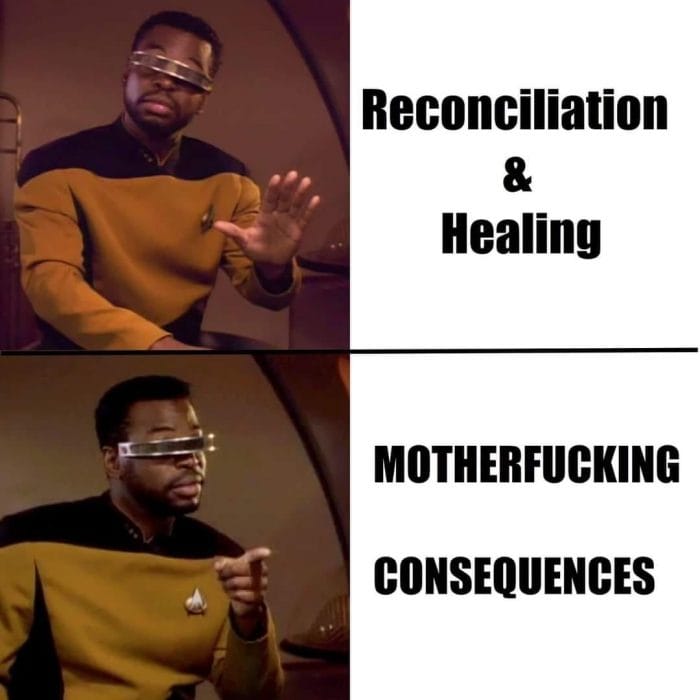
I like this meme for its clear approval for motherfucking consequences. Consequences are what is called for, no doubt. In this land we've gone so many cycles–my whole life, and more than a century before then–putting down the worst depredations and abuses of traditional white supremacy and fascism, only to hold back when the time comes to bring true consequence to the abusers; and by true consequence I do not mean vengeance but a clear-eyed account of the abuses done, and the total removal from the abuser of the ability to continue abuse. Instead we've found exonerative myths, forgiveness by proxy, redemption on the cheap. (Did they really do that? Was it really that bad? Perhaps they didn't know. Perhaps they couldn't know. Anyway this isn't what's important.)
What I don't like about the meme is that it presents things the same way that Hack Jeffries does: as a dichotomy. It's either reconciliation and healing or motherfucking consequences. You mustn't perform the former, because you need to work on the latter.
It's not a dichotomy, though. It's a continuum.
You can't get to reconciliation and healing without motherfucking consequences. Those who have perpetuated mass fraud cannot be allowed to run businesses, unless you want a fraud economy. Those who have murdered millions cannot be allowed power and authority, unless you would live in a world of easy murder. Those who have abused power must not be allowed to retain power. What house can be rebuilt while it is still on fire? How do you save somebody from a murder while working with the murderer to break into their house?
Or, to put it in terms that Hack Jeffries and his supporters might understand: how can you focus on affordability without recognizing who the people are who have deliberately made life unaffordable, stripping them of their ill-gotten gains, and separating them from the ability to do it again? How can we safeguard an affordable future if we teach those who stole that future away that the penalty for having done so is that they will get to keep what they stole, and may have to wait a few years before they try again?
To be sure, some probity and strategic planning and setting of priority is needed. As much as they've won, the Democrats haven't won enough yet to fully effect all that is necessary, including: The seizure of Elon Musk's property, the abolition of billionaires, the cancelling of government contracts placing the public good into private hands, the eradication of the white supremacist Republican Party and much more. Yet these are the motherfucking consequences that are called for if we are to have reconciliation and healing, and that is what the Democrats must pursue with focus and drive until it is accomplished, not instead of reconciliation and healing but as the only way to achieve it. And if they start with a declaration that the won't even begin to pursue it, they squander the victory we're all celebrating today.
Again: You can't get to reconciliation and healing without the consequences. It isn't a distraction, but a prerequisite. Those who have tried to turn a democracy into an authoritarian white ethnostate mustn't be permitted to participate in governance. Those who robbed the national coffers must not be allowed to keep the loot and the combination to the vault. Those who pretend otherwise are interested in something other that reconciliation and healing.
We need an accounting of what has been done, and then a reckoning, so that a nation that has always failed to prosecute its greatest criminals finally learns to do so. So that billionaires, who certainly seem dangerously pathological, but may just be maliciously greedy, have their ability to lord over the lives and fates of everyone else removed from them so that we can actually heal, and unify, and then maybe even reconcile and grow. Maybe we can study them and learn from them once they have been disarmed, the better to learn what it is in human psyches that can get so badly broken, and what it is in our collective psyche that is so conditioned to indulge and accommodate them, no matter how ridiculous their claims become, no matter how high the bodies pile. Maybe once we've done that, on the other side of motherfucking consequences, there might be reconciliaiton and healing, even for them. Maybe, on the other side of motherfucking consequences, they might become the sorts of people who can truly seek and even find forgiveness for the things they have done that are forgivable. And for the rest, perhaps, perhaps, to find some path to redemption. That path will involve them acknowledging what they have been and what they have done. It can in no way involve remaining a billionaire.
And so, too, with the rest of us, as we come to an accountability and a reckoning for how we have participated in such a society; the gains we have taken, the privileges we protected. Perhaps we can at last become people of consequence.
Can you see everything? You can ... but only if you look.
The Reframe is totally free, supported voluntarily by its readership.
If you liked what you read, and only if you can afford to, please consider becoming a paid sponsor for as little as $1/month. If you'd like to be a patron of my work, there's a Founding Member level that comes with a free signed copy of one of my books, and thanks by name in the acknowledgement section of any book I publish while you are a member.
Looking for a tip jar but don't want to subscribe?
Venmo is here and Paypal is here.
A.R. Moxon is the author of the novel The Revisionaries (2019) and the essay collections Very Fine People (2024) and Fighting in the Dark (2026), which are available in most of the usual places, and some of the unusual places. You can get his books right here for example. He's a wicked little critta with a sissy bar, and he lays a patch on the tar.



Comments ()