
The Good Guys
Raising uncomfortable answers in a predator’s paradise, and the vast gap between being ashamed and living in shame.
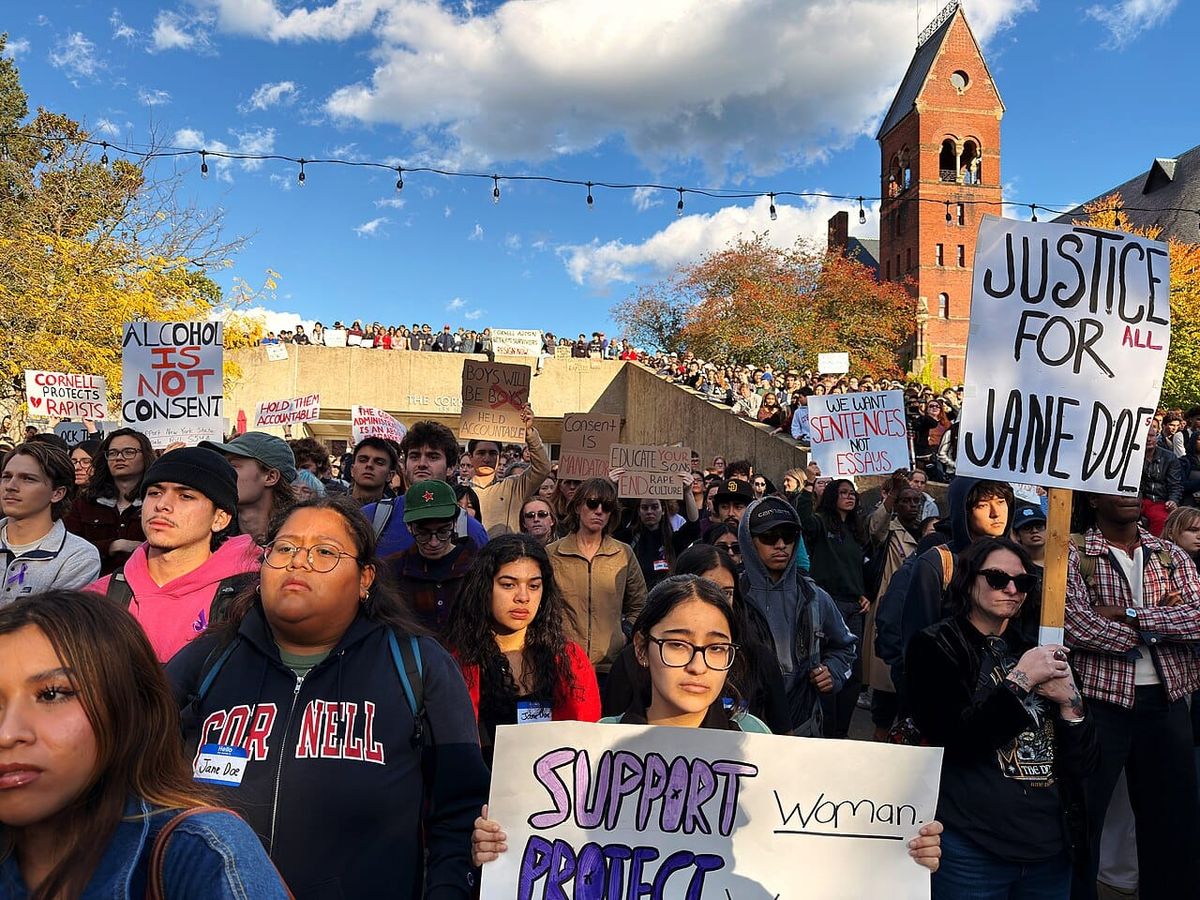
The group chat said there was “free pussy” upstairs.
Sometimes you read things and you shake your head a few times to see if the letters will re-arrange themselves into something more palatable. But no, that was the message that went out to the brothers of Chi Phi fraternity at Cornell University, on the group chat: Free pussy. Later someone asked shop still open?
Here’s what was happening. There was a young woman upstairs, incapacitated by ketamine and alcohol and other drugs, and she was being gang-raped by what appears to be up to seven young men, many of whom she had considered her friends. This was the open shop. This was the free pussy. This was the way these men felt they could talk to fellow members of their boy’s club about what they were doing—which in case you didn’t know, was rape, a violent felony. They sure didn’t act like they knew it. They assumed everyone would be OK with it—so OK with it, in fact, that nobody would act to stop it, or say anything against it, and some might want to join in. And they were right.
I see reports that there were fifty-seven active members of that particular fraternity. How many of them were on the chat? Was it all fifty-seven? I’m not seeing conclusive evidence. How many of them will have some exculpatory narrative for themselves? That’s also unknown to me, but I’d be willing to place a solid bet on my guess, which is 100% of them.
Even if the brothers of Chi Phi don’t have these exculpatory narratives ready to go, others are ready to run them on their behalf. You see these sorts of confusedly outraged exculpatory narratives all over the place in my nation, the predator’s paradise that is the United States. They issue forth from our billionaire-purchased spheres of influence, and from pulpits, and from halls of power. When someone is gang-raped, there appears to be something to defend, and it’s not bodily autonomy; there appears to be something to protect, and it’s not the victim.
The raped woman was not a perfect victim, you know. She did unwise things. She abused substances. She trusted people she shouldn’t have trusted. This makes her at fault for her brutalization in many minds—which suggests to me that, in many minds, bodily autonomy is only for certain types of people, and predation upon other people is something deemed permissible for certain types of people to do to certain other types of people who can open themselves to being permissibly predated upon, simply by not being the right kind of person, or by not making the right sorts of choices.
You know the narratives. They’re practically scripts. They’re practically lines of code. You could rattle them off like a stand-up’s tight five, a candidate’s stump speech. You could run them like an AI prompt. I didn’t know. I didn’t see it. I saw it but I didn’t know what it meant. I saw it but I didn’t take it seriously. Sure but what about all the wrong things that she did? She’s hysterical. She’s confused. She’s insane. We’re good guys. We don’t deserve this.
They’re the same lines that politicians use when they don’t want to have to address things they’d rather not have to address, like when the leader of their white christian fascist party has approvingly quoted Hitler again or threatened to murder 93.2 million Iranians or decided that the nation’s capital is now called Trump DC or whatever the fuck it is he’s done in the last few hours. The fascist white christian president does it; he doesn’t ask, he just does it. When you’re a star they let you, he said. And he was right—they do let him. Ask them, they’ll tell you: We didn’t know. We didn’t see it. We saw it but we don’t take it seriously. What about George Soros? You’re being hysterical. Trump derangement syndrome. We’re the good guys. We don’t deserve this.
The white christian president is himself an adjudicated rapist. The evidence is clear and undeniable that his best friend was modern history’s most notorious child rapist, who ran a child-rape human trafficking ring for hundreds or thousands of our society’s social and professional luminaries. This campaign fund crime isn’t the worst crime the white christian president has committed, but it’s certainly the latest. Another few crimes will drift by today. A few crimes drift by every day. Ho-hum. He’s excused because he is him. And many among the opposing party—most—will still tell you that it’s not wise to prosecute or impeach or issue consequence, that if or when they regain power, they want to work with the other side, not against them; to look forward, not backward; and whenever desperately needed change is proposed, they scold that we can’t do anything radical, despite growing evidence that radical change is what is not only needed, but desperately desired. So it seems we won’t do anything about choking medical debt, choking educational debt, mass incarceration and mass surveillance, police brutality, ICE invasions, predatory lending, predatory rent, predatory venture capital, predatory tech, open and flagrant corruption, the destruction of the commons, or the rapidly expanding and existential series of ongoing disasters that is climate catastrophe. These aren’t the same infractions as rape but they seem to rise from the same kind of spirit. This is the way it is because the people with money and power want it this way, and nothing would be more dangerous than changing the way it is, nothing would be more radical than listening to the cries of everyone else, begging that those with money and power—people who don't ask, they just grab—stop brutalizing them. In America—and, therefore in the rest of the world—unless you are a special case, consent isn’t on the menu.
In the American sociopolitical world, when there is revelation of abuse, of corruption, of crimes, there appears to be something to defend, and it isn’t the American public, nor the law, nor our democracy.
Meanwhile we’re told that the Cornell case raises disturbing questions, and I suppose it does. Those would be questions like “what sort of men would gang-rape expecting total impunity, what sort of organization would attract such men and offer such impunity, what sort of institution would recruit and shelter such an organization, what sort of nation would revere the traditions of such an organization, such an institution, and would protect such men?”
But I don’t think that it’s the questions raised that disturb. Rather, I think what people are responding to about this story is that it raises disturbing answers.
It's not the end of the essay! It's only a quick reminder that The Reframe is me, A.R. Moxon, an independent writer. Some readers voluntarily support my work with a paid subscription. They pay what they want—as little as $1/month, which is more than the nothing they have to pay. It really helps.
What sort of institution is Cornell? It’s a good question. It's highly respected, and well-established. My daughter applied there, interested in its biology program, which has an excellent reputation. So there's that. Also: The university ran a survey in 2025 wherein more than 35% of female undergraduates reported experiencing nonconsensual sexual contact involving force, threats or incapacitation, up from 23% in 2023. 1,200 sexual assault cases were filed at Cornell from 2018 to 2024, and “most of those found responsible received minor sanctions that allowed them to remain on campus, such as probation or training.” Meanwhile the CDC reports that in the United States at large, more than 1 in 5 women have experienced rape in their lifetimes, and only a quarter of rapes are reported, and only about 4% of those result in any kind of conviction.
Here are our disturbing answers, then: What sort of institution is Cornell? A very common one. What sort of institution is the fraternity system? A very typical one. What sort of men would gang-rape expecting impunity? A very usual sort. What sort of nation would revere the traditions of such institutions and protect such men? Our own.
When you listen to a lot of people talk, it’s clear they don’t think rape is something a young white man with a promising future can do, categorically speaking, any more than they think a white christian man can rape his wife or a white christian president can rape children. In their minds, rape appears to be what happens when one of the bad people—Muslim, immigrant, Black, brown, trans, what have you—misuses the female property of one of them, who are the good people. But when one of the good people uses their own property, how could that be abuse, much less rape? They seem confused, the good people, even outraged. They are the good ones, the husbands, the boyfriends, the good guys, the breadwinners, the protectors, so naturally the woman is theirs: free pussy. It married them, the pussy. It dated them. It smiled at them. The pussy trusted them when they were friendly to it. How can they possibly be thought to have raped it?
It took 2 years for the Cornell story to even come out. Somewhere along the line, Cornell must have determined that this could be handled quietly, and, because they thought it could be, they decided it should be. And why wouldn’t they think this? A third of all women on their campus experience some form of sexual assault. The consequences issued have been minor. Truly structural changes have been nonexistent. Reforms exist to manage the problem, not end it. This was the situation at Cornell before this incident, and Cornell isn’t unique among colleges, and colleges are not unique within the country. It seems this is just how college life is, because it’s also how life outside of college is. I imagine that Cornell is surprised to find itself being treated as if it is special rather than just another abusive institution in a land of institutionalized abuse. I imagine the brothers of Chi Phi are surprised to discover that they are being treated as if their behavior is somehow anomalous, when to them it seems to have been the most natural thing in the world: free pussy for them, men who have been taught by a million social cues that they don’t ever need to pay, or ask, or even think about it.
I’ll tell you how it all makes me feel.
It makes me ashamed. Ashamed of my country, this predator’s paradise.
In mentioning shame I’m handling radioactive stuff here, psychologically speaking. People will quite rightly tell me that shaming is not a healthy thing for anyone, the shamer or the shamed, that living in shame creates cycles of shame, which create more abuse, that shame is incompatible with healing. I agree. I think that’s true. I think there's plenty of evidence.
Still shameful acts by shameless people persist, and I can’t help but feel ashamed that they are permitted. They’re rampant, really; they’re rewarded, and that truly is a shame. If you’re like me, I think you’d like to see change, improvement, growth, and healing. The instinct for many—for me, certainly—is to try to address the shame of it by using shame, making these shameless people feel the shame of what they have done, and certainly would be better if shameless people stopped being shameless. But more than wanting them to feel the shame of what they’ve done, I suppose that is what I want: for them to stop doing shameful things. I suppose my first concern isn’t whether they stop because they’ve had a change of heart or because it simply isn’t an option for them anymore—at least not a consequence-free one. There’s something to defend here, in this predator’s paradise, and, at last—at long last—I would like that something to be their victims, not the predators.
Who will stop the shameless people? How will they be stopped? Talk about disturbing questions that raise disturbing answers!
I want to make a distinction now; I want to define some terms—not the standard coinage, perhaps, but suitable for the purposes of this essay.
I want to talk about being ashamed, distinct from living in shame.
An important distinction, I think.
Have you ever done something that you were ashamed of? I hope so.
That’s a weird thing for me to say. I hope you’ve done something you were ashamed of?
Maybe that’s not quite right. Let me rephrase. I do not hope you did something shameful. But I know that even the most well-meaning people do things that fall short of their intentions and standards, and I therefore presume you have fallen short of both. I sure have. If your standards are fine ones that honor human dignity, then I hope that when this happened, you felt ashamed of it, because in my experience—my direct experience—that’s the moment that triggers an opportunity to change. If you didn’t feel ashamed of what you did, it likely didn’t trigger much of anything. Many such cases, as they say.
Anyway, I’ve done things I’m ashamed of. I’m going to assume you have, too. If you haven’t, I’m going to suggest you might want to work on that. In my experience, people who can’t think of a single thing they wish they hadn’t done aren’t in the best place, morally or psychologically speaking.
I’ll tell you about a direct experience I have with being ashamed.
I belonged to a fraternity in college, you know—or, probably, you didn’t know. I don’t talk about it all that much. We told ourselves we were the “good guy” fraternity—which might have been true, to some degree; and certainly I had my proofs of this ready to go … yet I can’t help but notice how frequently any random fraternity guy will tell you that they were/are in the “good guy” fraternity. This strikes me as an admission that the person making the claim sees that there’s something about their institution that is not good, while claiming an exception for themselves and their group. Somehow everyone knows there are bad ones, and somehow it’s always somebody else. There is something to defend, and it is themselves. I’ve become wary of exceptionalism, so I’m not all that committed to the narrative that we were the “good guy” fraternity anymore. I was certainly committed to it back in the day. When a venerable women’s studies professor had toured the fraternity houses earlier that year and explained that fraternities were an endemic part of a culture of violence against women, I was outraged—outraged. I argued with her. I believed in equality. Feminism. How dare she suggest this of me—me? There appears to have be something to defend there, and it was myself.
But there’s a vivid memory that happened some months, or maybe a year later. A party, a hallway. Me and one or two other fraternity brothers talking, and we were talking about women, specific women, by name, and we were laughing, and we were not being kind. There was no physical abuse, but we were exhibiting a learned and practiced brutality of sorts, a dehumanizing way of speaking common to young men who have been taught about sex but not about intimacy, who have chosen the ease of moral laziness readily available to them over the more difficult and more discouraged internal work of vulnerability. It was, in short, the standard foul traditional script of American masculinity; a reduction of women to objects of consumption and personal gratification. It’s the sort of thing that can and does lead to the next thing. I suppose our white christian child-rapist of a president would have laughed too; would probably defend it as “locker room talk.”
And then I turned the corner to the adjoining hallway, and one of the women we had been talking about was right there. We hadn’t heard her. She sure had heard us. She saw me, I saw her. I was caught. I wish I could tell you I acquitted myself well in that moment, or in the days or weeks to come. I wish I could tell you that I apologized. Instead I pretended none of it had happened, and got out of there pretty fast. It was easier to act as if I didn’t know, as if I hadn’t heard, hadn’t registered, as if I wasn’t aware that I was doing what I had been doing. It was easier to avoid consequence. These were the instincts. The usual scripts.
The fact that I was caught doesn’t make what I had participated in worse; if she hadn’t been there, what we were saying would have been just as dehumanizing of her, just as cruel. But the “caught”-nes of it did one thing; it forced me into a confrontation with a certain truth about myself and what I thought was funny—or at least what I thought was acceptable to laugh about. Was it worse that she was there? Maybe so. The words themselves weren’t any worse, but I have to think it was worse for her in the moment to hear it. It certainly felt worse to me that she heard. But the fact that she heard let her know true things that were probably useful for her to know about me. And the shock of the exposure raised questions with uncomfortable answers, transformed an instance of “bro talk” that I wouldn’t have thought about five minutes after the end of the conversation into something I still remember today.
I was ashamed. I was so ashamed. I was a good guy, you see, and I was in the good guy fraternity, and how dare anyone think otherwise of me? But now here I was, confronted by the truth of what I had said, a good guy who didn’t know anyone was listening. This was not who I wanted to be, and yet, in the eyes of this woman, here it was, incontrovertible evidence that this was exactly what I was being, exactly who I was, exactly who I would be, for as long as I continued behaving this way.
When was this? Sophomore year? Junior year? I don’t remember that part. I just remember how I felt, and knowing I didn’t want to feel that way again. Not wanting to be that way again. It planted a seed in me that worked on me, slowly but surely.
What was clear to me in that moment was that I had a choice. I could keep being the sort of person who spoke about women that way, the sort of person who laughed along with people who spoke that way, or I could change.
If I was going to change, I would have to change, which meant not laughing along, and not letting it slide when people talked that way, which meant probably having awkward exchanges with social peers and being thought of as less of a laid back, chill, and fun guy than before by people who required laughing along as a perquisite of being thought cool. If I was going to keep being the sort of person who would be thought of as laid back, chill, and fun, I’d have to come up with ways to pretend I didn’t care about betraying my supposedly good intentions and breaking my fine standards, until I could find excuses for doing so that worked for me, so I could change those standards, until I was somebody who thought talking that way about women was fine, that thinking about women that way was fine, and that those who didn’t laugh along were not fun—were annoying, possibly dangerous. I would not be ashamed then. I would instead have become another shameless person in a shameless society.
I chose instead to change. I’m glad of it.
I don’t want to make this something it wasn’t. This isn’t the only event, merely one of the more vivid; the real transformation was more of an accumulation of events. Nor was it an instant conversion; there are still moments that occurred after this instance I can recall of going along, even laughing along, because doing so was easier, and I didn’t want to pay the costs of pushing back. So, because I am changing, there are still moments I am ashamed of. However, because I am changing, I do not live in the shame.
Being ashamed. Living in shame.
Do you see the difference?
I think it’s a big one.
To be ashamed is to become aware of a gap between the story one tells oneself about the standards and intentions of themselves or their groups, and the reality of what one or one’s group actually does. If one stays in this awareness, it can create a pressure to either change oneself or one’s group to meet the standard, or to reject the standard. Which of these options really depends on the standard.
Change yourself if the standard is good. Or change your standard if it is not.
To live in shame is to choose a third option, which is to deny awareness and avoid the costs of change. To find ways to not know, to not acknowledge, to still think yourself good, to find exceptions for yourself. To not change ourselves to meet the fine standards we claim, or to not change a standard we now know to be unworthy. We know because of the narratives: practically scripts, practically lines of code.
Perhaps counter-intuitively, it’s the most shameless people—those most inculcated against the discomfort of being ashamed—who most live in shame. I believe our dominant cultural norm encourages them to live in shame, which we can tell by the ways our culture protects and promotes and rewards and celebrates the shameless, the ways it works to manufacture and eradicate consent, to promote and reward the abuser, to exclude and punish the abused.
Am I still ashamed of that moment? I am. I probably always will be. It’s not a pleasant recollection. It isn’t pleasant to confess it to all of you. I wish I had been better and done better. I always will. But I don’t live in that shame, because I decided I wanted to live elsewhere, and began the work of change. I also wish I had changed faster, and more completely, but I won’t let those failures prevent me from seeking further progress today.
If I hadn’t changed, then the experience of being ashamed would likely have faded into nothing. But I would still be living in shame, and that shame would dominate me, as I created more and more elaborate narratives of ignorance and complacency, more and more elaborate ways of shifting responsibility from myself, more and more elaborate ways of make other people pay the costs of that shifted responsibility, costs that I did not want to pay. And those narratives would have been popular and traditional ones in American society, very easy to set up and very easy to maintain, with plenty of support from our predator nation’s halls of power and spheres of influence. Who knows what I might have become? Who knows what I might have done, and to whom? Who knows what excuses I might have made to remain shameless?
It strikes me there are a lot of ways of living in shame.
There are the obvious ways. We could become the sort of bent and twisted person we see more and more lately, celebrating impunity, reveling in cruelty, openly talking about women as if they are nothing more than despicable but nicely-shaped dolls with holes in them, useless for anything but service to the whims of men, openly talking about other people of all kinds as if their mere presence is a dangerous crime that deserves violent redress, seemingly incapable of feeling pride in anything but abusiveness and domination Yes, that is a very common way of living in shame, especially lately.
Or we could become joiners; those who laugh along or lend their tacit approval through silence, who tell themselves that we don’t really agree, not really, we’re no worse than anyone else, we haven’t hurt anyone ourselves, and after all, what are we supposed to do? Make ourselves the target? Emptied of conviction, withdrawn into cynicism or nihilism, because doing what is right is costly and we like to skate by on the cheap, and discounts are being offered to us to separate ourselves from the inconvenience of caring. This, too, is a very common way of living in shame.
Or we could become apologists and accomplices, who offer devil’s advocacy on behalf of devils who are lavishly represented already; who ask leading questions that steer the conversation away from the difficult answers; who see danger not in the abuse but the accusation, who cast the victim as the abuser and the abuser as the victim; who see as disturbing and radical not the institutional abuse but the institutional change. Void of discernment, eventually unable to make any differentiation between what is right and wrong, because we want to be thought of as good, but we don’t want to go through the trouble of doing good, which means that right and wrong must be blurred and confused. Yet another common and popular way of living in shame.
But I think there are less obvious ways of living in shame.
I think there is opposition we perform to self-exonerate. To establish ourselves, not as ashamed of our part in a shameful system, but to deny that there is any reason to be ashamed by establishing ourselves as the good guys. (I am talking to the guys here, in case you didn’t know.)
The danger I perceive in the Cornell story is that too many of us will run the same old script; make this story the story instead of yet another story, that we’ll see it as exceptional, and therefore an exception, rather than something that should be expected from a country that lives in the shame of optimizing itself for the promotion and celebration and reward of predators; or that, because we see it as expected, we will tolerate it. I sense an urge to make this only a Cornell problem. I sense the urge to make this only a problem of these particular young men, the seven, or the fifty-seven. Or, to zoom out, I sense the urge to make this only a problem of the fraternity system, or of collegiate life, or only of conservatism.
And it is a problem of all those things. We ought to demand exposure of truth and consequences. We ought to stop tolerating this predator’s paradise. We also mustn’t see this as an, end, but a start. If this is only a them problem, and not also an us problem, then we risk avoiding being ashamed of living in a predator’s paradise—and we should be ashamed. Not so that we live in the shame, but so that we can stop tolerating shameful things in ourselves and around us, and thus transform what is shameful into something more, something better. To ask ourselves where should we start? rather than where will it end? To ask ourselves have we gone far enough rather than what if we go too far?
It’s easy enough to tell a story where we are the heroes, to proclaim what we would have done to stop the Cornell 7. Hopefully we would have. Somebody sure should have. It’s easy to fall back into violent fantasy and cast ourselves as the retributive hero. But the disturbing question that raises disturbing answers is: what will we do to stop the harasser right in front of us before the violence begins? What will we do if it is our friend? What will we do if we are told it is us? Rather than becoming as dangerous as possible, what would it cost us to become safe?
It’s easy to demand that Cornell pay steep costs for their complicity in this, to demand far-reaching consequence. Hopefully this will happen; it sure seems warranted. But what about the rest of the college system? What about the rest of the other systems and institutions? Do we want to quarantine change in a single place, or do we finally want to seek radical change, even if others will cast it as dangerous?
It’s easy to say how we would have blown the whistle on that group chat. Hopefully we would have. Somebody sure should have. But will we blow the whistle on our own groups? It’s easy to say the fraternity should be shut down, or even the entire fraternity system. If you read the Cornell story, it sure seems like it should be. But how will we show up in our own organizations? What will we do when somebody tells us that our group is doing the harm. What will we do when we realize that what we have done or said was ignorant, unwanted, uncomfortable, unwarranted, harmful, abusive?
It's easy enough to shout down people who are expressing views in support of rape culture, and there is a place for that, because there are other people to heal than shameless people, and the shameless person is not always who we're seeking to engage and convince depending on the circumstance. But there are people in our lives who we might be able to influence, and if we can, we should. What uncomfortable conversations are we having with them? Are we shouting just to make sure we're seen as the good guys? Or are we opening ourselves up to understanding gaps in our awareness, places we might still improve, ways we aren't yet good?
Are we brave enough to face the uncomfortable answers?
When we hear stories of abuse and shameful acts, will we decide to stop defending our groups, our positions, our credibility, our place, our reputations, and instead start to defend those harmed by the defense and maintenance of those advantages?
Will we stop demanding to be heard and start trying to listen?
Or will we choose to become shameless people instead?

The Reframe is totally free, supported voluntarily by its readership.
If you liked what you read, and only if you can afford to, please consider becoming a paid sponsor for as little as $1/month. If you'd like to be a patron of my work, there's a Founding Member level that comes with a free signed copy of one of my books, and thanks by name in the acknowledgement section of any book I publish while you are a member.
Looking for a tip jar but don't want to subscribe?
Venmo is here and Paypal is here.
A.R. Moxon is the author of the novel The Revisionaries (2019) and the essay collections Very Fine People (2024) and Fighting in the Dark (2026), which are available in most of the usual places, and some of the unusual places. You can get his books right here for example. He never half-steps cuz he's not a half-stepper.



Comments ()