
Stories We Tell
Recognizing victims and villains is not creating victims and villains. A series on living in a culture of repair, against a culture of abuse.
Back in the days when I was still going to church, the pastor who eventually persuaded me to stop going to church had a phrase that he liked to say a whole lot, and for all I know he still likes to say it.
I'll call this fellow "Pastor Mike" to avoid calling him out by his name (AJ Sherrill). Pastor Mike wasn't in an enviable position, I guess; he'd arrived at our church a couple months before our current temporary president was elected the first time, and before he knew it, the nation was being led by a guy who basically represented the antithesis of everything Christianity claims it is supposed to stand for. You probably remember what this time in our nation's history (2017) was like, but in case you don't, I'll remind you: It was basically the first attempt by white christofascist billionaires to create the authoritarian oligarchical ethnostate we are seeing take form around us today; all the same gutter bigotry and open corruption and incompetence and institutional complicity in the face of menace and hate that is present today was around then.
This could have been an energizing moment for a Christian leader, but sadly for Pastor Mike, most white Christians were and are not only in support of this political movement, but represented the movement's enthusiastic loyal base of organization and support, while most other white Christians found the act of confronting this sort of thing uncomfortably divisive, and while my church had earned fame in my town as disreputably progressive, we were pretty white by demographic breakdown. I don't know the facts of all the conversations that happened in church offices and wherever else things got chewed over by church leadership, but I would guess that Pastor Mike was facing significant pressure to address the anti-Christlike actions and statements and beliefs of our country's new leader, as well as serious pressure to not address them in any way that pointed out how many Christians shared and supported those actions and statements and beliefs, and most of all to not do so in any way that might alienate all those Christians who were in favor of these actions and statements and beliefs.
Anyway, if Pastor Mike wasn't facing such pressures, he sure did sound like he was facing them. He pretty quickly settled into an answer to this quandary that he seemed comfortable with, which was that political neutrality was the correct posture for Christians, and that our beliefs about these sorts of matters weren't as important as how we believed them. Week after week, he admonished us to focus on our shared belief in Jesus and not dwell so much on what that Jesus actually said, which is to say the real-world implications of our various differing political beliefs, because (as he would say) doing so "created victims and villains."
Created victims and villains. That was his phrase when it came to applying moral judgment to what was happening in our society, and in our church, and to real people all around us. He said it a lot. I suppose it was popular with the sort of people who liked that sort of thing. As for me, it was the phrase that persuaded me to leave the church, and to stop capitalizing "christian" most of the time. (If you've ever noticed and wondered about that little stylistic tic of mine, well, there's the reason.)
I've been talking about a cult(ure) of abuse, and I'm discovering that it's a series. Maybe someday I'll add links to the parts so it's easier to read the whole thing, once I figure out what I'm calling the series and what all the parts are. I think it started around here or here, but in a way I feel like it's what I've been writing all along.
The last essay set itself to starting a taxonomy of abuse. It defined abuse as an inappropriate use of power, which I think means that any consideration of abuse needs to consider the power dynamics involved—who has the power, and who doesn't. It also involves harm, thus any investigation into abuse must consider who is being harmed, and who is doing harming. And it determined that awareness of abuse carries a responsibility that involves priority and immediacy, which means that in cases of abuse, it is necessary to stop the abuse that is happening now if we are to hope to heal the traumatic effects of past abuses or prevent future ones.
This conclusion led to a question. It's the most common question anyone gets when they suggest that we have a personal responsibility to stop abuse, which is "how do we stop abuse without becoming abusive ourselves?"
It's a complicated question, but also it is a question that has been complicated—has been made complex, in other words, where it might otherwise be simpler. The cost of answering it seems to have been made artificially high. Whatever the case, it might take more than one essay to answer it, by which I mean it will. I want to get into the practicalities soon, but first I find myself curious that I find it necessary to start with such an obvious conclusion. You have to stop the abuse that is happening right now first. It seems so obvious, and yet it isn't treated as obvious—not in a culture of abuse.
So let me start my answer to the question with this question: "What is it about stopping abuse that you think puts us in such danger of becoming abusive that it is the first question you ask in response to the call to do so?"
I don't know if you've noticed that before. When someone points to our responsibility—individual and personal, or collective and societal—to end an abuse, the question asked next is very rarely about how to do it, but how to prevent us from doing it the wrong way.
I want to be careful and I want to be clear: I don't think it's wrong to consider this question. I think there can indeed be abusive methods used to prevent other abuses and abusive reasons to seek those methods, and so I think it is good and necessary to identify and avoid those reasons and methods. But I do find it interesting how often this question is the first question, and presented as the most important and foundational one. I find it even more interesting how the primacy of the question usually serves not as part of a call to engage our personal and collective responsibility to stop abuse, but rather as a way to avoid that responsibility entirely. All too often, it's the "how to prevent us from doing it" that seems to get priority in the formulation. The "wrong way" is just a decorative flourish back toward the concept of rightness.
I say this because when the question is posed it is so rarely followed by a list of non-abusive suggestions as to how to engage the problem. So often, it is followed either by a list of ways that will not be appropriate, or else by nothing at all, a void that tacitly seems to imply that there exists no non-abusive way to prevent abuse. It often seems offered as a reason to not start talking about the best way address the immediate and pressing need.
It's at the point where one suggests that the most pressing concern is that we stop the abuses that are currently happening, I have found, that we are scolded that we are creating victims and villains.
Why does this happen?
I think the answer comes in how we tell stories. Specifically, the answer comes in whose story we tend to tell, often without realizing we are doing so.
I'd like to give you an example. Let's talk about fonts.
Quick interruption time. The Reframe is me, A.R. Moxon, an independent writer. Some readers voluntarily support my work with a paid subscription. They pay what they want—as little as $1/month, which is more than the nothing they have to pay. It really helps.
If you'd like to be a patron of my work, there's a Founding Member level that comes with a free signed copy of one of my books and thanks by name in the acknowledgement section of my upcoming book.
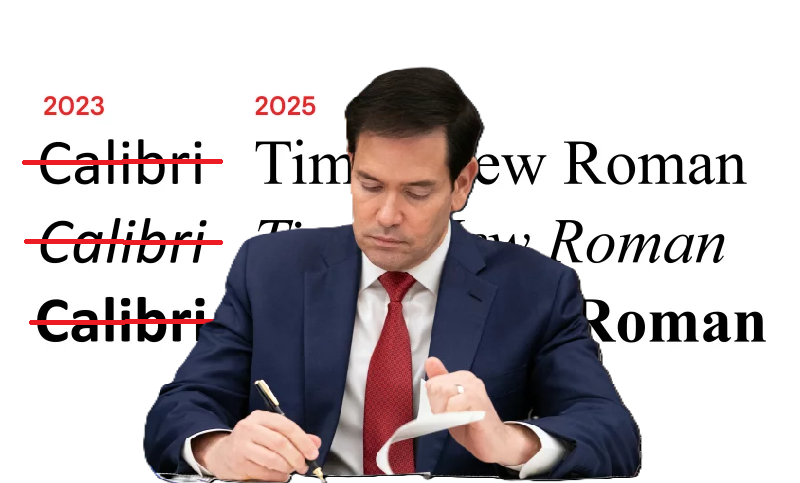
Did you hear about this one? Last week the State Department announced that it was switching back to Times New Roman from Calibri. The reason given by Secretary of State Marco Rubio is that it is "another wasteful DEIA program."
So Times New Roman is a font, which is a way of expressing letters in text. TNR is a popular one; it's got the decorative flourishes; those little do-hickeys on the ends of the letters which makes them look nifty to all the boys and girls. Except it turns out, this is not true for all the boys and girls. It turns out that some people have learning disabilities and some other people have lower vision, and some people probably have both. And it turns out that Calibri is also a font, which does not have the little do-hickeys on the ends of the letters, which means that everyone can read it. And that's how Calibri became the standard font for emails and documents in various software tools, and for various corporate and public entities, like my own workplace, and like the U.S. State department. It's a simple and easy way of recognizing that people with learning disabilities and low eyesight exist, and acknowledging that they are welcome in our spaces. It's a way of hearing their stories, which is something that a person or a culture does when they are committed to including the wonderful diversity of human experience.
Conversely, refusing to accommodate different types of people is a way of not hearing their stories, and acknowledging that our spaces are not for them. It's a way of refusing to acknowledge that the wonderful diversity of human experience exists.
I do not have a problem with users of Times New Roman, by the way. I'm using it now, as I write. Until this week, I didn't know this stuff about fonts at all. However, I'm sort of wondering if I should change the font I use when I publish, because of what I've just learned. There might be a bit of work to make the change, but then again it might be super easy. Either way, I want to make this a welcoming space, and maybe I'm making it a bit harder, so maybe if I actually want to make it a welcoming space, I will do the work. It's just another way of accommodating the wonderful diversity of human experience. The U.S. State department itself only recently moved through this process. It changed its fonts very recently, in 2023.
It wasn't bad in 2022 for using TNR. It just learned something, and then changed. Maybe it took longer than it should have, I don't know. But it did change, and in so doing revealed some good intentions, which is refreshing, particularly from an entity as frequently abusive as the U.S. State Department.
A couple years ago, I published a book called Very Fine People, which was about the shared, foundational, generative, automatic, inextricable, configurable value created by natural human societies, a value far greater than any value any individual could create themselves, and the responsibility each of us has to improve and maintain and repair that society, and to pay the natural costs of doing so. And I wrote about how the process of repair involves awareness that the thing is broken, a conviction that it should be repaired, a public confession of that awareness, a change of heart (I say "repentance") from an alignment against costs of repair to an alignment for them, to the actual reparation, or the repair itself, the maintenance itself, the improvement itself.
I wrote about the malicious collective spirit of supremacy, which holds that only some people matter, and tries to steal of a natural human society's value to itself while making everyone else pay the cost of the theft, including (and most foundationally) the blame for the effect of the theft. And I laid out supremacy's regressive sabotage of the natural process of reparation, maintenance, and improvement, enacted to avoid natural costs and responsibilities—of ignorance, complacency, denial, oppression, and war; also the various accommodations of those sabotages—of neutrality, compromise, exoneration, reconciliation, and surrender, all of which unnaturally raise the cost of repair; and finally of the tools we possess to counter sabotages and their accommodations—of witness, hope, clarity, solidarity, and defiance, all of which naturally raise the cost of sabotage.
I mention all this not to plug my book (Very Fine People, available wherever books are sold), but to locate myself within this story of fonts. I'm at awareness, which is moving me into conviction, which leads to this public confession. If I actually do the work to switch the font under which I publish, then I will have actually changed my alignment and done the work.
I try to do this all the time, by the way, and so I bet do you. In that very same book, I referred to our current temporary president as "the pig president," and somebody told me that this had hurt them, given the ways that the descriptor "pig" is typically used to shame fat people, and I thought about it, and I decided that hurting people wasn't my intention, but I now knew that it was the effect, so if my intention truly was not to hurt people, I probably would do well to not call him that anymore, or I would be demonstrating that I felt my own story of blamelessness was more important than other people's story of pain. And I don't call him that anymore, and you know what? It's fine. And you might have noticed that I started this bit of the essay by talking about all of us collectively as "all the boys and girls," which is something that I did as a flourish to keep the essay conversational, but which I would not do in say a work email, probably, and I quickly switched back to "people," because that is more inclusive language. Or maybe you didn't notice. I've learned that sometimes a flourish is fine; but more often than not it's best if things are standard-use.
These are all small examples, and they may strike you as inconsequential. Maybe so, although they may strike you as less inconsequential if you have dyslexia or low vision and have to read State Department documents.
What isn't inconsequential is the reason given by Marco Rubio, which is to avoid "another wasteful DEIA" program. In his statement, Rubio didn't translate the letters, but they stand for diversity, equity, inclusion, and accessibility, and these are the qualities that Rubio, and the administration to which he belongs, and the temporary president at the head of it, and the political party he leads, and the majority of the people who vote for them, all are opposed to.
What is "wasteful" about a font? There's probably a cost to switching, though it seems likely to be minor, and anyway, once switched, the same cost would presumably attend switching back. Calibri doesn't have the do-hickeys and do-dads, so I imagine you spare a certain amount on ink, which might be quantifiable if you print enough of your documents. There's no cost I can think of to employing a more accessible font—none, that is, other than the cost of acknowledging other people's stories.
And that's the cost Rubio is talking about, of course.
Not using TNR doesn't mean you are against TNR, or opposed to people that use it. Switching to a more inclusive font in public spaces doesn't attack people who like TNR and use it. But people who are opposed to accommodating anyone but themselves see any accommodation of the wonderful diversity of human experience as an attack against them, precisely because they attack anything they oppose, and they oppose anything that isn't them. The accommodation they request is not some accommodation for their own inclusion in society; it's not even a request, but a demand for accommodation of their active, deliberate, violent exclusion of the existence of all others. It's a demand for no accommodations save for the destructive and exclusionary accommodation of non-accommodation.
Supremacy holds that only an ever-shrinking class of preferred people have lives that matter, and the rest do not, and that, therefore, anything that is done to people that do not matter, no matter how wasteful and abusive and cruel and violent, is both justified and justifiable, and that nothing that people that matter do, no matter how wasteful or abusive or cruel or violent, can ever be anything but good and right.
This eradication of diversity and equity and inclusion and accessibility is happening everywhere you look. It's called the "war on woke," and it means that any accommodation of anyone else is so annoying that it justifies harm and exclusion. Anyone getting a job, getting a benefit, even getting to exist in society without first being white, a man, able-bodied, christian, wealthy, is deemed a waste. And this goes far past jobs. Our history books and museums are being censored, our universities are being stripped and propagandized, our scientific apparatus is being torn apart, all to avoid telling any stories but the supremacist one.
And the cost is fathomless. As with the illegal so-called Department of Government Efficiency—which cost us billions of dollars, and killed hundreds of thousands of people, and will almost certainly kill millions more—the desire is never to eliminate waste, but to eliminate people who have been deemed a waste. Everywhere you look, marginalized people are being eliminated from public spaces, as are the programs that promote and accommodate their existence. The font thing at the State Department is just another decorative flourish of exclusion. It's almost astonishingly petty, the font thing; it's breathtaking in its open meanness, just like everything else Republicans do, but it's all in service of their cult of abuse, which demands that only their story be told, and that it only be understood the way they demand it be understood.
This is all very consistent with cycles of abuse and the abusers who perpetrate and perpetuate them. If you're aware of other people, then you might have a responsibility to treat them like people. You might have a conviction that they should be included, and that might actually lead to including them. And that might mean that you're actually listening to them and accommodating everyone, rather than accommodating only the ever-shrinking number of people whose lives matter.
Nor is this opposition casual; it's as violent as can be imagined, utilizing every single tool of supremacist sabotage: ignorance and complacency and denial, of course, but also suppression and oppression, and now, even war—unless you have a word other than war for troops deployed in the streets by somebody calling the deployment "war."
Nor is it merely violent—it is blamelessly violent. The violent abuses that are enacted to eradicate diversity, equity, inclusion, and accessibility are framed as self-defense, and any attempt at self-defense in the face of this abuse is framed as violent abuse, while any attempt to even name what is happening is framed as incitement to violence at best, or violence itself. The costs of the war, including the cost of blame for starting the war, are always to be borne by those against whom it is being waged.
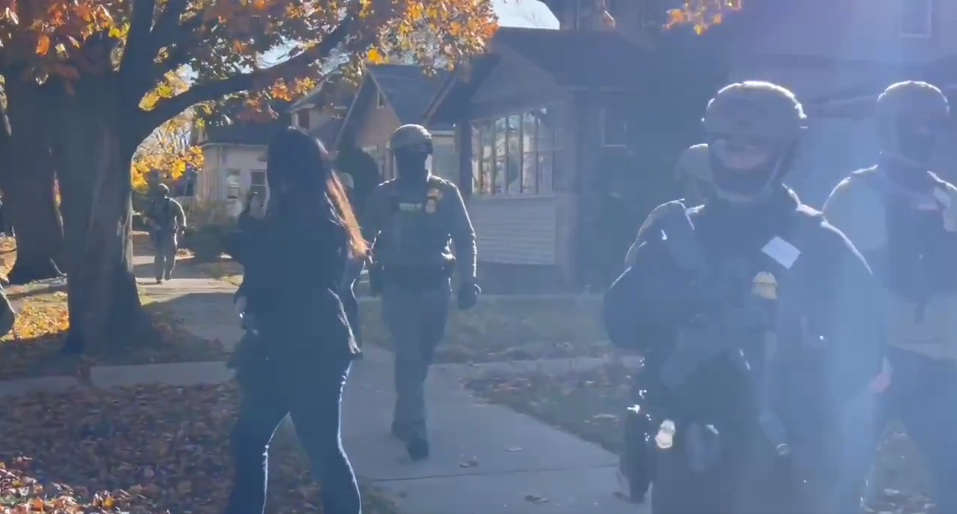
Here's our illegitimate Attorney General Pam Bondi, recently: "Under President Trump's leadership, there is zero tolerance for political violence and domestic terrorism. I am deploying federal agents to ICE facilities around the country. If you so much as touch one of our federal officers, you will go to prison."
This is extraordinary talk from somebody who is tasked with upholding our constitution and our law, but who actually is deploying troops into the cities of her own country to terrorize the civilian populations there, to brutalize them, to hunt them and kidnap them, to tear their families apart, all in service of one of the most overtly corrupt human beings in our national discourse, in order to establish an authoritarian fascist apartheid ethno-state that operates upon a for-profit imprisonment economy and feeds upon every bigotry you can name. This is an invasion, in the name of stopping invasion. It's war. It's happening on our streets, right now, as I type this.
But this is entirely consistent with an abuser's behavior. For a person who has tied their identity to their ability and right to abuse others (which is in the end what a supremacist must become) the only story that matters is their own. The abuse they are doing is not to be talked about, and if it is talked about then it wasn't that bad, and if it was that bad, then it was deserved, and any suggestion that it wasn't deserved needs to be treated as an incitement to violence against the abuser, a threat deserving retribution as if it had already occurred, an abuse in itself. It's the old DARVO dance of any abuser: deny, accuse, reverse victim and offender.
That's on them.
But the DARVO Dance ... it works. All too often, it works.
That's on us.
Us, and the stories we tell.
Or don't subscribe. I'm not the boss of you. But if you do subscribe, you get one of these essays pretty much every week.
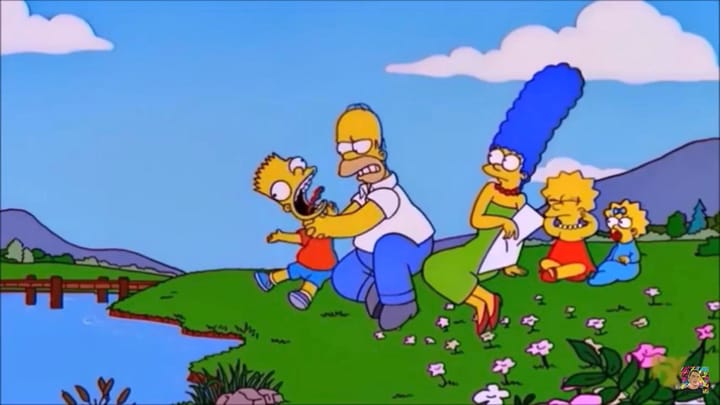
Say I tell you, “My father is choking my brother.” What do you say to that?
One thing you might say is "That is a story about your father and what he is doing. Make it about your brother and his need. Say instead, 'Help free my brother, who is being choked. Help stop my father, who is choking him.'"
It's very interesting t0 me, the way we so often put the abuser at the center of any story of abuse. We ask: What leads them to do it? What could have prevented it? How could somebody with so many other good qualities be part of such a thing? How could we persuade him to change, and become better?
These aren't unimportant questions. They're absolutely worth considering. But fingers are on your brother's neck. What questions, you might ask me, should we ask about that?
Asking that question is not the same thing as being opposed to my father's potential for improvement. You wouldn't know it, though, not in a culture of abuse, which instinctively tells the abuser's story.
⚬──────────✧──────────⚬
Say I tell you, "If I tell everyone my father is an attempted murderer, I am leaving him no path for redemption."
You might conclude that I have decided that this is not a story about the danger of my brother being choked, but rather a story about danger to my father's spirit and reputation, and how it might be saved. You might also conclude that I have, whether I have made myself aware of this belief or not, agreed with my father's story about this ongoing abuse, that the most important thing in this moment of abuse is establishing and defending the abuser's reputation for goodness. I actually don't see how you can conclude otherwise.
And if you drew these conclusions, your observations would be a different thing than being opposed to redemption. You wouldn't know it, though—not in a culture of abuse, which instinctively tells the abuser's story.
⚬──────────✧──────────⚬
Say I tell you, "I cannot stop my father from choking my brother, because I oppose all violence."
You might conclude that I don't see what is happening to my brother as violence. You might also observe that I have, whether I have made myself aware of this belief or not, agreed with my father's story, that what he is doing isn't violence, but any attempt to stop what he is doing is violence, and even the suggestion that he stops must be taken as an incitement of violence against him. I actually don't see how you could conclude otherwise.
And if you drew these conclusions, your observations would be a different thing than inciting violence or favoring violent acts. You wouldn't know it, though—not in a culture of abuse, which instinctively tells the abuser's story.
⚬──────────✧──────────⚬
Say I tell you, “We can't persuade my father to stop choking my brother, for he refuses to agree that choking my brother is wrong."
You might conclude that I have, whether I have made myself aware of this belief or not, agreed with my father's story of his ongoing abuse, that he has the right to do what he is doing, and he not only has the right to do so but he is right to do so, and so the only legitimate way of stopping him from doing so must involve persuading him of the reasons he must not, so that he stops not because he can not or should not, but because he decides he would rather not. I actually don't see how you could conclude otherwise.
And if you drew these conclusions, your observations would be a different thing than being opposed to reasoning or the act of persuasion. You wouldn't know it, though—not in a culture of abuse.
⚬──────────✧──────────⚬
Say you tell me about these conclusions that you've drawn, and I tell you "I think you're creating an us-versus-them narrative, and creating victims and villains."
I think you'd have to conclude that, by presenting your mere observation of my brother's ongoing victimization as something that is creating the victimization, I have entirely accepted my father's abusive views.
I think you'd have to conclude that by presenting your mere observation of my father's ongoing villainy as something that is creating the villainy, I have entirely accepted my father's abusive perspective.
I think you'd have to conclude that I have aligned with my father's perspective so totally that I must actually have made myself aware of these other beliefs of mine, to so effectively tell my father's story and refuse to tell my brother's.
I don't actually see how you could conclude otherwise.
⚬──────────✧──────────⚬
In the supremacist story, their abuse isn't creating a victim. The act of observing the victimization of their victims creates the victim. The blame is yours, not theirs. In the supremacist story, their abuse isn't creating a villain. The act of observing their villainy creates the villain. The blame is yours, not theirs. These categories aren't the already-present and observable results of something unjust and violent they are doing, but rather something unjust and violent that is being done to them.
Abusers today are demanding what abusers always demand, which is that only their story should be told, and that all other stories must be suppressed, and all those with different stories must be eradicated until the offense of their differing story no longer offends, because the offense of their differing existence no longer exists.
And all too often, all too many of us accommodate, not our responsibility to acknowledge and include the wonderful and diverse spectrum of human existence, but rather this totalizing demand of supremacist abusers. Some of us even accommodate it from a place of opposition, almost as an instinct. It shows in the way we approach our responsibility to stop the abuse that is happening.
It shows in the way we respond to our awareness of abuse by claiming that we are "creating victims and villains."
It shows when we ask "how do we stop the abuse that's happening without becoming abusers ourselves?" not after we have actually decided to stop the abuse, but before.
It shows in the way we ask that question not as a way of entering conviction of our responsibility to end abuses, but of avoiding it. Like supremacists—exactly like supremacists, I'd say—we'd rather not have to pay the cost of abuse when other people are there to do it for us. We'd rather tell the abuser's story, because the abuser promises us their story won't cost us anything, and even though we know they lie in every breath, we believe them, because we want to avoid costs.
We even want to avoid the cost of being seen as aligned with abuse. So we shrug, "how to stop the abuse without becoming abusive?" and shuffle away.
Which is not to say it isn't an important question. It's one I intend to address.
I just needed to get us (or at least myself) on the other side of the wall of conviction first, so that we could ask it another, better, way.
"Now that we have already determined that we are going to stop the abuses that are happening, no matter the cost, what is the best way of accomplishing that?
The Reframe is totally free, supported voluntarily by its readership.
If you liked what you read, and only if you can afford to, please consider becoming a paid sponsor for as little as $1/month. If you'd like to be a patron of my work, there's a Founding Member level that comes with a free signed copy of one of my books and thanks by name in the acknowledgement section of any books I publish.
Looking for a tip jar but don't want to subscribe?
Venmo is here and Paypal is here.
A.R. Moxon is the author of the novel The Revisionaries and the essay collection Very Fine People, which are available in most of the usual places, and some of the unusual places. You can get his books right here for example. He is also co-writer of Sugar Maple, a musical fiction podcast from Osiris Media which goes in your ears. He no are no nice guy.

Comments ()