
Run It Like a Business
Efficient systems are brittle systems, and the money saved by making things worse isn't going into our pockets. Why do we permit this?
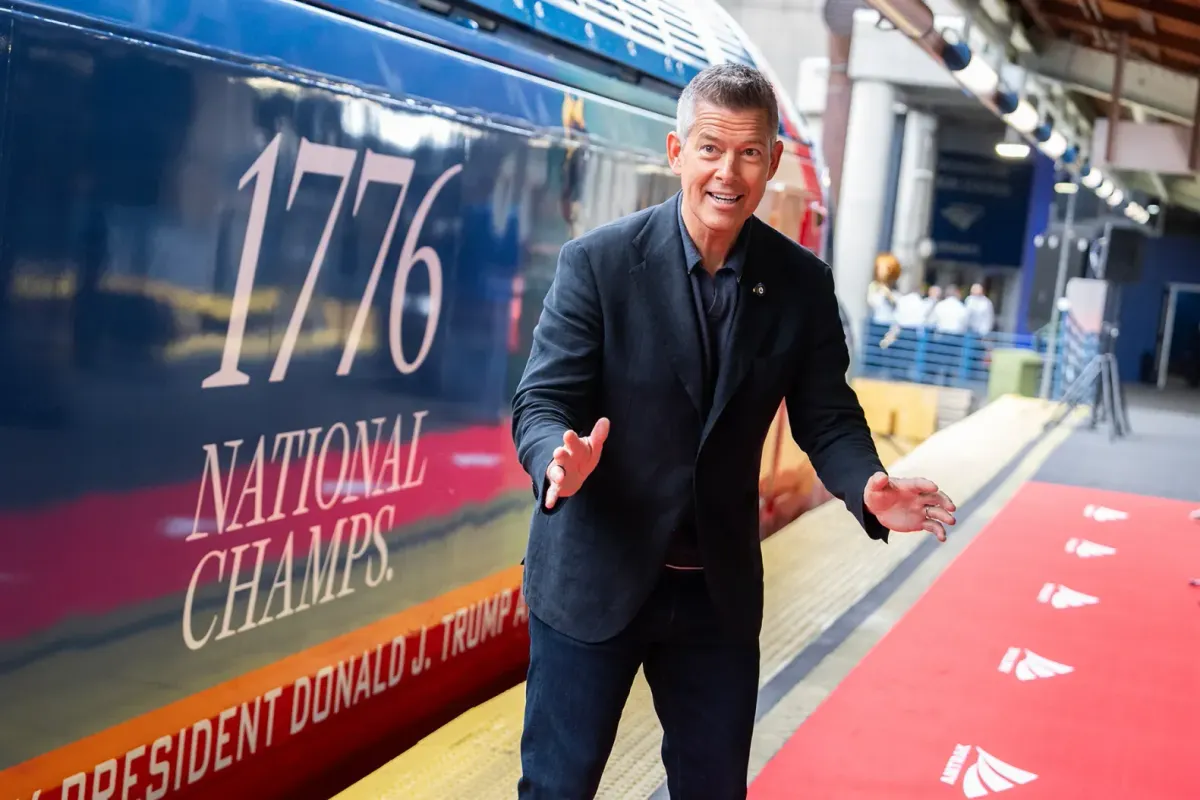
Well, the Federal Aviation Administration announced that all flights were grounded due to "extraordinary circumstances" on Friday. It was the largest disruption to air travel since the 9/11 attacks back in 2001, and it lasted for all of 5 hours. It was over before the FAA had even said what the circumstances were, but in their defense, they still haven't really told us what the circumstances were, which may be because (in their defense) they are being run by a dilettantish ninny best known for being a reality TV star, which gave him fame he parlayed into political office. No, I know what you're thinking, but I'm not referring to the U.S. President, I mean a different dilettantish ninny best known for reality TV. This fellow is an airbrushed dandy named Sean Duffy, who before he started making our Road Rules (and our Air Rules and Space Rules) also spent a decade serving as a representative from Wisconsin as a member of our fascist political party known as "Republican." This is all standard stuff. A Fox TV host runs Defense. A fake wrestling entertainment personality is figuring out how to demolish what remains of Education. I already mentioned our grotesque turd of a temporary president, a frequently-bankrupted real estate developer who played a dipshit's version of a Business Guy on America's teevee sets for a spell.
In the explanatory briefing, Duffy seemed to have little idea what he's talking about (why would he?) or perhaps he was just lying (which is almost a given when it comes to the American fascist party), since by at least some reporting, his story seems to make little sense to actual air traffic professionals; nevertheless he has demanded $50 billion dollars to fix whatever was broken. This is interesting, since when the Republicans (who currently govern the FAA) swept into power, they identified the immediate problem as government waste, and then gave the world's richest man a chainsaw to cut all government programs to the bone, including the FAA. Their claim was that government spending was mostly waste, so they ignored warnings from experts that these cuts would tax an already creaking system, causing increased risks and dangers. This ignore-ance was not because they had evidence to the contrary, it seems, but because they just took it as a given that spending equals waste, and so they set their Dork Leatherface loose to cut into our infrastructure like so much teenaged flesh, and they all thought it was epic. In the billionaire world, which is the world of business, cutting costs makes the stock go up, and then the shareholders are happy, and you can stop worrying about pesky things like the effects of those cuts on human beings.
The explanation given at first for the air traffic grounding was a transition from copper wire to fiberoptic cables on a network owned by L3Harris, which is a corporation. And indeed, there has been increased pressure to privatize what the FAA does; to turn air traffic over to corporations to run, in other words. We've already done this with so much else of what the government does (prisons, military, space, medical research, education, etc. etc. and etc.), and a handful of people have gotten magnificently wealthy as a result. The world's richest man—the one with the chainsaw—is at the very top of that pile. Winning government contracts to do for a profit what used to be done for human beings is how he became the world's richest man. It's how he got his hands on the chainsaw in the first place. He cut everything out. Now it's gone. Now somebody can replace it, selling back to us whatever he killed. Maybe that someone can be him. Maybe that was his whole idea from the start.
The idea here is that we ought to "run the country like a business."
It's a popular idea, though its a popularity that mostly makes me think that most people don't understand how businesses are run—these days, anyway.
It's not the end of the essay! It's only a quick reminder that The Reframe is me, A.R. Moxon, an independent writer. Some readers voluntarily support my work with a paid subscription. They pay what they want—as little as $1 a month, which is more than the nothing they have to pay. It really helps.
If you'd like to be a patron of my work, there's a Founding Member level that comes with a free signed copy of one of my books and thanks by name in the acknowledgement section of any book I publish while you are a subscriber.
I was in an airplane when I found out about the shutdown, as it turns out. I was among the lucky ones, because I was pulling up to the gate at my final destination, so I was not inconvenienced by whatever this colossal screw up was at all. There was a decided lack of transparency surrounding the circumstances leading to the worst air traffic disruption in 25 years, and there still has been. While there have been some hopeful signs that incoming Democratic majorities may have a different view, Mike Johnson, the current (Republican) Speaker of the House, has stated he sees no reason for an investigation into the matter. Apparently he has no questions after what was clearly a massive systemic failure, or a faked massive systemic failure. I have questions, though. Since I just so happen to be typing some of this on a flight, I have very particular questions, like "what the fuck is going on?" and "should I be on a commercial airplane right now?"
Here are some other questions: Who made the call to ground all flights? What was the actual danger? What dangers did the flights then in the air (of which I was one) have to deal with, and was the danger of the grounding actually greater than the danger of flight? How was it resolved in only five hours? What is the nature of that investigation? How long will it take to fix? What is the actual danger going forward? What would this demanded $50 billion be spent on? Why was it only $30 billion two months ago? Who would get the money if allocated? How can we be sure those who get it will fix the problem? Who is taking culpability for slashing the FAA two years ago, if it turns out it needed this much money? Why is Duffy only blaming previous administrations for the lapse? Oh and now Duffy, who has spent many months of his tenure at the head of U.S. transportation shooting a YouTube reality show of him and his family driving around in a bus, now claims the issue was a router. What about his previous story? Who told him it? What are his methods for verifying information he shares with the public?
These questions and others aren't being answered, and those currently in charge aren't seeking them. Either they don't know and don't care, or they do know and they don't want to tell.
Whatever. Here's the first point I want to make, since we are talking about running the country like a business: This lack of transparency is how a business is run. Those who own the business and those who run it from the executive suite do not give all available information to those who work for it or those who buy from it, and they certainly don't share key information with competitors. Here's the second point I want to make: When a country is run like a business, those who run it do not see citizens as co-owners. They see us as customers at best—if we're lucky—but that doesn't mean they'll be transparent with us, it only means they will market to us. They may see us as employees, who must do their bidding as long as we are useful, and expect us to be thankful for the opportunity. For many, they see us as competition, to be defeated and discarded. But mostly, they see us—increasingly all of us—as either the product or a cost.
And there are many other aspects to this debacle other than transparency that show how corrosive it is to run the country like a business. A business doesn't make its money for its customers or its employees, you know. It makes its money for the fellow owners, who are plenty happy whenever the costs get slashed and the line goes up, because the line goes up means that wealth that might have come to others, like customers or employees, is now coming to them. This is efficiency in an organization run like a business. It's an efficiency that shuttles the wealth into the handful of owners ... which is what we see now.
Our systems are efficient—magnificently so. They're also brittle. They'll break down terribly. Microsoft Outlook went down rather spectacularly last week, and we all realized how much we use it for communication. A bunch of banks just went down yesterday. If Sean Duffy is to believed, apparently the whole country can collapse when you replace copper for fiberoptic in one location. (Or maybe it's a router. Something else tomorrow, perhaps.)
This is because a system run for its owners will not prioritize those who use the system, it will prioritize the people who own it. "Efficiency," then, is defined as "money saved," which means that "money spent" is always framed as waste. (Cue the chainsaw.) "Efficiency" in the FAA and our airline industry is not defined as "flights rarely cancel." If it was defined that way, we'd spend more money on more personnel and more infrastructure, so that our systems, which might cost more to run, would be more durable, more suited to handling the goal of efficiently transporting people around the country without interruption. The purpose of our nation's transportation systems, then, is not transportation of people. This should bother you, if you are a person.
Pockets are being lined to make us less safe, less aware, less healthy, less free, less represented, less considered. They aren't our pockets.
Why, then, would we want to run a country like a business? Why would we seek efficiencies that make things worse for us, and benefit only a few, who use some portion of that wealth to leverage even greater control over our bodies and lives, in order to grow their already pathologically unhealthy wealth even more?
I don't think it's because it makes sense to run the company like a business.
I think it's because of the marketing.
The marketing tells us we're whenever we run the country like a business, we will get to be the owners, too—and our shares will increase by taking shares away from the undeserving. We believe that, like the executive suite with all the privatized contracts, we deserve to be co-owners of our country.
And, crucially, that we believe others do not.
Or don't subscribe. I'm not the boss of you. But if you do subscribe, you get one of these essays pretty much every week.
It's possible to run a business as if you care about long-term sustainability rather than making the number go up, you know. Some do. This usually involves understanding that we all live in a generative, connected, inter-relational natural system known as human society, a part of an even more generative, more connecting, more inter-relational natural system known as the ecology.
That's not the way business is run in our country. Our country has been taken over by venture capitalists; smash-and-grab bandits who just want to bust it out and sell the parts. Here at USA Inc. Corp., profit is job one, and a lot of people, who should know better, have been told they have a share.
What I've noticed about slashes to government programs is they are usually justified by a question of what is deserved. Appeals to the public that we are cutting programs because their money is going to those people is a much more potent message than the truth of these billionaire heads of the USA Corp Inc, which is "if this money goes to all of you in order to keep you alive and healthy, or to make your lives easier and better, then it will not go to us, and we fucking want it, because it is money, and we are unsound in our souls and our spirit, so we want all of it."
And so sick people become consumers, if they have good enough insurance to be able to pay increasingly astronomical medical fees, and when that stops being the case, they become costs to be written off the books. And so students become consumers, if they can afford increasingly astronomical tuition, or they become product, if they are willing to put themselves into massive amounts of predatory debt. We would never want to pay to educate them, not here in USA Corp Inc. That would be a cost. The idea that a educated population might be an investment never comes up. And so with the costs of paying for environmental care, and so with housing, and so with adequate representation in our legal system, and our roads and bridges, and on and on.
After all, why should your money go to give those people all of those things, when they do not deserve them?
We can't afford these things for everyone, after all, because then those people, who do not deserve it, would get it, too. So, in the end, none of us get those things. Eventually the system, maximized for efficiency, becomes too brittle. All the money from that efficiency went into somebody's pocket. It wasn't our pocket—we who believe we deserve it. We who were told that we, too, were shareholders in USA Corp., Inc. We, who were told those cost reductions would come to us.
The most common way of establishing who deserves and who doesn't is bigotry; those are the easiest ones for me to see, anyway. (Why should my money go to illegals? Why should I pay for the education of that sort of child?) But wealthy people are sly about growing their wealth even while they're so stupid about the public interest, and they understand that many of us mistrust them, so they use that mistrust to create more questions of what is deserved. They get us more concerned that any truly public program that doesn't bother with what is deserved, any program designed to help everyone, will not have sufficient guardrails upon it to prevent wealthy people, who do not need help and therefore do not deserve it, from benefitting, too. And so we set up meticulous programs of means testing, meticulous and complicated and byzantine bureaucracies designed to eliminate waste.
Now: I'm all for eliminating waste. And I don't like the prospect of billionaires lining their pockets. I can see the appeal in making sure that the wealthy aren't fraudulently availing themselves of funds meant for those in need. So I'm not against safeguards. But I can't help but notice how much easier it is for billionaires to seize the public good when it has been set up around questions of what is deserved. I can't help but notice that what these means-testing programs usually do is make it harder for poorer people to access public programs, and cost more to administer than they save, and so help make the case that public administration is wasteful and incompetent. I think this happens because deep down the American public sets its bureaucracies not around establishing safeguards, but around questions of what is deserved.
So we hear that public good is waste, and the health and thriving of human beings are not the point of a functional society, that instead efficiency is; efficiency defined not as everybody gets everything they need, but rather as nobody gets anything they don't deserve.
After all, why should your money go to pay those people for those things?
But it's not your money; not anymore. It's in the pockets of the owners of USA Corp Inc., the ones. That's the scam, the red queen in their 3-card monte game, the one you'll never pick no matter how closely you watch. You weren't a shareholder. You never were. At best you were a consumer. Soon you'll be a cost, and off the books you go.
The point of human society is not business, and it can't be run that way. Business has a few people who are owners and the rest of the people who are not, no matter how responsibly it is run. And even a responsible business can only be run responsibly if it understands it is a part of a whole, not the whole thing.
USA Corp. Inc. isn't where I want to live. The good news is, we don't live there. USA Corp. Inc. is a lie. The truth is, we all live in a generative, connected, inter-relational natural system known as human society, a part of an even more generative, more connecting, more inter-relational natural system known as the ecology.
The only way we have a share is if we share.
There is no deserve.
The Reframe is totally free, supported voluntarily by its readership.
If you liked what you read, and only if you can afford to, please consider becoming a paid sponsor for as little as $1/month. If you'd like to be a patron of my work, there's a Founding Member level that comes with a free signed copy of one of my books, and thanks by name in the acknowledgement section of any book I publish while you are a member.
Looking for a tip jar but don't want to subscribe?
Venmo is here and Paypal is here.
A.R. Moxon is the author of the novel The Revisionaries (2019) and the essay collections Very Fine People (2024) and Fighting in the Dark (2026), which are available in most of the usual places, and some of the unusual places. You can get his books right here for example. He heard a sound. He turned around. He turned around to hear the thing that made the sound.


Comments ()