
The Shovel Next Time
Liberation from tyranny is also liberation for the tyrants.

I wrote a TV post about LOST last week, but it felt too trivial a thing to post in the wake of Renee Good's murder by fascist Republican death squads, so I saved it for this weekend. But Saturday, before I hit the publish button, I saw the news, and here we go again. It feels false to publish about anything other than these weighty matters. Who knows the next time it ever won't?
Death squads will sure enough murder civilians; it's what they were formed to do and trained to do, and death squads are what we very clearly have now, as ICE has summarily executed another U.S. civilian on the streets of Minneapolis. Powerful Republican Nazis like top presidential advisor Stephen Miller are already lying about this good man, slandering him in post-hoc justification of his unlawful state execution. I'm not going to dignify Miller's lies by repeating them or acting as though they are worth considering on the merits; that, it seems, is legacy media's job. What I will say is that Alex Pretti was a nurse and a helper, a friend and a son, and many other things beside; he was a human being, and an irreplaceable and unique work of art, and now he is a corpse, because corpses are the only thing Nazis can create, and Republicans aren't different from Nazis in that respect any more than they differ from Nazis in most other respects.
Pretti was also a gun owner and a gun carrier, and it appears he may have been legally carrying at the time of his murder. He didn't use his gun when he was threatened by the Republican death squad, and they had taken it away from him while they were beating him, and before they shot him. Nevertheless, the fact of it is now being offered by the death squads and their defenders as proof that Pretti was a killer who deserved to be shot again and again and again, after being beaten brutally, while being held to the ground.
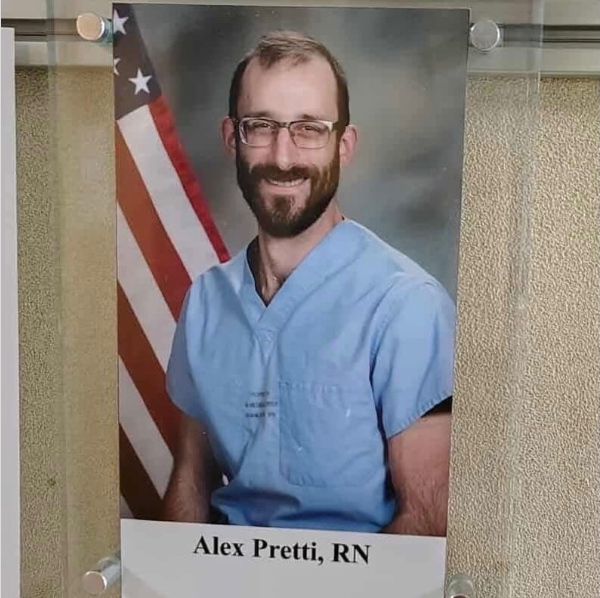
Having a gun and being able to carry it wherever you want is a core and fundamental right of every U.S. citizen, or anyway that is what I have been told all my life by the same people who now use the mere existence of Pretti's alleged gun as proof his murder was justified. The NRA for example released a statement, which boils down to the fact that they are A-OK with secret police executing legal gun carriers. The idea I was given by the NRA and others is that if the government becomes tyrannical, it is a citizen's duty to murder the government and its officials with your guns. This didn't seem to be Pretti's idea at all, and it's not my idea at all, but it is the Republican idea about civilian ownership of guns, and they say it in exactly those words to defend guns after each gun massacre. If Pretti had used his gun against the death squads in this way, he would have been entirely in line with the Republican story about why guns are a fundamental American right, which I mention only to demonstrate that Republican gun defenders were lying all along. So now we have another Nazis output besides corpses: Lies.
These Republican authorities murder because they intend to murder, and if you listen to them you'll hear them say as much. They lie about the murders and their intent in order to justify the murder, because they intend to murder some more—much more, as much as they will be permitted.
This means that we're dealing with a massive national gang of lying murderers. It's an uncomfortable fact, but it's the reality. If we are to get out of this situation, our dealings with Republicans ought to be informed by that reality.
I know some will still, even after all this time, read these words to mean that I am instigating violence against Republicans, rather than simply observing what they are doing and saying, and speaking the obvious truth about what their words and actions mean about them, and the obvious point that our truthful understanding of them should inform our dealings with them. They are lying murderers, not because I don't like them, or because I disagree with their politics, but because their leaders are sending paramilitary death squads into our cities to commit premeditated acts of state terror and murder against our civilian populations and then telling lies about it, and their rank and file are lending their spiritual and financial and political support to the effort. One can't deal with a problem properly unless one deals with the reality of the problem, and one can't deal with a reality unless it can be spoken. So I speak the grim reality, not because I would live in a world of abusive violence where might makes right, but because I do live in such a world, and I think it is a problem, and I would like to change that.
Speaking the truth about an abuser—what they are doing, what they are saying, what their false words and violent actions say about how we ought to understand them and deal with them—is taken as abuse itself, is taken as violent intent or even violence itself against the abusers, is taken as a blasphemous sin against the abuser's indestructible presumed innocence, is taken to mean that you are preventing the abuser from ever attaining redemption, is taken as all this and more.
This is how I can tell that it is a cult of abuse we are dealing with, and a culture of abuse that we are living in.
Quick interruption time. The Reframe is me, A.R. Moxon, an independent writer. Some readers voluntarily support my work with a paid subscription. They pay what they want—as little as $1/month, which is more than the nothing they have to pay. It really helps.
If you'd like to be a patron of my work, there's a Founding Member level that comes with a free signed copy of one of my books and thanks by name in the acknowledgement section of my upcoming book.
A person I know who is outraged by the state execution, and realizes that is exactly what it is, shared with me his opinion that it was stupid for Pretti to bring the gun. This person told me with a certain amount of pride his own family had taught him better than to do something so stupid as that. I can only conclude that, in this person's mind, this is the reason Alex Pretti is dead, or at least a significant factor: not the death squad but the fact that his family didn't teach him right. If only Pretti had been brought up better, it seems, he'd be alive now. It was an important thing for this fellow to say to me, it seems.
This same fellow compared Pretti to famous teen killer Kyle Rittenhouse, who, like Pretti, carried a gun in public. This analogy is astonishing to me, since Rittenhouse, unlike Pretti, came to somebody else's community to offer his support to fascist authority, rather than acting in support of the U.S. civilians those authorities brutalized in his own community, as Pretti was; and Rittenhouse, unlike Pretti, had his gun out and ready to go, not tucked and never drawn; and Rittenhouse, unlike Pretti, used his gun to murder people at that demonstration; and Rittenhouse, unlike Pretti, is today alive and well and exonerated and celebrated by Republican Nazis.
Again, this was said by somebody who is shocked and horrified by the state execution of Alex Pretti, and thinks of it as such. So we can see how instinctively any of us might turn to the abuser's mindset, even as we move to oppose it; to tell the abuser's story rather than the victim's, to ignore who is in power and who is not, who is being abused and who is doing the abusing; to shield the abuser from natural understanding of their abuse and the natural consequences of that understanding. This is not some isolated moment. I've noticed it's an extremely common response to a state execution carried out by death squads: He died, I did not. I am alive; it must be because I have done something right. Therefore, he must have something wrong. It's tempting to think this, because then this killing means that you are still protected somehow by something, and perhaps means we are not dealing with murderous liars who are going to kill you whenever they want to kill you no matter what you do, unless they are stopped. And that means that there isn't a moral imperative to help stop them, which would be convenient.
But the death squads are death squads, and they do need to be stopped.
How to stop them?
Well, they are lying murderers, so I think we ought to issue natural consequences that attend lying and murder. We should stop trusting them. Every word they say should be taken as a lie. Even occasional truths that come from their mouths should be understood as serving larger lies. Every intention should be presumed malicious. We should guard our words around them and lie to them about our intentions in order to confound their expectations. We should disobey them and harass them and demoralize them at every turn. We should protect our neighbors with our bodies and our lives and our time and our money, as Alex Pretti did, as the extraordinarily brave people of the Twin Cities are doing. We should disrupt their events, as with the demonstrations exposing and shaming the allegedly Christ-worshipping congregation of the Cities Church, whose pastor, David Easterwood, is a local director of the Republican death squads. We should resist them in inventive and disobedient ways that grind down the vile mechanisms of their vile intentions. At the very least, we must keep a correct understanding of what their words and deeds mean, and permit them to experience the natural consequences of that understanding. We must remember that those engaged in resistance of mistrust and deception and disruption and disobedience against these abusers are not attacking, but rather are exposing abusers to the natural consequences anyone should expect who creates a world of abuse and makes all others live in it.
When we do this, we will be told we are treating Republicans as if they are irredeemable, even as we seek to redeem this country they have degraded; we will be told that we are violent even as we practice non-violent resistance. For pointing out that a war against civilians that was already declared by the U.S. president is indeed currently being waged against us all, we will be told we are calling for war.
Rittenhouse and Pretti make an apt comparison in one other way, I suppose: Both of their stories do exemplify the Republican position that Republicans and only Republicans can kill whoever they want, whenever they want, however they want, for whatever reason they want, or for no reason at all if that's what they want. Both of their stories do exemplify the Republican position that everyone else must live in this world where Republican might makes right and any violent abuses must be accepted and endured with perfect compliance by everyone else, while claiming that they and only they should be able to live in a world of perfect safety where they and only they have the right to defend themselves from any perceived threat, no matter how hypothetical or imaginary or fabricated.
But here's another truth: Those who create a world where might makes right think that they can live in a separate world of safety and comity; that's their delusion, and they commit their acts of horror to maintain the delusion. But it's a delusion all the same. They live in the world they've created, too. Eventually, if they are not stopped, somebody is going to meet them on their terms, and meet their outrageous persistent violence with a violent reply. I'm not saying this because it's what I want. I'm saying this because that's what happens in a world where might makes right, where death squads execute civilians in the street and the leaders who sent them tell bald-faced lies about it, where guns are deemed a fundamental right of every citizen because every citizen should be permitted to use their guns against government tyranny. Anyone who makes such a world eventually draws such a response. Thus far U.S. citizens in Minnesota and elsewhere have been extraordinarily disciplined—and we would do very well to honor that discipline—but we would also do very well to hold the awareness that if the fascist Republican death squads are allowed to persist in their campaign of hate and terror, a response in kind will come, and if it doesn't come, then Republican fascists will, as they often do, invent one that serves them just as well.
Many will point out that this sort of response is exactly what the fascists seem to want, and I will agree with you, but point out in return that the reason they want it is that they know from long experience that any moment of perceived violent resistance in response to their ongoing violent abuse is the moment when many people—even people who otherwise oppose them and their abuses—will instinctively return to our learned culture of abuse, will stop telling the victim's story and start telling theirs, will start ignoring who is in power and who is not, and will start explaining why the abuse is now justified because the protestors gave them exactly what they wanted, will completely ignore that using violence—and specifically guns—to kill tyrannical authority is an idea held close and dear by Republicans, and a world in which violence remains such an ever-present option exists specifically because of their policies.
If this moment—which I do not call for or hope for or seek—arrives, it will not be an abuse that the abuser is suffering, but a consequence they are experiencing for the world they have created. And when the fascists do what fascists do, which is escalate their abuses in response, many—even those who oppose the fascists—will be tempted to claim that the fault is that of whoever met the fascists on their own terms, rather than the fascists themselves.
If and when we do so, we begin telling the abuser's story for them. We shield them from a natural understanding of what they are by their words and deeds, and the natural consequences of that understanding. We'd do very well to remember that, too, and be prepared and ready to avoid these instinctive traps when this eventuality (which unless checked will become an inevitability) arrives.
I hear the question: What about those who have a change of heart? Aren't we closing the door to that possibility?
Given present rhetoric and policy, this eventuality seems unlikely, but I think we should welcome it if it comes, and be prepared to assist it if it arrives. Certainly there are tens of millions of people aligned with Republicans, and some of them will fall away, shocked by death squads in our streets.
Let me talk about changes of heart.
Or don't subscribe. I'm not the boss of you. But if you do subscribe, you get one of these essays pretty much every week.
I understand why people would seek a change of heart, because if your father is choking your brother, it is necessary to stop your father, and it would be easiest if your father simply had a change of heart. But there are a lot of ways to stop your father.
You might appeal to your father with reason or appeal to his better self.
You might persuade your father that there will be consequences for his abuses, and greater consequences if he continues.
You might hope that your brother overpowers your father, and frees himself.
You might convince other people to help you wrestle your father off your brother and hold him down.
If not, somebody might hit your father in the head with a shovel.
Yikes.
⚬──────────✧──────────⚬
I don't know how you would feel if I said that you or your brother or whoever else who had resorted to the shovel were being abusive, or had become just as bad as your father, because hitting somebody to stop them from murdering your brother is not the same thing as somebody murdering your brother, and is not the same thing as believing that hitting is good.
Most people don't want to hit their father in the head with a shovel. Me either. I don't want to hit my father with anything—in fact, I don't want to hit anyone with anything, and certainly not with a shovel. I don't want to live in a world of shovel-hitting. A shovel fight seems like the second-worst possible outcome to this scenario, and the solution you should try last, when your father has shown himself immune to reason or morality or consequence or attempts to overpower him.
The worst outcome, incidentally, is watching your father choke your brother until he is dead, then watching your father turn to your sister, and then your mother, and then to you. This is why stopping your father is necessary, and the shovel might eventually, however regrettably, come into play.
The best outcome of all is if your father stopped choking anybody all by himself, and recognized all by himself that choking is wrong, and all by himself decided to never choke anyone again, and agreed to accept the consequences of the choking he'd already done.
So I get why people would seek this outcome, and I agree that we have to be open to it, because it does happen. I just want to be clear about what this outcome looks like.
⚬──────────✧──────────⚬
The idea most people talk about when talking about this sort of change of heart is "redemption." In fact, creating paths of redemption is something I am told is our responsibility. I agree with this, though I would like to interrogate what is popularly meant by "redemption."
In our popular culture, redemption is a big deal. It's one of our favorite stories. There's a lot of different ways redemption plays out, so let's list a few.
In the first redemptive story, a person who everybody said was wrong persists over great adversity and is proved right in the end. What I'd point out here is that this is not redemption, but vindication. Vindication is all well and good, provided the person being vindicated actually had the truth on their side. I can't help but notice, though, that this is the redemption that our Republican Nazi Party is hoping for, and enforcing at the point of violence: Say we're right and good, or suffer. And this is the form of redemption that so many of us who say we oppose U.S.ian forms of white supremacy accommodate, instinctively, as a way of avoiding the struggle of opposition and paying the price of that struggle. Over a hundred years ago, back before we even had the word "Nazi," we had defeated a previous version of this supremacist spirit, that confederate insurrection of murderous slavers, and were reforming the country into something more liberatory, when we made a compromise with those slavers that vindicated all their beliefs about their insurrection and the rightness of their cause. This compromise allowed nearly a century of Jim Crow and terrorist violence against Black people and their allies. The slavers called this vindication Redemption, and that's what the historians call it too. What was redeemed were the abuses.
The second redemptive story involves a change of heart. A miser becomes generous, or a self-centered asshole becomes a team player, or a bigot learns through a shared love of fried chicken or something that certain Black people should be treated better because they are actually very talented (I wish I was making this up but nope this is a real movie that won a real best picture Oscar). I'd like to point out that this is not redemption, but repentance. Nor is this an insignificant distinction; it's the difference between turning away from an abusive path toward decency and humanity (which is a very good and necessary first step), and the lifelong work of actually walking the path and paying the cost of negotiating the terrain, of walking back all the abusive ground you covered. In our entertainments, the redemption is assumed. In our real life, also, I notice we want to assume the redemption; immediately jumping to reconciliation even before the repentance. A change of heart is good, and we should foster it and encourage it wherever we see it. However, be cautious of somebody who claims a change of heart but refuses to walk in a new direction, or insists that somebody else carry them down the path, for you are neither dealing with redemption or a change of heart, but just another tactic for avoiding cost.
In the third redemptive story, a person who did something terrible in the past sacrifices themselves somehow in order to save the day. These things usually play out in action movie, so the redemptive person usually dies as a result, but sometimes they just lose their reputation or their fortune or some other advantage. This actually is redemption, because it involves paying a cost, and usually a steep one. It doesn't involve the person being able to keep their ill-gotten advantages; it doesn't move the person being redeemed to a place of greater safety, greater wealth, greater reputation, greater power and influence, greater advantage, greater authority, but lesser. If the person gains advantages from their action, it might still save the day, but it isn't redemption. The thing about redemption is, something gets redeemed. There is something that carries a cost. As previously stated, that usually means a road to walk over a lifetime. I think that's why dying is such a popular redemptive method in movies. It's ultimate, but it's quick. Not so much work. What I'd like to note is that natural consequence is an intrinsic part of redemption, so if you are trying to help somebody avoid natural consequence, then you aren't making a path to redemption, and if somebody is seeking some sort of restoration without consequence, then redemption isn't what they are after.
⚬──────────✧──────────⚬
I want to note that redemption as popularly understand is an individual matter, and, as we are an individualistic society, we tend to value it highest.
However, there's something collective and systemic that opens the door to possibilities of collective restoration by making abuses harder and more costly; it frees people who were suffering abuses from that suffering, but it also can free those who were committing the abuse from the ongoing consequences of being abusive.
It's what happens when people who are suffering a systemized culture of abuse free themselves from those abuses by freeing themselves from the system and create new systems and cultures that make abuse costly, while paying the natural costs of human solidarity. It's a very powerful and complicated thing I'm talking about, and I imagine I'll expand upon in coming weeks.
This is nothing new, by the way; I'm a fool, so it's something I'm only slowly learning about. It's something that activists for equality, humanity, equity, diversity, and freedom are far more interested in than redemption, because it doesn't require millions of individual redemptions to be worked out, one after another, in order to achieve.
It's called liberation.
Liberation is liberation for everyone. For you, for me, for your brother.
For your father, too.
⚬──────────✧──────────⚬
Let's end with this point: Liberation always frees the victim from the abuse, but it also frees the abuser from the abuse. Liberation from tyranny is a liberation for the tyrants, too.
If your father decides to stop choking your brother, then your brother is no longer being choked, and your father is no longer doing the choking. It is only now, at this moment of dual liberation, that we can work at keeping your brother free from abuses, and build new institutions and paths and social and legal penalties that make those abuses far more costly, that can find healing for those who abuse, that make it much less likely for abuse to happen at all. This is true liberation, because while it means your father will face natural consequences for his words and deeds, it also means that your father is now free to walk a redemptive path if he so chooses. Moreover, even if he doesn't choose to walk it, your brother is safe from his abuses, and even your unrepentant father is safe from being able to abuse, or being abused in retribution; his only penalty will be the natural one, which is a clear understanding of what he chooses to be, and the natural consequences that attend that understanding.
So liberation might be achieved. We might hope for it. But there are other ways to achieve it. Liberation from choking isn't something for your father to decide about. It's something we can decide without him.
If your father refuses to change on his own, we might persuade your father with appeals to reason and morality. If, in the attempt, we perceive that your father has made himself immune to reason and morality, we might still achieve liberation with appeals to consequence. If, in the attempt, we see that your your father is unmoved by consequence, then your brother might still overpower him and cast him off, or, if your brother lacks sufficient strength, you might still achieve liberation through solidarity, by overpowering your father through main force and pulling him off of your brother. And, if he cannot be overpowered, there is still the shovel.
These are not equal methods of liberation, but they are all liberatory if they lead to a point where nobody is being choked anymore, and structures can be built to prevent further abuses. Some methods involve less struggle, less violence, less strife, less pain and suffering and danger. However, if we would avoid telling the abuser's story, we must remember that a person who refuses to be choked to death is not the same as a person who refuses to stop choking, and an action taken to free oneself from murder is not the same thing as the same action taken to kill, that holding somebody down to prevent them from killing is not the same as holding somebody down to kill them. If your father reaches for the shovel to finish him off, it is a completely different matter than if your brother reaches for it to knock your father away.
We should always encourage changes of heart. We should always look for and hope for the liberation that involves the least suffering.
But so should your father, if he would avoid the natural consequences of forcing everyone to live in a world of suffering.
Because liberation from tyranny is liberation for the tyrant, too.
Eventually a hand that has reached for everything else will reach for the shovel.
The Reframe is totally free, supported voluntarily by its readership.
If you liked what you read, and only if you can afford to, please consider becoming a paid sponsor for as little as $1/month. If you'd like to be a patron of my work, there's a Founding Member level that comes with a free signed copy of one of my books and thanks by name in the acknowledgement section of any books I publish.
Looking for a tip jar but don't want to subscribe?
Venmo is here and Paypal is here.
A.R. Moxon is the author of the novel The Revisionaries and the essay collection Very Fine People, which are available in most of the usual places, and some of the unusual places. You can get his books right here for example. He is also co-writer of Sugar Maple, a musical fiction podcast from Osiris Media which goes in your ears. He don't know what to want from this world; he really don't know what to want from this world.



Comments ()