
Winnable Battles
Sports-knowing, Chuck Schumer, The Baileys, and other figments of the imagination that help us give up the fight without trying.
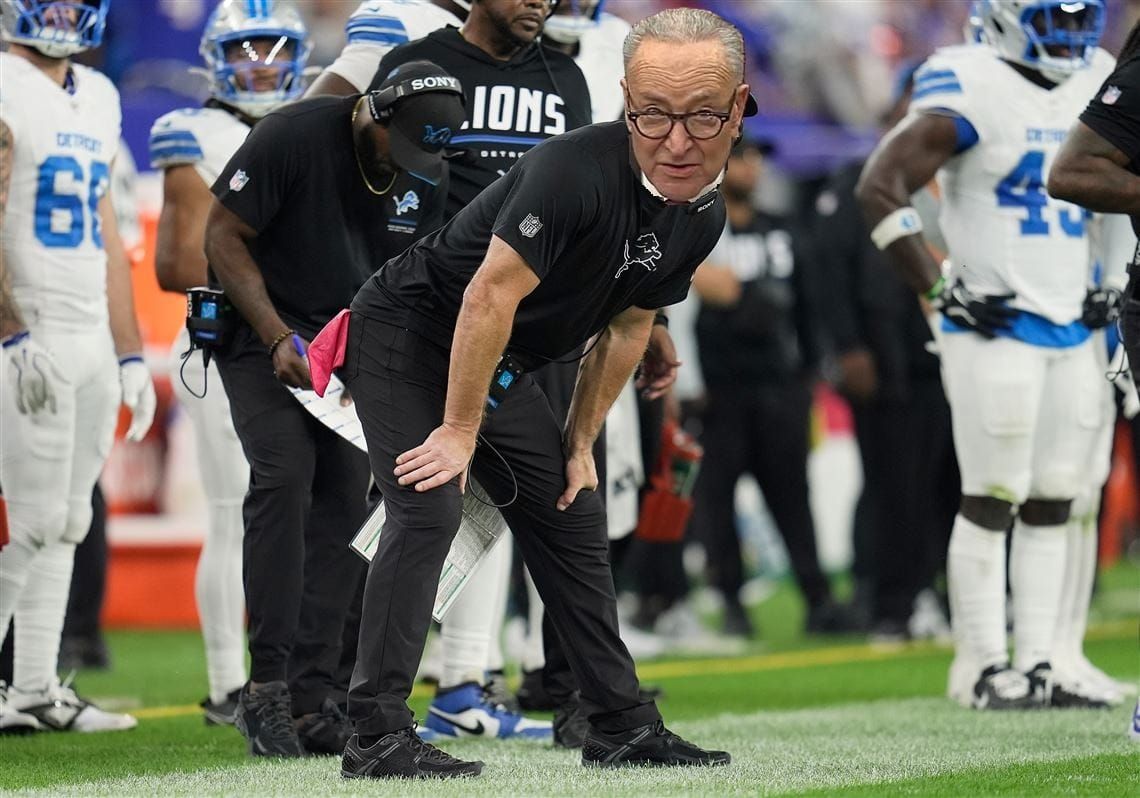
One thing that sometimes surprises people about me is that I am a sports-liker. A fan of sports, that is. To be more specific, I am a fan of all the Detroit teams in professional sports. It was something I was born into, and something I imprinted on in a formative way in my younger and more vulnerable years, and here we are. The Trammell / Gibson / Morris Tigers were champs when I was 9 years old. The Bad Boys were champs when I was 14 and 15. The Wings finally hoisted the Cup in my early 20s. And decade after decade, the Lions managed to suck rotten turkey legs, even with the greatest running back of all time on the roster. These were my formative years. A legacy of championships, championships, championships ... and crushing, endless, loserdom.
Yes, I'm a fan of the Detroit Lions, which is a shameful admission on a couple of levels. First, the NFL, as an organization is problematic to say the least. Second, the Detroit Lions, until recently, have been a real sad sack of an organization. We even went entirely winless one season, which at the time (the long-ago age of 2008) had never been done before. It was a sort of perfection in a way, and, as it was the only sort of perfection we as Lions fans had been conditioned to receive, many of us wore it as a badge of pride. Then we got this new coach, and he believed in winning, and in going for it, and in sticking with the team you have, and fighting every game, every drive, every down. And that has transformed the organization. We've had our disappointments and frustrations, yes. There have been tough losses. There have been some questionable calls. We're no longer the sad sack squad, though. We're the gang that Goes For It. They'll be playing today, the Lions of Detroit, hosting the Buccaneers of Tampa Bay. Maybe they'll lose. Maybe they'll win. Maybe they'll tie. Maybe it will rain. These are the options I'm aware of. (If it rains, it won't matter. The Lions play in a dome.)
Here's a fun thing I've noticed: There exists an entire ecosystem of meta-industries that have sprung up around these silly yet violent football games where Lions battle Bengals and Bears and Bucs, oh my, and these industries seem geared around the notion of knowing what will happen in the game before it happens. Not sports institutions or even sports-liking institutions, exactly—sports-knowing institutions. We've got fantasy and betting and pundits, oh my.
Betting has been around the longest, I suppose, though these days it's really taken hold in mainstream life. Time was if you wanted to bet on a game outside of a friendly office pool or you had to go to Vegas and bet the house, or find a local bookie from whom you'd need to hide when your team didn't cover the spread, or whatever. But these days the gambling industry has gone online and big-time. You can see ads for FanDuel and DraftKings and the rest of them, on billboards and during commercial breaks and in stadiums and other sporting venues, and over a quarter of Americans, largely men, have an account. The proposition these sites offer you is that you personally are good at sports-knowing—that is, knowing what will happen before it happens. You are so good at sports-knowing, in fact, that you can beat the mathematical odds the betting institutions have racked up against you. Yes, and Americans legally bet nearly $167 billion on sports in 2025, which is a lot of money even if you're Elon Musk. This represents an 11% increase from 2024. The industry realized $16.96 billion in revenue, too, which came right out of the pockets of everyday Americans, so it would seem that most people are less good at sports-knowing than they might otherwise think. There are horror stories about this, because gambling addiction is a known disease, and the gambling industry is there to profit from people's fantasies of scoring big from their excellence at sports-knowing. This is precisely the sort of thing you might expect to see in a society that values profits over people.
Speaking of fantasies, lots of grown folks (mostly men), spend a lot of their time fantasizing about being NFL general managers, which involves pretend-drafting different real players into pretend teams and then starting this player or that one, and then after the game these pretend GMs receive points based on the actual results of the real players. I've done a very little of this sort of stuff (back in 2008, I did an online NHL invitational league one year through Yahoo.com's in-site service; I named my team "Ľubomír Will Crush You" and then started Oilers defenseman Ľubomír Višňovský and nobody else; I was kicked out of the league for deliberate tanking and not taking NHL fantasy seriously enough, which is certainly fair enough; I changed my team name to "Nobody Loves Ľubomír " and my fantasy career ignominiously ended), but the fun appears to derive from the camaraderie that comes with a social league, adding an easily accessible built in topic of conversation among friends, and probably the enjoyment of data crunching (we sickos who enjoy spreadsheets are out there), to say nothing of the thrill have having your analysis proved correct by actual events. If you're good at sports-knowing, the proof will be in the pudding—which is everyone's favorite place to keep proof.
The industry that is most directly tied to sports-knowing, though, is punditry. I don't mean the commentators. These are the guys who announce the game, mostly in rich, mellifluous, garrulous voices (and also Tom Brady). Their job is either to tell you what is happening, which means they are play-by-play people, or else to tell you what it all means or to provide a hopefully interesting story hopefully related to what is happening, which means they are color commentary people. And I don't mean the sideline reporters, whose job is mostly to annoy the coaches about the things that just happened with questions like "You haven't scored as many points as the other team so far. Is that a concern for you?" No, no, I mean the pundits.
You've seen these guys (they're mostly guys). These are the professional sports-knowers. They're focused not so much on what did happen but on what will happen. They are mostly shout guys, and they have booming or shrill shouty yell-voices, and they pronounce with a high degree of confidence what is going to happen next week, or for the rest of the season, or in the playoffs, or who is or is not going to make the playoffs, or who is or is not going to win the championship this year, or even next year. Confidence is the big thing for them. They are sports-knowers. They know. When they're right, which does happen sometimes, they puff out their chests and bray the excellence of their sports-knowing. When they're wrong, which happens at least as often, they endure a good-natured ribbing from their fellow sports-knowers, and then get right back to sports-knowing in a professional capacity with a superhuman level of confidence.
This is all fun and games, and I guess I don't begrudge anyone who enjoys it. Sports-knowing rubs me the wrong way, though. One thing I've noticed about the sports-knowers is that what they think will happen almost always involves looking at the shape of what did happen and then carrying it unbroken forward into the future. Their imagination about what will happen is constrained mostly by what they have seen happen. This is reasonable enough, I guess. A team that has won most of its games so far is probably a pretty good team and probably has a better chance of going to the playoffs or even winning a championship than does a team that has lost most of its games. But still, something about it rankles. Maybe it's the unearned nature of the confidence these sports-knowers have about what is going to happen, the way they get to just go on confidently saying shit even though they're wrong at least as often as they're right. Maybe it's the way I notice almost everyone talking about sports the exact same way, spouting their favorite sports-knower's lines as if they think they're having original thoughts. Maybe it's the way that this practice of sports-knowing seems to feed into this national trend of approaching the actual event itself at a metatextual remove, a way of establishing oneself as an insider, a knower-of-things, to such a degree that the outcome itself is known already, to such a degree that many people often seem to be offended and upset when something surprising and unexpected happens in the actual game—which ought to be the fun part, in my opinion.
I think that's the big issue I have. It puts everything at a remove. It makes already knowing what is going to happen more important than experiencing what is happening. Imagine if the players and coaches approached the games that way. Imagine a team that didn't even try to run the ball because they had been told they didn't have a run game. Or imagine a sports team that constantly lost until, like its fan base, it stopped hoping for success or even trying. Imagine they didn't even bother to field a team because the loss was already decided. What if they stopped imagining the future and only lived inside the past, created an imaginary rulebook inside their heads based on those outcomes? What if they decided that they would only play the winnable games?
I'm a sports-liker but I'm not a sports-knower, so I have no idea what's going to happen in today's games. I have guesses, but I always have guesses, and those guesses are often wrong. What I do know is that surprising things happen all the time. Unforeseen outcomes, unbelievable plays, unexpected winning streaks. An unknown player rises from obscurity and shocks the world. A wild-card team catches fire at the right time and brings down an undefeated behemoth. The underdog defeats the powerhouse. The fighter with a puncher's chance catches the champ right on the button. All the knowledge of all the sports-knowers is confounded on a weekly basis, which makes all this pageantry of sports-knowing seem sort of gross and worthless. A part of me wishes we'd just play the games. That's the fun part to me, a confessed sports-liker.
I'm probably making too much of this. It's only football. We might question if the sport should even continue to exist as it presently is. We might decide it shouldn't.
These side industries aren't unique to football, though. They aren't actually even unique to sports. You can gamble on anything these days, including the outcomes of democratic elections, or whether or not a war will be started tomorrow or next week, here or there or anywhere. And you certainly can fantasize that you know things you don't know. Can you bet on how people will bet? Can you bet on how people will bet people will bet? Did I just describe the stock market? And everywhere I look, I know people who are pundits or pretending to be pundits, professional future-knowers who all spout strangely similar lines about what they know will happen, predictions whose imaginations are constrained mostly by what has happened so far, even though we all know that things that have never happened before happen all the time.
This brings me to Chuck Schumer and his imaginary friends.
It's not the end of the essay! It's only a quick reminder that The Reframe is me, A.R. Moxon, an independent writer. Some readers voluntarily support my work with a paid subscription. They pay what they want—as little as $1 a month, which is more than the nothing they have to pay. It really helps.
If you'd like to be a patron of my work, there's a Founding Member level that comes with a free signed copy of one of my books and thanks by name in the acknowledgement section of any book I publish while you are a subscriber.
Charles "Entertainment" Schumer is the current Senate Minority Leader for the Democratic party, which a position he's surely earned. He's been Majority Leader before, too, enjoying a brief stint during the Biden administration which ended when the American Nazi Party known as Republican wiped his party largely off the board, in large part because his party had spent a lot of time on incremental gain and not much time on bringing the American Nazi Party to account.
At the time the professional politics-knowers told us that this wipeout was a permanent thing. We were told it was a vibe-shift. We were told to prepare for a nationwide conservative thousand-year Reich. We were told that it was time to give way on "social issues," which largely meant that we needed to abandon the people that conservatives were targeting with most of their rhetorical venom and actual abuse. We were told to tamp down our desire for a diverse, pluralistic, free and open society, and start to get a bit less aware and less convicted about matters of justic, in order to gain the support of people who wanted some aspects of a white christian nationalist ethostate ruled over by an authoritarian cult.
This was the idea, per the professional politics-knowers. We had lost because freedom and fairness and diversity and equality were losers. Fascists had won because people were afraid of all those things, and the fascists had successfully played into those fears. We were going to have to win by successfully playing into those fears, and not wanting freedom and fairness and diversity so much.
These were the same professional politics-knowers, by the way, who had smugly assured us that Donald Trump could never win the presidency, because such things simply didn't happen. Why, Trump would have to completely take over the Republican Party, and that sort of thing just doesn't happen, either. The politics-knowers were clear: Things are the way they are. Things will be the way they were. These are the rules. You can't win by getting caught in lies, or sex scandals, because those sorts of things have always sunk campaigns before. You can't win if you simply refuse to release your tax returns, because nobody ever has before. It turns out these were imaginary rules, but professional politics-knowers couldn't imagine anything else until it happened. Now they tell us that bringing accountability for being manifestly corrupt, manifestly a serial rapist, manifestly a liar, is just something that can't happen. A distraction. A losing battle.
Before Trump, these politics-knowers told us that America wasn't ready for a Black president, and that nobody named Barrack could win that office—a losing battle. They told us the Iraq War would be over in a matter of months—a winning battle. They told us the banks were too big to fail and bailouts were inevitable and absolutely necessary, that brining accountability for the people who mugged America as a losing battle. They told us Americans would never accept gay marriage—a losing battle. They told us many things, too, and some of them were right, but more often than not the thing that couldn't be suddenly was, mostly because it turns out that a lot of people don't pay attention to what professional thing-knowers already know is or isn't possible, and just play the damn game.
In recent days these same politics-knowers told us that no socialist could ever become Mayor of New York City—a losing battle. Then they told us he could never drive the results that he's driven rather easily Then when it happened they told us that it could never happen in the Midwest; they told us that unhinged party-jumper Haley Stevens was the safe choice, because nobody named Abdul could win a Senate seat—not in purple Michigan (losing battle). They told us that trans rights were a losing issue. They told us that universal healthcare was a losing issue. They told us many things, and most of them were proved wrong, and now that they have been proved wrong, they are telling us that they knew it all along, and these outcomes, which they did not predict, prove that they were right and that we should listen to them some more. And what do they most want us to know? That while progressive candidates, who they insisted could not win in Trump districts, may have won in Trump districts, nevertheless the biggest mistake Democrats could now make is to give voters—who just voted for progressive change—too much progressive change. We mustn't go too far, we're told. Going too far is a losing battle. And a lot of people out there are playing fantasy pundit, repeating the same old lines that everyone knows.
According to many politics-knowers both professional and amateur, the lesson of a transformative wave election is that voters want more of the same, and more of the same leaders to deliver it. Arms across the aisle. Bipartisan solutions. Working with the other side. More corporate money in politics. Not so much divisive accountability.
Is that what voters want? I don't know. I'm not a professional politics-knower. I don't pretend to be an oracle whose proclamations about future events are so determinative as to make those events inevitable. It doesn't seem likely to me, though. It seems to me that voters who deliver transformative results are usually signaling that they want transformative change.
And these are largely the same professional politics-knowers who now tell us that Chuck Schumer has to be the Senate Majority Leader—that it is inevitable that he should hold that role, because the outcome of the vote is a done deal—so completely predetermined that we ought not to even worry ourselves about it. Any attempt to unseat him would be a losing battle. We're also told that the role isn't that important anyway, mostly administrative, mostly functionary. That's interesting, since most of the same people who say the role isn't all that important also seem to treat it as of utmost importance that the role go to Schumer. We're told that Schumer knows how things are run, which may be true, but I also know that the Senate decides how the Senate is run ... so there seems to be a tail connected to an awfully waggy dog there. Most of all we're told that Schumer knows how to focus on the winnable battles, which is all well and good, though I will note that we only win the battles we fight, and winning wars often involves actually fighting the losing battles rather than ceding them unfought to the enemy.
Will Schumer become Senate Majority Leader? I don't know. I'm not a professional politics-knower. I don't pretend to be an oracle whose proclamations about future events are so determinative as to make those events inevitable. He might become Senate Majority Leader. It certainly seems possible, maybe even likely. They said the same thing about Hakeem Jeffries becoming the Speaker of the House, and they were right about that one. They tell us Jeffries is going to pursue the things that voters want. He never has before, when he had less power. Maybe he will this time, when he has more power. Do people tend to change when they are rewarded with more power? I guess we'll see!
Here's something I know about Chuck Schumer. He's a bit of a fantasy GM himself. Per his staff and his colleagues and his own autobiography, he likes to base his decisions on what the Baileys do.
Who are the Baileys, you ask? They're a family in Staten Island. A conservative family in Staten Island, or at least they usually have voted for Republicans. Or they would have voted for Republicans, if they were real.
That's right, the Baileys are not just a conservative family, they are an imaginary conservative family. They live inside Chuck Schumer's head. He made them up. He invented a family of people who believe different than he says he believes, and he uses them to justify the decisions he makes. Does he base the Baileys on what he actually hears from actual voters? I hope so. Does he base the Baileys on actual data? I hope so. I have to say, based on the sorts of political positions he holds, he doesn't seem to. The things that he has spent his career blocking and slow-walking are not only desperately needed, but often hugely popular. Is he a conservative? I think he'll tell you "no." He'll also tell you that he made up a conservative family that tells him what to do, and he does it.
I'll tell you one other thing I know about Chuck Schumer. He doesn't strike me as being a leader, no matter how inevitable his Leader-ship may be.
Giving your decisions over to the Baileys is not being a leader. That's being a fantasy leader.
And a lot of us are like that, too.
Or don't subscribe. I'm not the boss of you. But if you do subscribe, you get one of these essays pretty much every week.
I don’t really trust people who say various outcomes are inevitable so everyone should just shut up and get over it. Or that those who expect better outcomes rather than worse outcomes are not to be trusted and should shut up. Or who insist that the shape of what has come before must determine the shape of things to come.
I feel like these are people who would rather we don't even play the games.
It makes me wonder why, exactly. Feels to me it's because if the game isn't played then you don't have to risk losing. Far better, if you don't want change to happen, to simply nod to what everyone knows, which is that you won't win because you haven't won. It's an away game, after all. Those are harder to win. That team has a great player. Don't you wish you had that great player? No way that great player can lose. They have a lot of fans. Wouldn't those fans like you better if you just let their team win? Maybe that would get them over to your side. Don't you want to focus on the winnable battles? Isn't that the responsible thing?
There are so many Baileys floating around in people's heads. There are so many people who are fantasy owners of their own god damned lives, following imaginary rulebooks they pretend somebody else wrote for them. They'll tell you that they want universal healthcare, sustainable energy, national public transportation, a diverse pluralistic modern society, but unfortunately it's not popular, so they support some weaker strain, some pre-loaded failure; something incremental, something hesitant, a retreat, a half-measure, a holding action for some more favorable time, and, as a treat, just a bit of racism or sexism ... not for their own comfort, no, just for the imaginary conservative family that they invented and invited inside their heads, these other people who don't even exist, but just won't come aboard unless their bigotries are pacified.
These are people who won't even suit up for the game, because they're worried they'll lose. To me that's the ultimate alignment with supremacy; to be so focused on being consistently correct ahead of time that the thought of losing is a mortal fear, that even a chance of a setback must be avoided at all costs. To have tried for something and fallen short is a loss, after all; it puts you in a vulnerable position, it establishes you as a non-knower of things, a not-insider. Far less vulnerable, far safer, far more protective to your own sense of rightness to simply declare that that the battle before you is a battle that was doomed to lose, so you have simply abdicated, chosen only the votes guaranteed a win, chosen only to fight the winnable battles.
I think we should get out there and play the game. Don't give somebody else your jersey. Put it on. Play your game, not somebody else's. Want what you want, not what you think somebody else wants. Believe what you believe, not what you imagine somebody else believes. Risk the loss, so you can find the unexpected win. Risk being a loser, so you can learn how to be a winner. Refight the ones we lose. Learn and grow and fight that battle better next time. Let people see that you can imagine something better than has been, so that they can imagine it, too.
Who told us that we ought to keep our powder dry? Is there a powder shortage? is a war won by the side who ends the conflict with the driest powder?
Who told us to fight the winnable battles? What sort of record do you think a team would have, if they only played the games they were supposed to win?
Who told us to let other people decide whether we should fight the battle before us? Fight the battle before us. Fight every battle before us.
Do it because it is the battle before us, not because we have decided it is winnable.
And then, someday, when the clock has run out, look up and look around.
I can't tell you what the score will be.
But I know the organization will be transformed.
The Reframe is totally free, supported voluntarily by its readership.
If you liked what you read, and only if you can afford to, please consider becoming a paid sponsor for as little as $1/month. If you'd like to be a patron of my work, there's a Founding Member level that comes with a free signed copy of one of my books, and thanks by name in the acknowledgement section of any book I publish while you are a member.
Looking for a tip jar but don't want to subscribe?
Venmo is here and Paypal is here.
A.R. Moxon is the author of the novel The Revisionaries (2019) and the essay collections Very Fine People (2024) and Fighting in the Dark (2026), which are available in most of the usual places, and some of the unusual places. You can get his books right here for example. It's his soul, it's his soul, it's his soul people, it's his soul.

Comments ()