
Apologies For Being White
How supremacists convert responsibility into blame to avoid paying natural costs and to make everyone else pay unnatural ones.
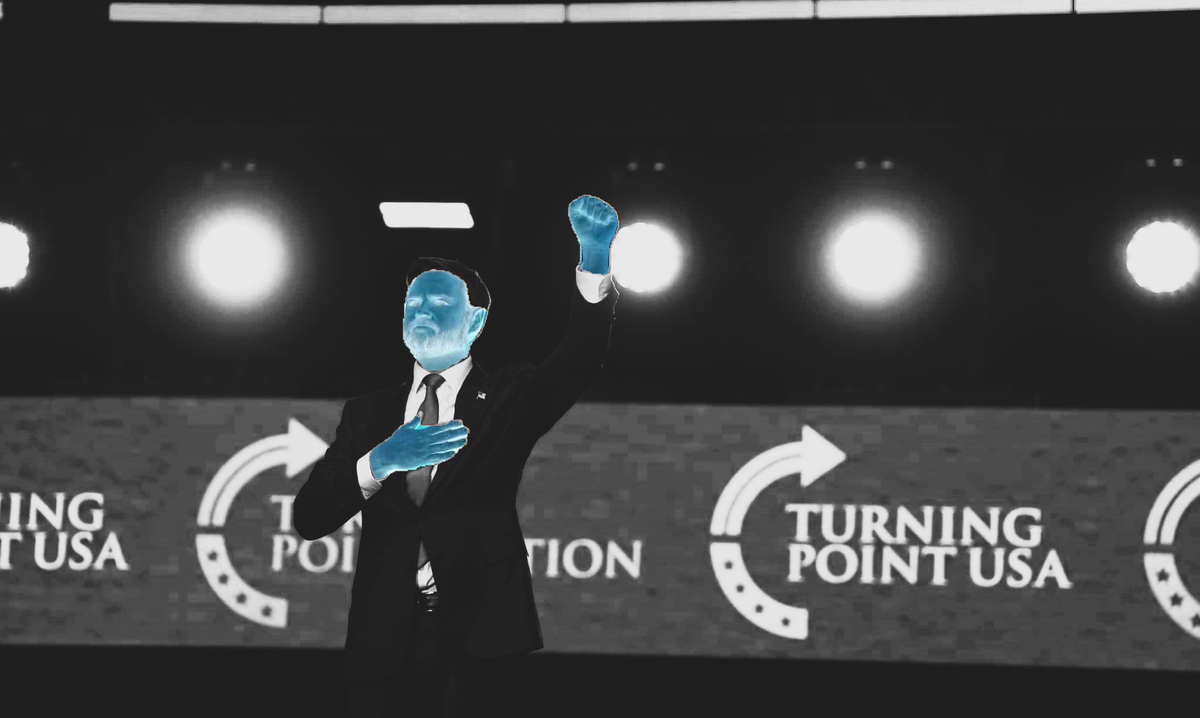
American Vice President JD Vance took to the stage at Turning Point USA a few weeks ago and said an extraordinary thing that brought the crowd to their feet in rapturous applause.
"Unlike the left ... we don't treat anyone different [sic] because of their race or their sex. So we have relegated DEI to the dustbin of history, which is exactly where it belongs. In the United States of America, you don't have to apologize for being white anymore."
You might find this an extraordinary thing to say because JD Vance's Republican Party has actually been cruelly and energetically persecuting millions of people because of their race and their sex, and because of their gender and religion, and for their beliefs, and for their speech and any number of other things. Or you might find it extraordinary to suggest that "relegating diversity, equity, and inclusion to the dustbin of history" promotes equality and fairness. Or you might find the venue extraordinary, since Turning Point USA is a white supremacist hate organization, one that masquerades as a free speech organization even though it maintains a list of professors and targets them for suppression based on their speech.
All of these aspects are interesting in their own way, but we've been talking about a cult(ure) of abuse, and the people who enact that abuse in order to gain perceived advantages, and the people who enable it, so while we might still be shocked, we may not be terribly surprised to find abusers promoting frameworks that cast them as simultaneously the heroes and the victims in the national story of the abuses they are enacting, or demanding others accept their story, or even to learn that others are accommodating the demand.
What I find truly extraordinary today is this claim that now, in the U.S.A. thanks to Republicans, you don't have to apologize for being white anymore.
It's a statement worth dissecting.
You is interesting, because it suggests that the VP is speaking exclusively to Republicans deemed "white." This was known already to anyone paying attention, but it's good to note that we are addressing specifically people for whom whiteness is core to identity.
Have to is interesting, because it suggests that there is some sort of threat behind the expectation. These people of whiteness ... it seems they were being forced into this apology by some greater power. They've been forced to apologize, apparently from a powerless position, apparently by the existence in our culture of diversity, equity, and inclusion. There is another implication, slightly more submerged; a tacit acknowledgement that—like most forced apologies—they weren't ever sorry.
Anymore is interesting, because it suggests that this is an oppression that has been overcome, a victory of justice and equality achieved for white people. Oppressed by untold decades of brutal apologizing to their marginalized overlords, forced upon them only because of the color of their skin. Now they are free at last, free at last, thank God Almighty, they are free at last to never have to apologize to anyone ever again. Apology was apparently the sole remaining obstacle to racial equality, and now it has been achieved, and there is no better place to celebrate it than the stages of Turning Point USA.
All of these are interesting.
But apologize ... apologize is extraordinary.
It suggests that white conservatives have apparently been apologizing.
This blows me away, because I honestly don't remember American conservatives apologizing very much, if ever. In fact, apology seems to be antithetical to the conservative project. Over the years, I remember books from conservative presidential candidates called "No Apology" and slogans like "I will never apologize for America" and stuff like that. I remember a lot of talk about apologizing being weakness. Their leader, who has a lot to apologize for, certainly isn't big on apologizing. Nor have I ever heard anyone say that anyone white had to apologize for being white. But "your skin is white, and you should apologize for it" is apparently a common demand.
It was time to investigate.
I went to a place where people who have made whiteness core to their identities gather. I went back to my old neighborhood, Twitter (or X, as it has been dubbed ever since it was purchased by a preposterously wealthy Nazi sympathizer whose AI is apparently popular for generating sexual abuse material, including child sex abuse material). Once there, I generally mused over what the most recent time was that white people were forced to apologize for being white, and who made them do it, and how the apology had been forced from them.
My friends, the whites of Twitter did not not like this question.
A decent number of them were scornful that I would take Vance at the clear meaning of his words, rather than understanding what was, to them, the clear figurative meaning ... but when I followed up by asking if they could tell me what the figurative meaning of "you don't have to apologize for being white anymore" was, they became less forthcoming.
Still, many actually did give me examples of what had forced them to apologize for being white. The answers came in 3 main categories.
1 - Public awareness of our inheritance of past abuse - these are things like land acknowledgements, removal of monuments to traitorous white slavers, and Black history—tales of Black people surviving and overcoming the white history of slavery, marginalization, and oppression, and the effects of that oppression. Basic historical truths of that nature.
2 - Awareness of the ways this inheritance now expresses itself in current abuse - the main culprit here appears to be on-the-job diversity and sensitivity trainings, but also coursework at every level of education, whether scientific, anthropological, philosophical, or journalistic, and anything involving academic study or public acknowledgement that there still exist systemic privileges granted to those deemed white, and systemic disadvantages to those not so deemed. Again, basic truths.
3 - Awareness of the existence of marginalized people - this seemed to be the most offensive thing of all. Think of trans people in spaces that they felt ought to be reserved for cis people. Think pronouns in social media bios. Think immigrant communities. Think representation of Black people and queer people in popular media, or in academia, or in publishing, or just in jobs.
None of these stories of apologizing for being white actually involved any actual apology for being white, by the way. The very act of bringing awareness to what whiteness does was deemed a de facto apology for whiteness. The act of acceptance and inclusion of other ways of being and living was deemed a de facto apology for whiteness. And these apologies were consistently viewed as an attack—an obvious attack. There was a lot of anger on the part of Twitter whites, that this wasn't abundantly obvious to me that the apology wasn't being done by them, but to them. As they seemed to see it, this was being done mostly by other white people, who (as they appeared to see it) were permitting this awareness and inclusion to occur as a performance, in order to avoid taking their own share of the totally unfair application of blame coming from agitating non-whites.
Seemingly, it wasn't a demand for apology that offended them, but rather the renegotiation of blame. Indeed, everything appeared to be mediated through the lens of blame—who was at fault, who was not.
And, since we've been pondering what to do about a cult of abuse, and a culture that accommodates that cult, and what our responsibility is to stop it, this makes me think of how abusers operate—which is to convert responsibility into blame, and to mask their abuse underneath some finer quality.
Let's go to an illustrative scenario I've been using for the last month.
Your father is choking your brother. What do you do?
Quick interruption time. The Reframe is me, A.R. Moxon, an independent writer. Some readers voluntarily support my work with a paid subscription. They pay what they want—as little as $1/month, which is more than the nothing they have to pay. It really helps.
If you'd like to be a patron of my work, there's a Founding Member level that comes with a free signed copy of one of my books and thanks by name in the acknowledgement section of my upcoming book.
Say you confront your father about his tendency to choke your brother.
And say he says he's sorry, but afterward he keeps choking your brother. You'd have to conclude that the apology wasn't sincere; was, in fact, just a way of extending his license to enact abuse. You might even note that he apologized to you, not to your brother.
Say you next publicly expose your father's tendency to choke your brother, and others begin to express their belief that your father—despite being careful to aver that he is an awfully good guy otherwise—ought not to do that. And maybe your brother's story would lead to other stories coming out, of other fathers who choke, of societies that teach the virtue of choking sons, and perhaps other brothers would talk about the trauma that choking caused them, or of brothers who died from being choked. And perhaps a new story would begin to form, about how choking is harmful and abusive, and fathers who engage in that behavior ought not do so. Maybe some fathers who choke might even start to contend with their own inheritance of trauma and abuse.
Imagine now that your father responds by saying, "forgive me for being a father." You might recognize that this isn't an apology. Or imagine your father begins to complain, "you're not allowed to discipline your own children anymore." You'd have to conclude that your father equates his identity as a father to abusive behavior, and abusive behavior to discipline, and he expects you to do so as well. And you would have to conclude that not only is he not sorry, he intends to go on abusing your brother however he still can, even if, because of changing social pressure, he no longer feels as free to choke him.
Now imagine your father found people willing to advocate for his position, and admonish you for causing so much trouble and familial division around questions of who choked who. You would then be tempted or compelled to use time and energies that might be used more productively on healing, instead explaining why your opposition to your father's abuse does not mean that you are opposed to family togetherness, or discipline, or fatherhood, and you'd have to explain that exposing your father's abuse is not an attack on family, or discipline, or fatherhood. If enough people listened to these advocates, and joined with them, your father might feel empowered to begin choking your brother again.
And, as his fingers close around your brother's neck, he might even say "At last you don't have to apologize for being a father anymore," even though he was never asked to apologize for that, and in fact he never apologized for anything.
Yes, and he might even believe it, too. So much for the intrinsic virtues of belief.
⚬──────────✧──────────⚬
We live in a society—a natural human system. Natural because it exists in the natural world. Human because it is inherited by humans from other humans, and maintained and improved by humans while they have it.
The inheritance is a natural value.
The cost and labor of maintenance and improvement involve natural costs. We all pay these costs in a healthy human system.
Abuse is a brokenness in the world. If the abuse is personal, it speaks to a personal brokenness. If it is systemic, it speaks to systemic brokenness. Abuse is a misuse of power, of using the power to enact violence to steal natural inheritances for oneself and make all others unnaturally pay all costs, including the cost of brokenness, and especially the blame for brokenness.
Abuse is an unnatural cost and results in unnatural inheritance.
Awareness of brokenness carries a conviction to repair it, and pay the costs of reparation. If the abuse is personal, then the work of repair and the cost of payment is personal. If systemic, then it is systemic. This conviction conveys a responsibility to repair, and the responsibility for reparations falls most to those with the power to enact that repair. If the brokenness has a cause, then the responsibility falls most to those involved in the cause or those who most benefit from it, and least to those to whom it was done, and who most suffer from it.
These reparations are the natural costs of brokenness.
Because of this, supremacists stand against all repair. Supremacy is the belief that only some people matter, and that all others don't; that those who matter should gain all of society's value, and inherit it blamelessly with interest compounded, and those who are deemed not to matter should bear all of society's costs, and inherit all brokenness with interest compounded, beginning with the blame for the theft and the brokenness it causes. Being deemed to be one of the people who matter is what whiteness is, in case you didn't know. That's what people who rely upon whiteness for their identity are defending. Whiteness means not having to apologize for anything; it means being the presumed good guy no matter what you do; it means the license to escalate violent punishment on anyone who refuses to see you as such; it means making everyone else pay any cost of blame for any brokenness that arises from systemic cultural abuses.
This makes the lens of blame of utmost importance to an abusive person.
These are pretty obvious things to say. Those who want to say something else know they have to obscure their meaning, which is why I have spent so much time focused on clear meaning.
⚬──────────✧──────────⚬
If you tell somebody that they've hurt you, they tend to apologize for the hurt they caused, and then change their behavior to not hurt you again, if the hurt was not intended, and the person is not an abusive type. With an abusive type it's a bit different. With an abusive type the point of the interaction is not to prevent harm coming to you, but to avoid responsibility for harm, and prevent blame coming to them.
"So now I'm not allowed to talk," is something you might hear. "I won't ever speak again, then."
"Oh well forgive me for taking up space," is something you might hear. "Forgive me for living."
"Oh sure, I'm always the bad guy," is something you might hear. "After all I've done for you."
These responses sometimes carry the structure of apology, and they speak to expression and goodness and kindness and self-sacrifice, but perhaps you've noticed they don't actually contain any actual apology, and they don't actually contain any of those other good qualities, either. Something else is being smuggled into the container, and you are expected to swallow it right off the spoon. For the crime of exposing abuse to the abuser, you are being told to defend yourself as an attacker, an offender, an enemy of expression, an accuser of the innocent, an excluder and shamer and shunner, an inciter of violence, somebody who is indifferent to or even contemptuous of any good quality the abuser might possess.
What I'd like you to notice is how deftly the appeal to good qualities converts the discussion from the offense of actual abuse at hand to a defense of some goodness, and reframes the outer edge of possible remediation not to the work of reparation but to an unwillingly and unfairly extracted apology.
I'd like you to notice how deftly appealing to good qualities converts a natural responsibility to unnatural blame; how it reframes natural awareness and conviction and reparation into unnatural abuses, and how it reframes actual abuses into a natural right enacted for a common good.
By way of illustration, CBS recently appointed a fascist-friendly propagandist named Bari Weiss to run their news division. And Weiss recently spiked a 60 Minutes story about the ethnic cleansing concentration camps we're running, and the torture and murder and other abuses that happen there. Her rationale was that we hadn't got the side of the government officials that were enacting this national ethnic cleansing project. The government's position hadn't been secured, not because the government wasn't asked, but because the government had declined to comment when asked. So the failure of transparency on the part of the government was converted into a failure of diligence on the part of the journalists, and awareness of abuse was suppressed in a shocking act of journalistic abuse performed in the name of journalistic ethics. Yes, and CBS News just tossed its journalistic ethics handbook, in favor of a 5-point mission statement, number 4 of which is "We love America. And we make no apologies for saying so."
So there's apology again. What a world.
Apparently there have been demands that CBS News apologize for loving America. Had you heard? I hadn't. I think that, as a news organization, CBS News had been expected to tell the truth about what America is doing. Speaking of America, this morning I see that it just launched an unprovoked military attack on oil-rich Venezuela and appears to have kidnapped its elected leader, which quite frankly is very traditional American behavior. We might tell the truth about that, especially if we are a news organization, and saying so does not put us in opposition to love.
I'd like you to notice how the idea of apology—which is the suggestion of blame—appears to be the greatest offense imaginable to those who depend on abuse for identity.
I'd like you to notice how, when it comes to people who are actually being abused, the problem at hand is not their complaint are being forced to apologize by less powerful people, but rather the reality that they are being abused by more powerful people.
Or don't subscribe. I'm not the boss of you. But if you do subscribe, you get one of these essays pretty much every week.
Maybe you've noticed that what is being asked of Black people and queer people and immigrants of color these days isn't an apology. They're being asked, "do you belong here?" with the clear implication, "no you don't." The bribed far-right members of the Supreme Court of the United States just declared that if you aren't white it's reasonable to be stopped and harassed by lawless squads of kidnapping goons. And the temporary president loves to talk about "Black jobs," which presupposes jobs that aren't for Black people. And so on.
No, Black people and queer people and immigrants of color aren't asked to apologize for their identities in our culture of abuse. Any apology they might have offered for their identities has already been rejected by white supremacists due to the offense of their existence. Because of their unforgiven identities, they have to prove that they deserve to live—to walk down this street, live in this house, have this job, use this bathroom, receive this medical care or this social aid, speak this language, wear these clothes, worship in this building, play this sport, be a citizen, be a voter, be around children, be around students, be around period—and they have to prove it every day, to authority, and to power, and also to whatever random white person is wondering what you're doing in front of their house or in their grocery parking lot, and if the day comes they can't adequately prove their right to exist to authority or to power or to a random white person, then they can be disenfranchised, denaturalized, fired, expunged, harassed, terrorized, brutalized, kidnapped, imprisoned, tortured, killed, all in the name of justice and equality and fairness and safety.
And if you talk about this as abuse, or suggest that the abuses should stop, or if you even exist in public without permission, you'll be told—by the Vice President of the United States no less—that you and/or your ongoing existence are forcing white people to apologize—which is not something that has been asked nor something any of them are doing— for being white, and this alleged demand for apology will be positioned as the one and only remaining obstacle to a world of racial equality and justice that they themselves are bringing about, even as they crush equality and demolish justice on the basis of race.
Which is how a man like JD Vance, who espouses Nazi rhetoric and pursues Nazi tactics, can cast everyone else—and human diversity itself—as the enemy of equality and justice, and can cast his party's attempts to crush diversity, equity, and inclusion as an act that secures equality and justice. Swallow it right off the spoon.
I want to land on a few parting thoughts.
Takeaway 1 - It is very important to not take an abusive person at their word. This is very simple. Our national fascists are people who have equated even the best parts of their humanity with the enactment of systemic and often personal abuse. They are lying, and they should be presumed to be lying. They are lying about their intentions, and they are lying about their methods, and they are lying most of all in their rationales. A great many of them are even lying to themselves, but frankly until they are out of power the distinction isn't of particular interest to me. Just because they've hoodwinked themselves is no reason to join in.
Takeaway 2 - This makes it very important for us to put first things first. The question I've been working toward is "how do we stop a cult(ure) of abuse without becoming abusive ourselves?" I'm working toward it because I think it's a very important question, but I'm approaching with caution because it is precisely at this point that meaning has become obscured, and if we don't untangle the cords we won't know how they connect.
Earlier in this series I noted that our answer to a culture of abuse must be to stop the abuse that is happening now, which involves understanding who is hurting who, and what the power dynamic is.
This led me to wonder why I felt compelled to start with such an obvious statement, and my answer was that a culture of abuse has a habit of telling the abuser's story first, if not exclusively, which means that while it should be obvious to say that we must stop the abuse happening now, it is not obvious.
And this leads me to wonder about this habit. Why do so many of us, especially those who are benefitted by supremacy, so often tell the abuser's story?
I think it's because we don't put first things first and we take abusers at their word in the name of fine qualities like trust and unity. We don't notice who is hurting who and we don't notice the power dynamics, so we allow ourselves to join in the manufactured confusion over the facts of who has the control over the situation and what the harm actually is. We let people who have made abuse a part of their core identity define unnatural costs of blame and harm as natural, and natural ones as unnatural.
When we don't put first things first, and we take abusers at their word, we're very likely to take the abuser's frame, which keeps us in the abuser's picture. Ceding the frame will always lead us into inappropriate agreement with abusers. We're likely to agree that inclusion of others is a de facto provocation, that exposure of abuse is a de facto attack or an incitement. We're likely to focus on acknowledging and celebrating the abuser's claimed good motives without noticing they have no interest in promoting those good outcomes, and to cast those who do notice as being opposed to those good outcomes. We're more likely to approach the question of ending abuse not as an opportunity to repair, but as a danger to ourselves.
Moreover, if we fail to leave the abuser's frame, we're likely to view the entire project of ending abuse as a negotiation of blame, even if on the surface of our minds we oppose the abuse. You actually do get white people who apologize, you know—not for the abuses caused by whiteness, but simply for being white. It's a way of freezing the responsibility into blame, and expunging it by apologizing for an offense that was never the accusation. Encountering the reality of abuse, we respond by immediately centering it around ourselves and trying to repair, not the brokenness, but our own blamelessness. This sort of empty gesture never matures into doing the actual work of repair, and, because it exists within the abuser's supremacist frame, it bolsters the supremacist case that it is all merely shallow performance.
How do we stop a culture of abuse without becoming abusive ourselves? We start by refusing all aspects of the supremacist frame, including the urge to expunge our responsibility as guilt.
Takeaway 3 - Social pressure works. This is a simple practicality. It can't have escaped your attention that the thing that equated to "apologizing for America" in the minds of Twitter supremacists wasn't anything that they had done, but simple acts of awareness and conviction and repair and inclusion that other people had done. In their very objection, supremacists admit their great vulnerability.
Awareness and conviction and repair and inclusion hurt abuse, even if the abuser doesn't participate. This means we don't need the permission of abusers to get started at dismantling abuse.
How. About. That?
I gathered from the whites of Twitter that the worst offenders of vicarious apology are other white people and other men, which might be anticipated. Supremacy is systemic, which means it runs on systems. A primary way that supremacy structures its unnatural privileges of theft and unnatural costs of abuse is along lines of race and gender, which means the systems are more hard-pressed to abuse white people and men for opposing it (directly, anyway; they do abuse white people and men by dint of being oppressive people-abusing systems, but that's another essay), simply because they are systems set up to unnaturally privilege white people and men.
Whiteness carries certain disadvantages when it comes to awareness and conviction and repair and inclusion. Privilege makes the reality of abuse harder to detect, and it means that awareness and conviction and repair and inclusion carries a natural cost—the loss of supremacy's unnatural gains, that is—which can present, for many, an obstacle to overcome. On the other hand, whiteness unnaturally provides certain protections and privileges that can make the act of opposing whiteness safter, and the paying of natural costs easier.
Whiteness might be thought of as a sort of an armor to white supremacist systems.
Funny thing, armor. It protects you from the outside, but it's a real horror if something gets inside. Imagine putting a few bees through the visor and you'll catch my drift. Eventually the armor becomes an uncomfortable place to be. Eventually you might have to take it off. You'll lose the unnatural protection, so you might not be in as great a position to swing your sword. But you will be equal to those without, and maybe if you put the sword down you'll find that there's no real reason to live and die by it.
When other white people acknowledge the armor, drop the abuser's frame of blame, and take up the frame of responsibility to start paying natural costs of awareness, conviction, and repair, they create problems that abusers find harder to counter. It's not apologizing for the armor. It's recognizing that the armor exists, and then leveraging its natural weaknesses against those wearing it.
It's putting a bee inside the armor, which means a willing to take stings.
How to stop a culture of abuse without becoming abusive ourselves?
Here's a practical start: Be in the armor. But—bee in the armor.
The Reframe is totally free, supported voluntarily by its readership.
If you liked what you read, and only if you can afford to, please consider becoming a paid sponsor for as little as $1/month. If you'd like to be a patron of my work, there's a Founding Member level that comes with a free signed copy of one of my books and thanks by name in the acknowledgement section of any books I publish.
Looking for a tip jar but don't want to subscribe?
Venmo is here and Paypal is here.
A.R. Moxon is the author of the novel The Revisionaries and the essay collection Very Fine People, which are available in most of the usual places, and some of the unusual places. You can get his books right here for example. He is also co-writer of Sugar Maple, a musical fiction podcast from Osiris Media which goes in your ears. He is a prince, he has it all.

Comments ()