
Culture of Healing
Reparation, rehabilitation, redemption, reconciliation, restoration. A necessary taxonomy of healing in an age of unnecessary conversations.
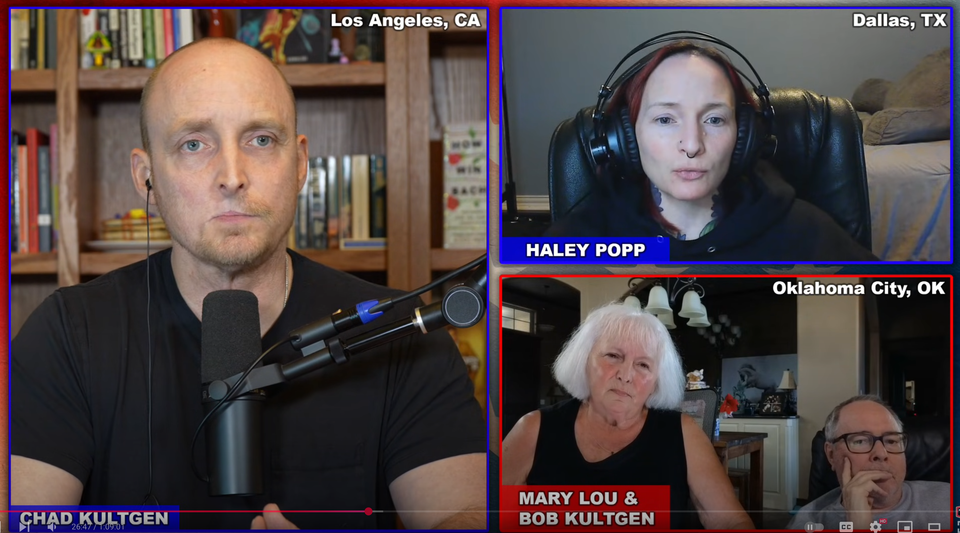
There's a popular-ish podcast out there, featuring a youngish man and his sister in what I suppose we can call "conversation" with their parents. The parents are in a fascist and political cult of bigoted abuse you may have heard of called MAGA. The man and his sister will ask the parents something, and the parents will reply with unfiltered self-satisfaction and unmitigated hatred and astonishing ignorance, which you might expect from members of a cult that worships the serial child-rapist and mass murderer who is the current temporary president of the Unites States of America. The children point out their parents' hypocrisies using reason, and try to correct the misinformation using facts, and counter their lies using truth, and nothing changes as far as I can tell, unless it's that the father digs in ever deeper. The son recently asked his father what should be done about people protesting the secret police who are kidnapping civilians in the U.S., and the father said that the protesters should all be murdered. What if I were among them, the son inquired. To this the father replied, without hesitation, that if the president decided to murder him—his own son—it would be well-deserved for the crime of opposing the temporary president. And so it goes. These adult children never lose their bemused expressions as their parents shower them with an eternal stream of the most astonishingly hateful invective, the most outré rationales, the most ignorant bigotry imaginable.
The podcast is called The Necessary Conversation. And I ask myself: Are these the necessary conversations? These conversations are necessary? What do they accomplish, these necessary conversations, other than racking up views and money? The idea, I think, is that we need to talk to these lost and hateful people in our lives, in order to find common ground and chart a path forward. I feel I now must take the risk of being perceived as an opponent of the finding of common ground or paths forward (which I am not), by pointing out that you won't find common ground with people who oppose finding it, or paths forward with people who are dedicated to moving backward, and the attempt to do so seems to convince abusive-minded people only that they will continue enjoying the privilege of normal relationships no matter how abusive they become in those relationships.
Let's not change the subject. The other day we all woke up to discover the temporary president started another war in the night—this one against Iran. He's already waging a war against his own country, the United States. His rationales for both wars are hateful horseshit. The actions are unconstitutional. The murderous results are deeply unpopular. Nothing's stopping him from doing it, though, because he is supported by that same cult of personality—MAGA—that loves abuses of power as long as the people abused first and hardest are perceived as being the ones the cult wants to see abused, even, it seems, if those people are their own children. They certainly can't be bothered about other people's children. The U.S. military bombed a girls' elementary school in Iran, murdering (at this writing) 51 Iranian kids and some dozens more.
I imagine somebody telling me those kids deserved it, and then I imagine somebody else smugly telling me the answer is to seek common ground with people who want to turn every bit of ground to rubble. This sort of thing strikes me as deeply sick and deeply sickening. It's alarming to say the least. A reasonable person might ask: what is the solution?
I've been contemplating a cult(ure) of abuse, and in so doing, I have reached some conclusions. The first conclusion is that when abuse is happening, the first thing is to stop the abuser from abusing, which means removing the ability to abuse—or the power to enact abuse—from the abuser. So the first solution in this situation, if we are to avoid the path of most violence, is to remove the temporary president and his party from power, using whatever levers are available, until none from that party remain in power, and then enforce the rules already in place that state that insurrectionists who wage war against the United States and try to demolish the government of the United States in order to subjugate and enslave the population of the United States are not allowed to participate in the government of the United States, and then bar all of them from government forever—this, before starting the investigations and trials and verdicts and sentences.
You might ask: how the hell does that happen? I think that's a good question. I will confess to you that I am a bit of an idiot, so I don't know. However, I do know that if we actually pursue that question in earnest good faith rather than pose it in a bad-faith attempt to shut the question down, it would lead to necessary conversations that could well lead to the answer. For now I'll just point out that it is what needs to happen, and, since it needs to happen, we might need as many people as possible to agree on the necessity of it if we're going to figure it out, so if you are a person, one thing you can do is agree on the necessity and then find a little corner of it to work on, and if we all do that, then we might get there, but if we don't, we certainly won't.
My second conclusion is that when abuse is happening, we must not tell the abuser's story of the abuse, which means focusing on telling the story of those abused. So the next solution is to remove from power the enablers: those who insist on telling the abuser's stories for them, who insist on finding abusive rationales understandable and reasonable, who sacrifice victims in order to make common cause with abusers, who insist on lending the visage of respectability and civility to those whose behavior is uncivil and unrespectable by continually playing the cooperation game with those who are playing the murder game. And that means that a lot of Democrats in power, who join the cult(ure) of abuse by refusing to oppose it, will need to lose their jobs, too, by whatever levers are available, and replaced with people who will tell the right story and be guided by it.
Again you might ask: how the hell does that happen? I think that's a good question. I will confess to you one again that I am a bit of an idiot, so I don't know. However, I do know that if we actually pursue that question in earnest good faith rather than pose it in a bad-faith attempt to shut the question down, it would lead to necessary conversations that could well lead to the answer. For now I'll just point out that it is what needs to happen, and, since it needs to happen, we might need as many people as possible to agree on the necessity of it if we're going to figure it out, so if you are a person, one thing you can do is agree on the necessity and then find a little corner of it to work on, and if we all do that, then we might get there, but if we don't, we certainly won't.
The third conclusion is that we must focus on building paths of liberation for all, rather than exclusive paths of an empty exoneration we call "redemption" for abusers, and that doing this will depend on working upon ourselves first and upon the world around us second, and will have to carry out this work without permission or help from those who have tied their identities and fortune to abusiveness, who are therefore opposed to all liberation. If what we manage to build is liberative, it will be liberative even for abusers, provided they will do the work of liberation upon themselves. This will benefit them, as healing always benefits the sick, but it will not be for the exclusive benefit of abusers, and abusive structures must be demolished and liberative structures built with or without the participation or permission of abusive-minded people.
And you might ask: how do we build paths of liberation for all?
Now that ... that is a necessary conversation I'd like to contemplate. The first two things that need to happen involve tactics and strategy on fields of politicking and organization in which I am inexpert, and which seem to often be situational. What I tend to do in these cases rather than advise is listen to people who are expert, to better understand my part in the solutions given my own personal situation, and then do that. But this last thing—building paths of liberation for all—has to do with transformation of the national spirit; it has to do with hearts and minds, and I happen to be in possession of a heart and a mind, so I think I can speak with the authority of lived experience.
How do we build paths of liberation for all?
Well ... what is liberation from a culture of abuse?
Hey! Its not the end of the essay! It's just a quick reminder that The Reframe is me, A.R. Moxon, an independent writer. Some readers voluntarily support my work with a paid subscription. They pay what they want—as little as $1/month, which is more than the nothing they have to pay. It really helps.
If you'd like to be a patron of my work, there's a Founding Member level that comes with a free signed copy of my upcoming book, Fighting in the Dark, and thanks by name in the acknowledgement section.
As I said I'm a simple sort of person, so I start with simple things. What I see all around is trauma and harm, and incentives to create more trauma and more harm, all of which makes more trauma and more harm more likely. It's the sort of thing that speaks to deep cultural sickness and a deep cultural wounding, in which those who wound are rewarded and those who are wounded are blamed for it, which is how I know we live in a culture of abuse.
I think liberation from sickness and wounding is something known as healing. So I put it to you that the answer to a culture of abuse is to build a culture of healing. The answer to a society that incentivizes and rewards abuse and nurtures and protects abusers is to make a society that incentivizes and rewards healing and nurtures and protects healers.
What I'd like to do today is contemplate healing—what it is, what it isn't, how it works—so that, hopefully, I can construct a platform from which to operate. A quick count reveals I've written eight essays on our culture of abuse, so maybe I can make eight observations about healing, and then hopefully I can write at least as many entries about health as I have abuse. That's parallelism, baby!
A couple points before I start: First: I think the idea of healing is literal. I think the people who are being harmed by the MAGA cult (and by the traditional spirit of U.S. supremacy that fuels it) have been badly wounded and desperately need healing from the wounds of trauma and their physical wounds and sickness, and as the victims of abuse they must receive our first sympathy and our first priority in this national triage. However, I also observe that those who are in the MAGA cult and those who enable it are deeply sick, and it's a sickness that creates deeper sickness, because traumatizing others is also self-traumatizing, and while I struggle to extend my sympathies to such people, I also observe that if we would all live in a culture of health, it would be good if they were healed, so we should make a world in which it is easier for them to seek the healing they need than one in which it is easier for them to pursue abuse. Second: When contemplating the moral vacuum of MAGA and its enablers, I also see a figurative healing here, which is to say a moral healing, and, for this reason, I will employ moral terms. However, we must always be extremely cautious with metaphors of this sort, because while the principles of healing do apply to moral sicknesses, being actually wounded or sick is not a moral failing, and in our culture of abuse it often is treated as such, to further abuse the sick and wounded. I will take care with my metaphors accordingly, but let's all remember this important truth at the outset.
So here we go.
1. Healing is a process of repair with a sequence. Let me suggest that healing is repair of a wounded body (I would say "body and mind" but the mind is a part of the body) or a sickened national spirit. Let me lay out the following as a sequence for the process of repair: Repentance, reparation, rehabilitation, reconciliation, restoration, redemption, renewal.
Repentance is the act of realizing a thing is wrong and acting to change the thing that is wrong. You have been stabbing your son, and you realize you should not do that, so you stop stabbing him, and you throw your knife away.
Reparation is the actual act of repair and paying the natural costs of those repairs. Reparation can only come after repentance. You get your son urgent medical care for his wounds, and confess your crime, and accept the consequences, and pay the costs of the damage you did, to the degree that you are able.
Rehabilitation is the act of growing stronger after enduring repair. Rehabilitation can only come after reparation. You try to understand why you would have become the sort of person who would stab their own son, and how you might become a different sort of person, someone who would never do such a thing.
Reconciliation is the recovery of what was lost from the brokenness. Reconciliation isn't always achievable, but it can only come after rehabilitation. Perhaps you find a way to once again have a relationship with your son, though perhaps you only become reconciled to your healthy self, and thereby become the sort of person that recognizes that this reconciliation is not something owed you, and is a decision for your son—over whose decisions you have no control—to make.
Restoration is a full return to the state that existed before the brokenness, or even an improvement upon the original state. Restoration isn't always achievable, but if it happens, it can only happen after reconciliation. Perhaps through reparation and rehabilitation and reconciliation of your own humanity, you become a more fully actualized human than you can ever remember being. Perhaps, if and only if your son is willing, you and he may even find a relationship that is more healthy and complete than it ever had been.
Redemption is a reclamation; a transforming the meaning of the wounding and the sickness from something that harmed to something that strengthened. Redemption isn't always achievable; it's only possible if you go through all the other steps, so it will be costly, and it's really something to be decided by others, not for you to decide. Has your healing recontextualized even the story of the harm into something inspirational? Such stories are possible. It's not something owed.
Renewal is an ongoing process of working to maintain health. Whether you ever achieve reconciliation or restoration, you must always return to acts of health if you would stay in health. If you return to the patterns and conditions that led to unhealth, then unhealth will naturally result. Perhaps you engage in daily meditations, routines, and practices. Perhaps you keep yourself from certain environments and certain stimuluses. It's a strong indicator from a healed person that health was the goal.
I begin with the sequence because health can so easily be sabotaged by those who would like to be seen as aligned with healing while promoting abuse. This sabotage occurs when we treat all of these steps as interchangeable, or we put a result like rehabilitation before the necessary reparation. We demand the redemption of abusers by forgiving them for things that they did not do to us before they are sorry for it, rehabilitate them while their abuses are ongoing, and enforce false reconciliation and restoration upon their victims, then call it renewal.
We insist on healing without paying attention to what healing is, and then scold those who know that what we are healing is not the wound but the reputations of those who wound, for being opposed to healing.
So let's say more about what healing is and isn't.
Essay continues soon. But first, wouldn't you love to subscribe?
Or don't subscribe. I'm not the boss of you. But if you do subscribe, you get one of these essays pretty much every week.
A few more thoughts about healing and then let's be done.
2. Healing is impossible while the wounding is ongoing. So often we in our culture of abuse want to talk about healing without first taking on the risk and cost of stopping the ongoing harm. A wound will potentially heal around a knife if the knife is not removed, but it would be hard to claim that this was health. Certainly no stab wound could be healed if the knife is continually removed and pushed back in, and neither can a stabber heal what is broken within themself if they go on stabbing. So with our culture of abuse, we will not be able to begin healing until we are willing to do what it takes to remove the knives from our national gang of stabbers, and keep it away from them. The cost may be high, and the intervention may be very risky, but this intervention is absolutely necessary, if we would be people who seek healing.
3. Healing is for the wounded. So often we in our culture of abuse want to talk about healing those least immediately harmed. Whenever we people eventually (hopefully) take back power from this deeply sick gang of fascist thugs, we will immediately hear talk about "a time of healing," meaning exclusively the consequence-free forgiveness of those who did the harming, on behalf of victims who can no longer speak or whose complaints we will decide to no longer hear. If we would heal—not only the victims of abuse, but the abusers themselves—we must move into consequence for the abusers, affording victims ample spaces free of abusers and conducive to healing, while affording abusers scant space and opportunity to continue abuse, and ample space and opportunity to enter their own painful process of healing.
4. Healing involves pain. Some sicknesses have numbing qualities, while some have pain that comes on gradually, which can be ignored or masked for far too long. Most healing involves some movement into some kind of pain, and very often it involves a movement into more pain than one is experiencing in their present state of unhealth. Even the admission of sickness is often a psychic pain that causes people to defer treatment, and rehabilitation after the initial treatment can often be excruciating. All too often in our culture of abuse, we identify the very pain that can instruct about sickness, and the very pain of healing and rehabilitation, as disincentivizing barriers to healing. We paternalistically propose a coddling "healing" that involves removing abusers from any the pain of the healing process, while making others pay the cost of that pain, and so we incentivize abusers to never enter healing, while we shut the abused from access to it.
5. Healing is a thing a damaged body does to itself. So often in our culture of abuse we talk about healing as something we can do on behalf of another. While it's true that some wounds require interventions of treatment and medicine, once these are administered, it is still the body that heals, or doesn't. All too often in our culture of abuse, we take on the abuser's perspective that healing is something for everyone else to do on their behalf, and that everyone else needs to heal by acting to the abuser's own specifications. But the greater the wound, the greater the pain. I think again about the father in that podcast, and his "necessary conversation" about how his own son deserves to be murdered in the street by masked thugs for the crime of opposing our serial child rapist of a president. How far gone do you have to be to get to such a point? How much spiritual death would you have to endure to even get to the initial step of repentance? I dare hope that this man is willing to endure such pain, but I must also recognize the unlikelihood. So often we in our culture of abuse want to believe that every crime can and must be forgiven, every relationship can and must be reconciled, and every person can and must be redeemed, and that if the abuser will not do the work to make it so, then it is the responsibility of everyone except the abuser to make that happen, or to do something that we can pretend is healing on behalf of the unhealed. If we are to be people of healing, we must build structures and institutions designed for healing, but we have to understand that not all will seek that healing or permit intervention, and so we must also build structures and institutions that create and enforce boundaries between those who would harm others and those they would harm.
6. Failure to completely heal is not failure to heal. Not all wounds heal completely. Not all sicknesses can be overcome forever. Some of us walk with limps and amputations. Some of us live with a chronic pain. Some of us live with a daily struggle. Sometimes reconciliation isn't possible, and the restoration is incomplete, and redemption is out of reach. All too often in our culture of abuse, we falsely leap forward to a perfected end, declaring restoration by ignoring the damage, as a way of enduring the pain of an ongoing process that may never complete, keeping abuse's easier rewards, avoiding the pain of healing. Or we refuse to enter health because complete restoration has not been guaranteed. And yet pursuing the process of health will lead to more health than not pursuing it, so we must celebrate the pursuit outside of any celebration of any result, if we would be people of health. A person in cancer remission who has a recurrence is not a failure. An alcoholic who relapses is not a failure. A traumatized person who still struggles with trauma's effects is not a failure. We can celebrate the process, and the bravery to enact it, even while we do not fail to recognize the pain of setbacks and or incomplete recoveries.
7. Healing is its own reward. It's true that it is better to encourage healing than to discourage it, but if one would be healed they must seek healing for its own sake. A patient will certainly do better if they are encouraged in the treatment, but if they quit treatment because they haven't been properly praised for having started, then we may conclude healing was not their priority. Too often in our culture of abuse, we put the outputs of healing in front of the inputs, or confuse the outputs for the inputs. We think that if we don't immediately bestow rewards of reconciliation and restoration and redemption to abusers first, they won't start the process of healing, failing to realize that what we have done by giving them the rewards for free we have encouraged them, not to heal, but to never start. We must discourage harm by making harm costly, and we must encourage healing by making space for healing easily available for all who would enter; yet we must respect the sick by recognizing that it is they who must enter those spaces, and respect the process of healing by observing those who engage in it ... and also those who do not.
8. Health requires ongoing mindfulness. This one requires additional caution, because while maintaining health requires a conscious effort, we must not suppose that those who are ill have chosen illness, or that illness is itself a moral failing. In point of fact, what I have noticed is that it is those who are ill who are most conscious of health, and who despite their illness most engage in an ongoing renewal of healthy practice. So, if we are to be people of health, we must recognize that health is a mindful thing, a practice that we engage with no matter our wounds and illness, and it is when we are least mindful that it can most degrade.
So we commit ourselves to stopping the process of harm wherever we see it, to engage in the process of healing, and to take on the ongoing and mindful practice of health. We seek health and healing in all we do.
These, I think, are the necessary conversations.
What do you think? Shall we build a culture of health?
The Reframe is totally free, supported voluntarily by its readership.
If you liked what you read, and only if you can afford to, please consider becoming a paid sponsor for as little as $1/month. If you'd like to be a patron of my work, there's a Founding Member level that comes with a free signed copy of one of my books and thanks by name in the acknowledgement section of any books I publish.
Looking for a tip jar but don't want to subscribe?
Venmo is here and Paypal is here.
A.R. Moxon is the author of the novel The Revisionaries and the essay collection Very Fine People, which are available in most of the usual places, and some of the unusual places. You can get his books right here for example. He is also co-writer of Sugar Maple, a musical fiction podcast from Osiris Media which goes in your ears. He doesn't have to have his Young Fresh Fellows tapes back now.

Comments ()