
Incredible Claims
Regretful MAGA, regretful comic legends, and the need for discernment in pursuit of systemic healing.
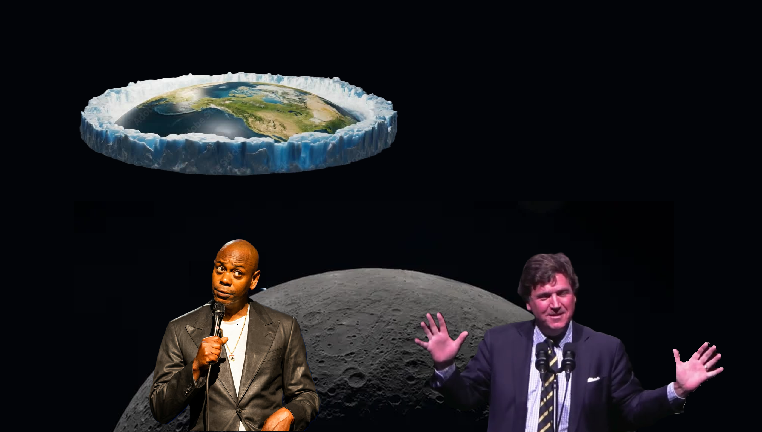
As you may have heard, comedian Dave Chappelle was interviewed at length last week by NPR’s Michel Martin, during which he claimed to be disturbed by the ways in which the Republican Party has been appropriating his trans-erasing and trans-diminishing material to erase and diminish trans people. I find this claim incredible, by which I mean I do not find it credible, which is to say I don't believe it. Here’s what he said:
If being big [in the sense of popularity] informs me in such a way that I feel like I don’t want to step on any hands or any blades of grass, I don’t want to hurt anybody then so be it; that’s what I decide. But I have yet to make those kinds of decisions. I don’t feel like anything I do is malicious or even harmful, and if I think that if I did hurt somebody at my work, boy they would have been laid that at my feet. I’m just not doing that.
And you may have heard that Nazi propagandist Tucker Carlson is very recently sorry that he supported Donald Trump. Carlson delivered his apology, which was precipitated by Trump’s disastrous and illegal war in Iran, on his hugely popular fascist white supremacist propaganda podcast. Carlson delivered his apology during an interview with his brother, Buckley Carlson.
You and I and everyone else who supported [Trump]—you wrote speeches for him, I campaigned for him—we’re implicated in this for sure. It’s not enough to say ‘I changed my mind’ or ‘Oh, this is bad, I’m out.’ In very small ways, but in real ways, you and me and millions of people like us are responsible for what is happening. So I do think it’s a moment to wrestle with our own consciences. We’ll be tormented by it for a long time. I will be. And I’d like to say I’m sorry for misleading people. It’s not intentional.
These are Carlson’s claims, and I find them incredible, by which I mean I do not find them credible, which is to say I don’t believe him.
And you may have heard that this month humans went to the moon for the first time in a long time, and we went ever so far, further out than ever we have gone before, and we observed the dark side of the moon, and took pictures of sights that we have never seen. By “we” I mean human beings, all of humanity, even though in reality only four human individuals went, which is the same as zero human individuals, statistically speaking. In saying “we” I recognize the collective nature of humanity. Most of us responded to this moment with wonder and awe. Unfortunately a number of us are flat-earthers, which means they found the evidence that the Artimis team had accomplished this feat incredible, by which I mean they did not find it credible, which is to say they didn’t believe it. They spent their time incredulously asking questions to which answers exists, and ignoring those answers.
I’m ruminating today about in-credible claims, and what makes people find them incredible, and why it matters.
I’ve written about Chappelle and his transphobia before, here and here and here and here, right at the start of The Reframe's existence. Feel free to check these essays out; they’ll give you a grounding in my own reality when it comes to Chappelle, at a level of detail that I won’t deliver here.
I’ve written about Carlson here and there, as part of my writing about the propagandists of the white supremacist fascist party of the United States, the Republican Party. I call him a Nazi propagandist because he has long been a promoter of Nazi propaganda such as the vile replacement myth, which he promotes to help energize ethnic cleaning and genocide and stochastic violence and so on. You can read about his apology here, in an article I recommend in part because it contains the phrase “Carlson's son, whose name is also Buckley Carlson.”
I’m not linking to the flat earthers. If you want my thoughts about people who have performed the mental judo upon themselves necessary to proudly proclaim their ignorance as proof of their expertise, you can read it here.
Let’s talk Dave Chappelle.
He’s a compelling fellow in a lot of ways. In terms of his craft—which is stand-up comedy—he is justly lauded as one of the best to ever do it. He’s community-minded, too; the occasion of the interview was the renovation and restoration of a local building in support of the local NPR station in Yellow Springs, Ohio (where Chappelle lives), an affiliate which, per Chappelle, was able to remain in Yellow Springs as a result of his donation. And Chappelle has proved hugely insightful throughout his career, evincing a lived knowledge of systems of institutional racism in the United States, and remarkable skill in conveying it. More than this, he’s demonstrated a strong moral conviction; he famously walked away from a $50 million dollar payday when he realized that his jokes satirizing racist beliefs were being misappropriated by racists to serve racist messages.
It’s this background that makes the Chappelle interview so frustrating, because it demonstrates the many ways that he has squandered his skill and moral credibility. Martin’s far-ranging questions eventually touched upon Chappelle’s decision to spend most of this decade telling jokes at the expense of the humanity of trans people, and here Chappelle made his least credible claims. We’ll dig into them, but for now, let me say that it’s very frustrating to watch somebody dissemble on a topic by using techniques and rhetoric that he himself has expertly identified and demolished when dealing with a different topic. It certainly harms the credibility of the person doing it.
But perhaps Chappelle has noticed that maintaining credibility isn’t all that necessary any more. If you’re a star, they manufacture your credibility for you. Temporary president and white supremacist genocidaire Don Trump spent last Friday lying about making progress in peace talks with Iran, which the press dutifully repeated. And I’m pretty sure the next time Trump makes a bogus claim, the press will dutifully and uncritically report it again. I’m pretty sure of this because Trump has, conservatively speaking, told tens of thousands of lies since starting his political life, and these have not convinced the press or the markets to exercise discernment on the matter of Trump’s pronouncements specifically or the U.S. war project generally. To offer another example, mRNA technology, which seems on the verge of developing vaccines for some of the deadliest cancers, was largely defunded last year by the head of Health and Human Services. RFK Jr., the HHS head, is a man well-known for ignoring scientific evidence and pushing junk conspiracies. He’s set himself in opposition to life-saving vaccines, and because of this alarming fact, has been put in charge of U.S. health policy. And Secretary of War Crimes Pete Hegseth recently got in on the game, declaring that vaccines would no longer be mandatory for our “war fighters,” in the name of freedom to die of preventable ailments.
I could go on in this vein for what seems like forever. We seem to be infected by a spiritual, moral, and societal flat-eartherism—a cultural death of discernment taking place in matters of credibility and evidence—which has stakes higher than can be found in the world of stand-up comedy. I’m contemplating Tucker Carlson because his influence is vast and his effects are massive. I’m contemplating Chappelle’s case, because it illustrates the ways abusive systems reach into otherwise enlightened minds, the way abusive systems infect all aspects of public life, from the most grave and weighty matters of state, to our scientific accomplishment and innovation, to the quotidian corners of small-town Ohio, and into our commerce, our communities, and our art—even an art form that is mostly about jokes.
Systemic is a key word here.
Discernment is another.
It is increasingly clear to me that our systems and institutions—of government and technology, of religion and journalism, of justice and enforcement, of economy, of enterprise, even of entertainment—are run on abuse and for the sake of abusers. This convinces me that we are dealing with a culture of abuse, a collective spiritual alignment with abuse known as supremacy—the belief that only some people matter. It’s a sickness that is systemic and social and spiritual more than it is individual, which suggests to me that the remedy will need to be systemic and social and spiritual as well.
How to heal from this systemic, social, and spiritual sickness?
My first observation is that if a remedy to a collective and systemic sickness isn’t collective and systemic, then it’s not really aligned with healing a collective and systemic problem. If all you do with a cancer is give somebody painkillers for individual symptoms, that represents a decision—made for whatever reason—to not treat the cancer. There are some valid reasons to do this, but if you do it, it is best to confront the truth of what you are doing, and what the results will be.
My second observation is that collective and systemic remedy will still require individuals to heal of their individual sickness, because it is individuals who make up a collective. But as with the collective, so with the particular: A person is a system, and if the remedy they seek isn’t aligned with healing the holistic system that is them, then it’s not really an approach aligned with healing. And if the system within which individuals exist isn’t healed, then healing for individuals will remain unlikely and unnaturally hard. So, while we would not oppose healing of individuals, and would in fact celebrate it, we would be wise to focus our first energies and strategies on the healing of systems.
My third observation is that pointing out that a proposed remedy isn’t actually aligned with healing doesn’t mean the person pointing this out isn’t aligned with healing—quite the opposite in fact. To distinguish between useful remedy and quackery requires a discerning mind.
We might find some hope in Chappelle’s newfound regretful posture. After all, he hasn’t been the least regretful up to this point—quite the opposite, in fact. Would it be good if he finally turned away from his abusive alignment with this spirit of transphobic dehumanization in which he has participated, and which he has helped normalize and promote? It would, actually. I would be open to that happening, and I hope you would be, too. On an individual level, this could represent the start of personal healing on Chappelle’s part, which is just fine with me. Chappelle has a powerful talent. I’d like to see it put to better uses.
And we might find some hope in Carlson’s apology, After all, he has spent his career as a horrifically talented promoter of the rankest gutter bigotry imaginable, and the sum effect of his life upon humanity has been brutal. It would be great if Carlson acknowledged the depth of his depraved crimes against decency, and retreated to a life of regret, to live outside the spotlight a diminished but possibly transformed Tucker Carlson, one who might do some small hillock of good in the world during the remainder of his life, a tiny counter against the mountain of vile abuses he is responsible for so far.
And we might spend some time explaining things to moon skeptics. We might spend some time giving them the answers to the questions they are asking, which have never been easier to find. It’s good to explain things, and maybe some of these people who have decided to arrange their personalities around not being convinced would be convinced.
So individual healing is to me like Jesus is to the Doobie Brothers. It is just all right with me.
My examples are just an illustration of a trend, incidentally. We've got a lot of Trump supporters right now who might be shocked into awareness by recent outrages, and there’s a lot of new talk about regret and defecting from their MAGA cult of abuse. Much like Chappelle distancing himself from transphobic Republicans, and Carlson issuing his statement of regret, people are falling away from Trump and his movement as he and it have harmed more and more people, as he and it have become increasingly socially toxic. The question becomes what to do with this opportunity, and what the opportunity actually is.
I don't want to waste time centering the people who got us into this mess over the people who were most harmed, and I'm doubly reluctant if it turns out—as often seems to be the case—that the regrets are feigned, the defections self-serving. Yet I also don't want to close the door on the possibility for healing. I'm not against finding common ground with people. If somebody is genuinely interested in doing restorative work, I would be a facilitator rather than an obstacle to that.
For this reason, I turn to discernment. I have to look at the posture of regretful MAGA and the proposals about how best to capture them and ask myself “is this aligned with healing?”
I ask the question of regretful MAGA the same way I ask it of regretful Chappelle, who is not MAGA as far as I can tell, or Tucker Carlson, who most certainly is.
And I ask that question, and I find that the answer is “no.”
So now let me explain why.
I wrote last month about my belief that the answer to stopping a culture of abuse is to imagine and create a culture of healing.
I wrote last week about how healing requires a confrontation with truth: a correct diagnosis, delivered clearly, and a willingness on the part of the person receiving it to accept it and pursue the remedy.
I want to say more about that phrase now.
Confrontation is a charged word. One might even call it a confrontational word. Truth is also a fairly didactic term. How do you know your diagnosis is right? Who are you to say your truth is actually true? Doesn’t confrontation provoke in unhelpful ways? Wouldn't persuasion work better? These are reasonable questions.
Instead of "confrontation with truth," I might do better to say that what is needed is a grounding in shared reality—and we do indeed need such a grounding. I notice that shared reality as a concept is under heavy attack these days by abusive-minded people, which seems indicative of the importance of shared reality to any collective remedy to a culture of abuse—and, as our sickness is systemic and collective, so our remedy must involve systemic change. So shared reality seems like a worthy goal.
Then again, MAGA already has a shared reality, and I don't think joining them in it will result in healing, any more than joining the shared reality of flat-earthers will result in science. So much for the idea that choosing a shared reality to inhabit together is all that’s needed for healing to take place. I think what's needed is discernment, which is what we'd want from anyone making a diagnosis.
And people who refuse to enter a shared reality with a grounding in evidence and expertise will always experience evidence and expertise as confrontation, no matter how gently or bluntly it is delivered. There even exists some evidence that this confrontation is, for those who have arranged their identities and fortunes around abuse and ignorance, something that triggers the flight-or-fight response.
People who cannot or will not enter a shared reality with a grounding in the deep sustaining truths of universal human dignity, the strength and beauty of diversity, and our dependance upon a naturally interconnected world, will always experience diversity, human dignity, strength, beauty, and mutual dependance and interconnectivity as a confrontation, no matter how subtly or overtly these qualities appear in their lives. Those opposed to evidence and human dignity will experience any exposure to evidence and human dignity as a confrontation, yet evidence and human dignity is what we must embrace if we would enter a shared reality based on truth rather than nonsense, and on healing rather than abuse.
My intellect demands we hold to the truth of evidence. My conscience demands that I hold as best I can to the truth of human dignity. So I say “confrontation” when it comes to matters of truth. If it's not systemic and holistic and honest, it isn't healing. And if it's just making people comfortable in their spiritual sickness, then it's capitulation to the sickness, not remedy.
And we people of good intention would do well to be confronted with the truth that—just as some who claim to be seeking answers about the shape of our planet are not actually looking for it—some who claim to seek healing are not actually seeking it, and acting as if they are will enable abuse, not healing. I think the quality that allows a person to confront themselves with truths that might otherwise be missed is discernment. So today I contemplate discernment.
I intend to ask the following three discerning questions:
What reality will we share?
With whom will we share it?
To what purpose?
What shared reality?
Dave Chappelle has dedicated his prodigious talents this decade to crafting and delivering material that minimizes and negates the humanity of trans people—for which he has earned tens of millions of dollars over the years, and also significant criticism. He’s responded to this criticism by claiming that he is being silenced, which is very clearly not the case, and by doubling down on the attacks with increasingly more transphobic material in each ensuing special.
Chappelle was confronted with this reality in the interview, and he refused to share it. His claim is that his words are being misappropriated, that what they are being used for was not his intent.
Chappelle’s words represent a reality he is enforcing if you would share reality with him. In his reality, he hasn’t hurt anybody, and his intention should be taken as inseparable from his effect. We’re invited to share this reality of exonerative complacency and dissembling. He makes it clear he won’t enter a reality grounded in any truth that confronts him.
I ask myself: Who is being centered in this narrative?
Chappelle has been presented with incontrovertible proof that his trans critics and their allies were right and he was wrong. His material is being used by bigots to normalize dehumanizing and harming trans people, ergo, he has been dehumanizing and harming trans people. Is his answer to focus on those who he has been harming, or to refocus back upon himself? Is there any admission that he has been wrong? Is there any acknowledgement of harm? Does this become a story about trans people and what he needs to learn from them?
No. He rejects the confrontation of the truth and offers an exonerating myth. He is still the one who is to be learned from. The request to change is an attempt to suppress his art.
To share Chappelle’s reality, we have to enter a world in which Chappelle has not been told already, repeatedly, and in great detail, and in many different ways, exactly how his jokes were harming trans people, and how, and why, and who was doing the harming. We have to accept a version of the world wherein we ignore the fact that truths of this harm have already been laid at his feet, and ignore the ways he has stepped over those who laid them there.
Tucker Carlson, meanwhile, could not have been more directly abetting and promoting the harm done by our systems of abuse. We might rush to congratulate him for his apology, which actually does recognize his culpability. Many people did exactly this in recent days. However, I can’t help but notice that it is only a massively unpopular war that has caused Carlson—who happens to be one of the most politically savvy and smooth-talking of the fascist propagandists—to falter in his support of Trump's political project. I haven’t noticed any regret for the dehumanization and the normalization of bigotry and cruelty and corruption and killing to which he has devoted his energies. I will watch Carlson, and if his regret extends into these areas, I will be encouraged. But when I use my discernment, I do not expect to be encouraged. And I do not accept the apology, because I cannot trust its motivation.
I think we can be encouraging, but we also have to be clear and truthful.
We have to say, “you are learning that you have been wrong.” We have to ask: “Are you ready to listen and learn the uncomfortable truth about what that means?”
If somebody is open to hearing those uncomfortable truths, that is a step, and—especially if we are similarly privileged—we might help them take another.
But if they are unwilling, we must leave them to the consequence of their false reality—not because we would not see them healed, but because we have used discernment to understand that they are not aligned with healing themselves or our systems.
We must leave them to consequence, because we would be aligned with the truth that our sickness is collective and systemic, that we therefore must work at creating systems and institutions of healing, wherein abuse is not incentivized and rewarded, wherein healing is seen as its own reward.
We must leave them to themselves, because we have healing work to do, and we would not waste our energies on those who fight the healing process, energy which we could otherwise spend on demolishing abusive systems, and building healing systems that might heal them.
Shared with whom?
The shared reality Chappelle offers is a world in which trans people don’t count, which we can tell by all the ways Chappelle refuses to count them. The harm he does in his exonerative myth is abstract, not actual; it’s done not to people but to "blades of grass." The decision over whether or not he even harms trans people at all is not up to them; it’s up to him. It's not a moral choice, it's a purely artistic one.
At another point in the interview, Chappelle speaks of comedy as the national kidney, which helps people process cultural toxins. He speaks of how the sort of comedy that Richard Pryor performed—a level of mastery to which Chappelle clearly aspires—has been described as “brain surgery” for its complexity and potential for spiritual healing. He speaks of how he is aware that his presence at the Riyadh Comedy Festival last year was a crucial part of validating the festival. So we can discern Chappelle understands that comedy has real-life effects, and that he carries significant moral, financial, and rhetorical influence in that world.
When it comes to trans people, though, Chappelle complains that media “reported on [my material] as if I was doing something other than a comedy show.” Suddenly he’s not the national kidney; suddenly he’s not a brain surgeon; no, he’s just a little guy doing little jokes in the unimpactful world of stand-up comedy, which is, per Chappelle a playing field where everyone must be permitted to say their piece.
I agree that everyone should be permitted to say their piece, but I won’t ignore the fact—as Chappelle clearly does—that the playing field isn’t as level as he insists. I won’t ignore the fact that few people have been given more opportunity in the world of stand-up comedy to speak and be heard than Dave Chappelle, and—in part directly as a result of how he has abused this opportunity—few people have had fewer opportunities to speak or be heard than trans people. I can’t ignore the ways that right-wing comedians have been able to utilize Chappelle's reputation and moral authority to bolster their own reputations and platforms as bastions of free speech rather than instruments of exclusion.
I ask myself: Who is the victim in Chappelle’s reality? It's not the trans people hurt by Dave Chappelle. No, the victim is Dave Chappelle. Republicans using his work to attack trans people is not something that is being done to trans people. It's something that is being done to Dave Chappelle, who did nothing wrong and has nothing to learn. I ask myself: What is the regret here? Is it the harm you realize you have done? Or is the exposure?
I can enter Dave Chappelle’s shared reality if I choose to; trans people cannot. The offer does not stand for them, unless they are first willing to ignore their own erasure and accept his self-exoneration.
And Tucker Carlson could not have been more directly abetting and promoting this erasure and the erasure of many others. I can’t help but notice that Carlson’s apology seems to be motivated by the harm he knows Trump has done to his audience, and the way his words seem offered for their benefit. I can’t help but notice that his apology does not seem to extend to those who he has encouraged his audience to harm. I will watch Carlson, and if his regret moves him to advocate with his time and influence and wealth for immigrants and homeless people and Black people and women and disabled people and Muslims and Jews and other ethnic and religious minorities that he has directly harmed, I will be encouraged. But when I use my discernment about who Carlson is and how he operates, I do not expect to be encouraged. And I do not accept his apology, because the harm was not done to me, so it is not mine to accept, and because it was not offered to those to whom it is owed.
I think we can be encouraging, but we also have to be clear and truthful.
We have to say, “because you were wrong, people were harmed and so was our shared society.” We have to say, “are you now willing to pay the cost of awareness and conviction, and of responsibility and reparation?”
If someone can center others rather than themselves, that is a step forward, and—especially if we are similarly privileged—we might help them take another.
But if regretful MAGA can’t recenter their frame around their victims, we have to leave them to the consequences of being themselves. Not because we would not see them healed, but because we have used our discernment to find their claim of regret in-credible, and so we understand that they are still not aligned with healing.
We can confront them with the truth, but if they will not or cannot accept the confrontation, then we can’t create healing by offering flattering and comforting lies instead.
Shared to what purpose?
As I mentioned, the NPR interview showcases Chappelle’s philanthropy in his community. I think it’s reasonable to say that Chappelle is aware that his reputation and credibility have been tarnished, and he's certainly aware that showy acts of philanthropy often help restore tarnished reputations. While he may be genuinely motivated by community-mindedness, I think it is also reasonable to assume he expected and expects his largesse to assist his rehabilitation. And listen: It is noteworthy that Chappelle has chosen to use a chunk of his money to better his community, and no doubt his community is bettered, and I am in favor of betterment, so I'm glad of it.
I just notice the system.
Chappelle has said before that he’s a capitalist, and it’s not difficult to see why. He's amassed a whole lot of capital. What I would note is that the world Chappelle lives in is indeed a capitalist one: namely, one in which the betterment of community is left up to the whims of the wealthiest members of that community, which confers upon those wealthy few an outsized control of that community. This would not be the case in a world where community betterment is handled by institutions and systems.
Our national sickness involves systems that are intrinsically aligned with unhealth. Discernment can show us that Chappelle has deliberately aligned himself with those systems. He's upset by how Republicans and other bigots have utilized his material, but in the case of trans bigotry—when he's not part of the group in the crosshairs—he's not walking away from the paydays, and he's not listening to the people he's harming, and he's not changing his behavior. What he's doing—the reason I think he's making a point of breaking with Republican bigots who share his bigotry—is establishing his own blamelessness.
I ask myself: What is being protected? It’s not trans people.
I ask myself: Who here is being asked to pay the cost? It’s not Dave Chappelle.
Chappelle is trying to invite the public into a conspiracy of self-exoneration. He's trying to create a shared reality where he can avoid paying the natural costs of bearing responsibility for what he has been aligned with. He is quick to (correctly) point out the places where he doesn't have privilege in our abusive systems, but fails to leverage that truth in order to expose systems of oppressions; rather he cynically utilizes that truth to camouflage the ways that he has benefitted from those systems, and to cover the ways that he participates in privilege. He's framing his decisions, which have a global effect, as personal and individual, to defend his power to individually make determinations that affect the lives of others.
And I can’t help but notice that Tucker Carlson’s apology evades his own culpability by equating his role to that of the millions of people he encouraged into culpability. I can’t help but notice how Carlson seems to be motivated by a desire to keep being a voice of power and influence, to protect the abusive systems that privilege himself, and to protect his well-paid advancement within it. I will watch Carlson, and if his regret moves him to re-evalaute and retreat, to stop talking about marginalized people and start listening to them, to stop broadcasting hateful lies and start seeking healing truths, and if the torment he says he feels leads him to abdicate his position and influence to promote the voices he has suppressed, to pay natural costs that he has unnaturally forced others to pay, then I will be encouraged. But when I use my discernment, I do not expect to be encouraged. And I do not accept his apology, because I can see how it feints at responsibility and consequence in order to avoid either.
I think we can be encouraging, but we also have to be clear and truthful.
We have to say, “you have hurt others, and that has consequence.” We have to ask, “are you now willing to demolish the abusive systems that privilege you, and build healing systems that work for everyone?”
And if regretful MAGA can’t move from regret for themselves and the suffering abusive systems cause them personally to regret for their part in perpetuating those systems, if they can’t leave their focus on their own individuality to recognize the diverse and interconnected nature of human society and the planet we share, we have to leave them to the consequences of being themselves. Not because we would not see them healed, but because we have used discernment to understand that they are still not aligned with healing. We can confront them with the truth, but if they will not or cannot accept the confrontation, then we can’t create healing if we offer them flattering and comforting lies instead.
We must leave them to their consequences, because we would be aligned with the truth that our sickness is collective and systemic, and so we must work at creating systems and institutions of healing.
We must leave them to their consequences, because we have healing work to do, and we would not waste our energies on those who will not be healed, which we could otherwise spend on demolishing abusive systems, and building healing systems—where the cost of healing is lower and the costs of abuse are high; where healing is its own reward; where healing is for those harmed, not those who have done the harming; systems that might heal the terrible damage they have done to others, and—maybe, possibly, someday—even to themselves.
Which would be truly incredible.
The Reframe is totally free, supported voluntarily by its readership.
If you liked what you read, and only if you can afford to, please consider becoming a paid sponsor for as little as $1/month. If you'd like to be a patron of my work, there's a Founding Member level that comes with a free signed copy of my upcoming book, Fighting in the Dark, and thanks by name in the acknowledgement section of any books I publish.
Looking for a tip jar but don't want to subscribe?
Venmo is here and Paypal is here.
A.R. Moxon is the author of the novel The Revisionaries and the essay collection Very Fine People, which are available in most of the usual places, and some of the unusual places. You can get his books right here for example. He is also co-writer of Sugar Maple, a musical fiction podcast from Osiris Media which goes in your ears. I guess he can't revoke your soul for trying.
Comments ()