
Story of Us
People increasingly want radical remedy, and need a radical vision. Pearls before swine, and disrupting the dominant scripts.

Dr. Abdul El-Sayed won the Democratic primary for Gary Peters’ soon-to-be-vacated Senate seat in my home state of Michigan last week; this, despite facing significant financial and rhetorical opposition from institutional leadership of his own party. There were other progressives who won their primaries over the course the last several weeks and months, and some who lost to their establishment opponents. Many of these things were real squeakers either way. Some weren’t so close. A handful were blowouts. That’s how it goes.
El-Sayed’s win was one of the squeakers, which is an extraordinary accomplishment, given the powerful institutional currents he was swimming against. The other progressives who won their primaries also won despite the opposition from Democratic party leadership. To suggest that this has re-exposed rifts within the Democratic Party’s base would be an understatement. To say that bad faith actors are now exploiting those rifts would be another understatement.
Conservative Democrats and their allies insist that El-Sayed is unelectable, for a great many reasons, which mostly boil down to the idea that his views are (or at least can be painted as) radical and crazy, and this will allow Republicans to paint him—and thereby the entire Democratic Party—as a filthy Communist.
Progressives respond that El-Sayed’s views, far from radical, represent the most basic and obvious solutions to some of our most pressing and serious problems, and represent the sort of refreshing differentiation from Republicans that might have a chance to actually capture the support of new voters—much as Zoran Mamdani was able to capture many 3-time Trump voters last year, which is the sort of thing conservative Democrats claim to want to do.
And back the response comes: That Mamdani thing may work in deep-blue New York, but in purple states like Michigan?—no way. We’re going to need a big tent, and radicalism turns people away. Nothing matters more than winning, and your leftist purity politics are why we’re in this situation. You’ve just handed the Republicans the Senate.
And back the response comes: For decades we’ve been running your center-looking triangulation politics, not ours, and these additional center voters you talk about rarely materialize, so your politics has led Democrats to this fraught and powerless position, not ours. Your refusal to take firm positions and your lack of vision are why we’re in this situation. You want to hand the Republicans the Senate, either by losing to them or by becoming them.
And so forth. This is only a taste of it. This is the polite version. I left out a lot of the hot sauce. You don’t need the hot sauce, right? You’ve seen it.
So which position is correct? You’d think we’re going to be able to collectively observe the truth in November—at least the part about what the results of the election are going to be—and attain a consensus shared reality. Based on how things usually go, though, I suspect that no matter the result there is going to be a lot of entrenching on positions. For most people engaged in this discourse, wins for El-Sayed and other Democratic progressives and socialists will be either 1) incontrovertible proof of the viability of a bold progressive vision or 2) outliers and exceptions that will be best minimized and dismissed as unrepeatable. Losses, meanwhile, will present everyone with an opportunity to assign blame.
There’s something about assigning blame that seems to be instrumental to this whole process of not changing your opinion. In fact, blame is already being pre-assigned in anticipation of bad outcomes. I’m told that Democratic primary voters in Michigan have made a terrible mistake and gone off the wackadoo leftist cliff; they will be at fault when Michigan goes red. I’m also told that Democratic leadership refuses to support progressive candidates and would rather see Republicans win than leftists, because they have more in common with fascists than socialists; they will be at fault when Michigan goes red.
Again, I’m leaving out the hot sauce. There’s a place for hot sauce, but I think this essay is more of an ice cream cone, so I’m going to drizzle on the hot fudge and sprinkles instead. (This metaphor got away from me. Send help.)
I have a view on this dispute. I imagine you’ll be able to guess it by the end of the essay if you haven’t already. I think one of these sides is telling a mostly coherent and logical story and one is telling a largely incoherent and illogical one. I also think the difference is desperately important, because the stakes are desperately high. But that’s a different topic.
It’s the dynamic I’m writing about today—the arguing and the anger and the blame. I’m not arguing against arguing any more than I’m arguing against proper application of hot sauce. I think arguing one’s position can be important and necessary, if the position is a good one, and outrage is an appropriate and frequently necessary response to outrages. I think there are people and ideologies more responsible for this mess than others. On the other hand, if argument and blame was the solution to our problems, then everything surely would be solved by now. We’re all arguing. We’re arguing the most.
What is going on underneath?
I think it’s a case of competing stories.
Its not the end of the essay! It's only a quick reminder that The Reframe is me, A.R. Moxon, an independent writer. Some readers voluntarily support my work with a paid subscription. They pay what they want—as little as $1/month, which is more than the nothing they have to pay. It really helps.
There’s a rather influential book of pop psychology that came out about fifteen years ago called Thinking, Fast and Slow, by Nobel laureate psychologist Daniel Kahneman, which suggests that most of our thousands of daily decisions are formed not with logic and reason, but almost unconsciously, based on preexisting frameworks and scripts. It’s an evolutionary development, per Kahneman, allowing our brains to make the sort of quick decisions that can keep us from existential dangers, like being eaten by a hyena, or accepting an invitation to a timeshare pitch. The scripts decide. The person acts. The logical part of the mind comes in later, and does the work of justifying the decision made by those scripts. I resonate with this. I think I do this. I think you do this, too. It appears to be what we humans do. We run on story—scripts and frames.
What I’m calling script is an existing belief. It’s a piece of a story that you tell about yourself and the world and your place in it—a story of Me, you might say. Me is usually the hero in each of our stories—or the protagonist, anyway. In the story Me often has a mission, and almost always has a community, and there’s a villain, and a conflict, and stakes, and so forth. Most of us don’t really think about ourselves as being in a story, but we tell ourselves things about ourselves, even if subconsciously, and we make sure that our communities tell us those things back to us, and if they don’t tell us our story back we usually make adjustments to our scripts so that our communities continue to give us the sweet nectar of validation.
What I’m calling frame is a superstory. Frames are formed by collective messages, communal norms, collective beliefs—a story of Us, you might say.
A frame is a boundary within which you can write your scripts and still be a part of the community. Your scripts don’t have to be coherent; they can be justified to the frame after the fact, as long as the justification stays true to the frame. You might say that the story of Us depends upon all the stories of Me. If enough of the stories of Me within any particular Us changed, it would make a new and different story of Us, and this would be a great big problem for anyone whose fortune or identity depended on the old story of Us. On the other hand, you might say that every story of Me depends upon a story of Us, a collective mass of stories of Me that creates its own gravity. A Me could depart from their story of Us, but that Me would have to find themself a new story of Us, because we humans are communal beasts.
This makes changing a story of Me or finding a new story of Us a scary prospect for most humans. Most of us resist any call to leave our existing story of Us. It would take an extraordinary event for us to do so. Many never do, no matter how extraordinary the events get.
Encountering a competing story of Us is stressful for most Mes—existentially terrifying, for many. An attack on a Story of Us is often experienced as an attack on the Story of Me. It's also an invitation to leave the present Story of Us, which creates a tension of dissonance. I’d say the terror of being confronted with a competing story is more terrifying for people the more incoherent their operating scripts and frames are are. The greater the dissonance, the greater the tension. The brain tells Me that Me is being attacked by a jackal or propositioned by a time share salesman. The brain floods with chemicals. The fight or flight reflex triggers.
In my experience “fight” tells you it’s time to defeat the other person. You argue the other person over to your side to resolve the tension of the dissonance, or else you establish the other person as the party who actually has the Wrong Story.
In my experience “flight” tells you it’s time to stop engaging with the tension by negating the critique or the evidence with a rationale, and then creating a justification for that rationale to manage the incoherence.
Do we have competing stories of Us? We sure do.
Once upon a time we had a shared story of Us. That’s how it seemed in my youth anyway—for a specific subset of we, anyway. This is the story of American Exceptionalism—a story of U.S.—which holds that all of our institutions are the best, because they are ours, and we are the best because we are us, and because of this we have blessed the world and maybe even the universe with the gift of our Us-ness. American Exceptionalism isn’t a good Story of Us—it is an unsustainable lie that consumes people for profit—but in my youth it was shared by enough people to create its own gravity. It was a shared story, foundational to both conservative Walker Texas Ranger and liberal The West Wing. Republicans and Democrats, living together. Everyone believed everyone else wanted basically the same good things—for a specific subset of everyone, anyway.
It’s not a shared story anymore, if it ever was. The lie was exposed, the truth came out. The unsustainable thing didn’t sustain. The critical mass is unraveling, the gravity is weakening. There are two competing sets of stories of Us—two at least—and the justifications being made for each side of each set are often incoherent in the extreme.
There’s a humanist story of Us and a supremacist story of Us. Justice and equity for all versus domination by a shrinking few. That’s the first set. It's one way of looking at it. I’ve certainly looked at it that way many times. I think that reflects the reality of the situation in observable ways … but not all of reality.
Here’s another: There’s an institutional story of Us and a radical story of Us. One story says our existing way of arranging power is working out, and should be preserved. The other says it isn’t, and needs transformation.
When you have two sets of competing stories, you tend to get four main groups. In this case: Radical humanists, radical supremacists, institutional humanists, institutional supremacists. Four stories of Us. Only two viable political parties to tell them. Maybe you see the issue.
For people who are radical supremacists, there is a political party to organize around that offers straight Nazism: Republicans. This party is in charge of our government right now, and radical supremacists have a grip on the party that seems unshakeable. It is doing its terrible work, and people are suffering and dying as a result, yet our institutions find its corruptions and abuses far more palatable than the clear solutions of radical humanism, which exposes their supremacist nature, if you ask me.
When you get a competing story, you have to decide where your loyalties lie. Most institutional supremacists in the Republican party have shown themselves far more loyal to the supremacy; they appear willing to accept and justify any attack on institutions, as long as the attack doesn’t touch the institution’s supremacist nature. Only a handful of institutional supremacists seemed more attached to the institution, and now find themselves "politically homeless," which is a condition that elicits far more sympathy and concern among institutionally minded people than actual homelessness.
They had to leave their story of Us, those institutionalist Republicans. They're looking for a new one. Now they are scrambling for control of the other party: Democrats. In a show of almost laughable bad faith, politically homeless institutional supremacists are advising everyone to lean into a slightly kinder version of supremacy.
Radical humanists, meanwhile, are offering a vision of transformation into a government that works for people instead of for property, and seeks radical transformation of supremacist institutions.
And institutional humanists have the controls right now, but their grip seems to be slipping, because when they do things like oppose humanist ends in favor of institutional norms, or like warning about the radical danger of Republicans while proposing finding incremental solutions by working with Republicans, people increasingly find that message incoherent.
Perhaps it has not escaped your notice that the existing system is working out for fewer and fewer of us, both globally and domestically. This, in my opinion, is because our current system is supremacist—which we can tell because it does what supremacism always does. It defines more and more boundaries between who matters and who doesn’t, defines “who matters” more and more narrowly, and polices those boundaries with increasing violence, increasing cruelty, increasing dehumanization, increasing corruption. Hateful frauds are rewarded while suspicion and punishment falls upon experts and humanitarians. Wealth disparity is at historic levels. Corruption enjoys immunity. There are death squads in the streets, rounding people up into concentration camps. Gutter racism is spoken openly once more by people with institutional power. People quite literally cannot afford to live.
Certain conclusions present themselves. A system where everyone wants the same good things does not optimize itself for fraudulent narcissistic eugenicist hucksters like Donald Trump (currently president) and Elon Musk (currently the world’s wealthiest man). A system that is exceptional and perfect does not resist providing for basic human needs, does not resist seeking solutions to real human problems, does not justify spending its money on genocide.
So fewer and fewer people believe that the existing system is working out. They want something radical instead. This is a term that institutionalists tend to use to mean scary and wrong and bad and crazy all at once, but which is also often used, especially in times of radical problems, with the word remedy. If you refuse to accept that you’re sick, a radical remedy is not desirable. If you realize that you are radically sick, then baby, the doctor is in.
Radical progressivism didn’t used to be able to win primaries against the collected will of the party. Now, increasingly, they can. Even when they lose, it's often a squeaker. Dr. Abdul El-Sayed used to be impossible. Now he’s not only possible but real. Democratic institutionalists are telling their voters their story of Us, and, in increasing numbers, their voters are rejecting it for a story that—while radical—they find more coherent. For institutionalists, who are used to having control, the prospect of losing control is existentially terrifying. Some significant number of them are now doing the work of adjusting their institutional alignment, and holding to humanist principles. For some significant number of them, however, it appears that they are more committed to the institutions than to humanist principles, no matter how supremacist those institutions show themselves to be.
I suspect the true institutionalist fear isn’t that El-Sayed’s vision isn’t popular enough to win in Michigan. I think the fear is that it is—because their script says it isn’t possible. If it is possible, and they don't want to modify their script, then they, too, will become "politically homeless."
As a result, there’s a lot of unspoken fear out there, which tends to come out as spoken anger and expressions of blame.
That’s what I think is happening. I think institutionalists are scared. I think radicals are angry. It’s fight or flight time.
Look: Things are scary right now. There's a lot to be angry about.
However, just as it’s not bad for a Me to leave their community and pursue something better, it’s not bad to leave a bad and unsustainable story of Us to find or form a better one. It would be good if we could persuade people to overcome their fear and do that.
The evidence seems to be that logic and facts and evidence don’t change people’s scripts. More often than not, it’s the opposite; logic and facts and evidence contradicting people's scripts often get people to double-down on their scripts.
I think if we wish to persuade, we instead have to disrupt the dominant scripts.
Someday soon I want to write about how we disrupt dominant scripts.
Today I want to finish with why.
We disrupt scripts because disrupting them liberates us, and we would be liberated. I’ve learned that an effective way to disrupt scripts is to use the language of the person you’re talking with, and give it a turn. Last week I took Elon Musk’s claim that he is not responsible for his many murders and pointed out that he is not responsible—in the sense that his refusal to accept his responsibilities makes him an irresponsible person.
Because I was raised Christian and know the book well, I can also do this to Christian supremacists with the Bible. It’s really hot stuff, guys. Christian supremacists do not like this disruption to their scripts. But look: My original scripts were written in Christian spaces, too, so I can use them to disrupt not only the scripts of other Christians, but my own. I'll do that now.
There’s a guy named Jesus in the Bible you’ve heard of maybe. One time he told a sermon on a mount, and they called it Sermon on the Mount. Not everyone is creative with titles.
During this sermon, he said this:
Do not give dogs what is sacred; do not throw your pearls to pigs. If you do, they may trample them under their feet, and turn and tear you to pieces.
You can take this to mean that people who are opposed to your viewpoint shouldn’t receive your full trust and your full perspective, if they have malicious intent. I have taken it this way many times, and there are certainly circumstances where that is good advice. (We might quibble about the dehumanization of referring to malicious people as dogs or pigs, though I know from experience I’m more likely to be told I’m slandering our dear sweet swines and canines.)
But then I think of that old fight or flight mechanism, the one that kicks in and runs whatever script is buried underneath—the one inside each of us that causes us to immediately assign blame, dominate, shut down, justify later.
Maybe it's these old evolutionary instincts, so useful in the wild, which are the beasts that tear us to pieces. Maybe our vision for a better story of Us are the pearls. Maybe we don’t waste them on bad old scripts.
Maybe disruption of these scripts of flight and fight frees us all from that.
Maybe if it frees us, we can help others free themselves.
We disrupt existing scripts because they are how the dominant supremacist story of Us runs, and we would not aid supremacy. I always proceed with caution whenever I talk about persuasion. It’s one of the most misused concepts in modern discourse, used to suggest that before we can seek solutions we need to get permission from people who like the problems; used to suggest we should flatter and pander to their worst impulses; used to suggest that we need to center the most abusive people among us and perform work of reconciliation and redemption on their behalf; used to chide people who suffer the most from ongoing abuses to do the bulk of this abuser-centered work so the rest of us don’t have to; used to suggest that the people with the least emotional responses are automatically more correct, both factually and morally.
We’re not talking about any of that. In fact, all these old scripts of exceptionalism, of blame, of domination, of complicity, of avoiding cost and responsibility—these are the scripts we disrupt, so we can pursue new, more responsible ones.
People actually are at fault for things. People actually do bear responsibility for things. And, if we are responsible people, we will recognize that responsibility, but we will only disrupt the supremacist blamelessness script if we focus first on owning our own responsibility.
People with incoherent institutional supremacist stories are perhaps more inclined to defend their blamelessness and avoid their responsibility. Supremacy is about being a person who matters, which means being a person who is not to blame, which means ignoring solutions in favor of establishing that somebody else is to blame. But I see people with coherent radical humanist perspectives doing this as well—lashing out seemingly without purpose, only to establish themselves as the blameless parties, not responsible for what has happened, not responsible for what will happen. When we try to establish our own blamelessness through our identity, we participate in supremacy. This is true even if we find our identity in anti-supremacy.
Maybe our vision for a better story of Us are the pearls. Maybe when we are offered the chance to assign blame, we instead clarify lines of responsibility. Maybe we take care not to hold ourselves blameless or exonerate ourselves. Maybe we begin with our own responsibilities.
And that will disrupt the dominant script.
We disrupt scripts because disrupting them requires mindfulness and awareness, and we would be mindful and aware. If evidence triggers fight or flight, then encountering an opposing story is inevitably going to be received as a confrontation. Apparently it’s physiological. Apparently it’s automatic. Yet it would be good if people moved closer to truth, so these confrontations with truth are necessary. And, as long as we are human, these interactions are going to be experienced as confrontations not only for our ideological opponents, but for ourselves, too. I think it would be good for us to disrupt this dominant fight script, so that we might have some control over what kind of confrontation it is going to be.
Existing scripts are predictable, which makes them exploitable, and we would avoid exploitation. Often people go looking for a fight specifically because they know it will re-entrench the positions they already hold, and they want to re-entrench those positions. They want the experience of establishing their story of Us by pitting it against an oppositional one.
There are bad-faith actors out there who know this, and are ginning it up. Not everyone on Threads starting fights is a sock puppet but a lot are. Not all of the people inviting me into a fight on Facebook are on my feed because the owner who controls the algorithm would like to split an anti-fascist coalition, but a lot are.
The person who can capture and control their fight-or-flight reflex can think about their options, can decide what they want to accomplish in any given encounter, which may vary based on whether they're dealing with somebody confused by propaganda, or a malicious bully, or somebody who is complicit and morally lazy. A reasonable back-and-forth dialogue is often called for, but not always. Sometimes a fight is needed. Sometimes an argument is necessary. Sometimes flight is wise. If we are mindful and aware, we'll be able to better discern which is which. An unmindful person will have no options; they’ll only have the reflex.
Maybe our vision for a better story of Us are the pearls. Maybe we don’t waste them on bad old scripts. Maybe we stop handing advantages to people who cynically push the worst stories. Maybe then we can more easily persuade people toward the better ones.
We disrupt existing scripts because disruption is persuasive in a time of change, and we would be persuasive. This is just a very practical matter. The old shared story of American Exceptionalism was institutional, and there really wasn’t anywhere politically speaking for a radical to go. That’s changing. Increasingly, because radical remedy is required, people are responding to a radical message. Stories of Me need a story of Us, and people who want radical change will seek a radical vision.
Right now, the only radical vision available from a viable political party is a supremacist one, so we really need a viable political party offering a humanist vision of radical transformation—if we don’t want to live in a christofascist oligarchical authoritarian ethonostate, that is.
Institutionalists don't have such a vision. Progressive candidates do.
Will this vision win in November? I do not know. There’s a lot of institutional opposition to overcome, and a lot of propaganda, and a lot of bad faith, and a lot of old scripts. But I do know that offering an institutional message to a people who increasingly want radical change will fail in a way that goes beyond elections.
Dr. Abdul El-Sayed won his primary by staying on message, and that message was: money out of politics and back in your pocket, government that works for working people, Medicare for All. His method of staying on message was notable. It involved the usual tools any polished politician has in their bag, and indeed Dr. El-Sayed is skilled at ignoring distractions and bad-faith framing, smoothly turning questions back to the preferred talking points. He has his scripts, just like all of us. But for El-Sayed, staying on message also included actually living up to what he was talking about, which included refusing to take any corporate money. In the more established areas of political punditry, this sort of consistency of message is seen as radically confrontational and dangerously unrealistic.
There are people who desire radical change who actually only want the supremacy, and convincing them will not be worth our energy. There are also people who desire radical change who have been willing to overlook the abuses of supremacy, because they did not feel the threat of it. That is not to their credit—indeed it is to their enduring shame—but they may respond to a radical humanist vision if one were offered. There are institutionalists whose faith in institution is shaking, and they will need somewhere to go, and guides on the way.
Will El-Sayed win the general? Will the other progressives and socialists win, too? I do not know. But I do know there is something persuasive in standing for something. There’s something persuasive in not being defensive in the face of attacks. There’s something persuasive in knowing what your frame is, and knowing that your scripts are coherent to that frame. There’s something persuasive about knowing what your business is, and then standing on that business. It draws people in. It creates a new story of Us for people to join if they want. If they don't, then they never were going to, but at least you know.
We don’t get there by pandering to their worse angels. We do it by pursuing our own better ones, doing it without shame, without worrying about our popularity. We do it by knowing where we need to go, and then heading toward that destination without defending ourselves for wanting that, not because everyone has already agreed to go, but because we know we need to get there.
Maybe our vision for a better story of Us are the pearls. Maybe we don’t waste them on bad old scripts. Maybe we just wear them around our neck, and go out for a dance, and let everyone hear the music, and if they want to bop their head to our beat, we will not stop them.
That would disrupt the existing script.
And that is why we must do it.
The Reframe is totally free, supported voluntarily by its readership.
If you liked what you read, and only if you can afford to, please consider becoming a paid sponsor for as little as $1/month. If you'd like to be a patron of my work, there's a Founding Member level that comes with a free signed copy of one of my books, and thanks by name in the acknowledgement section of any book I publish while you are a member.
Looking for a tip jar but don't want to subscribe?
Venmo is here and Paypal is here.
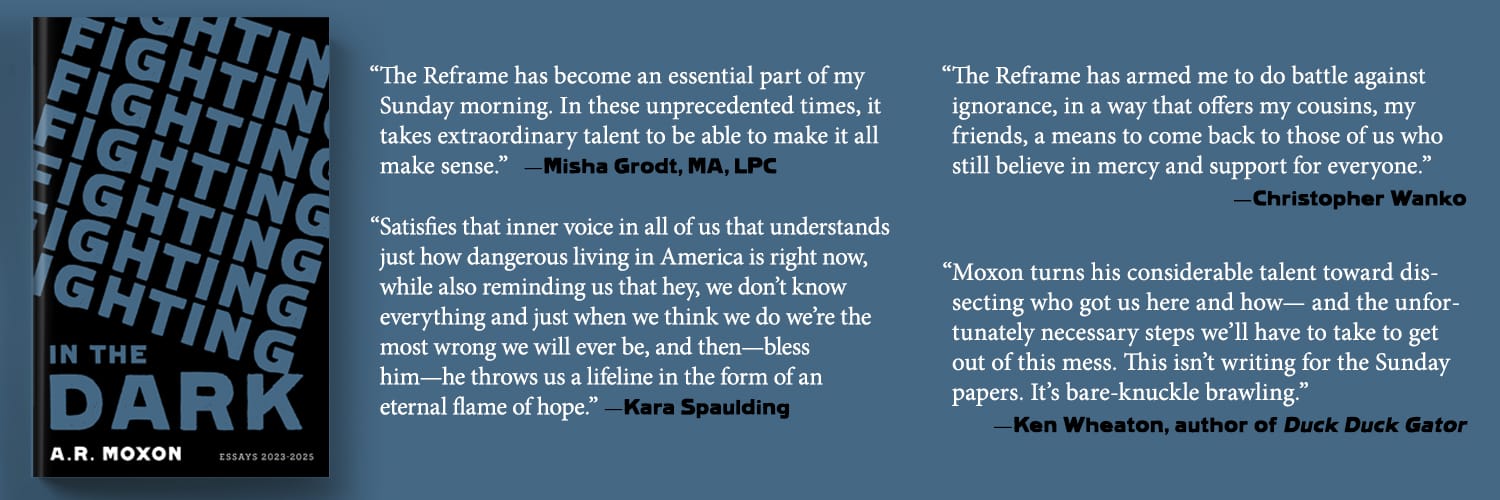
A.R. Moxon is the author of the novel The Revisionaries (2019) and the essay collections Very Fine People (2024) and Fighting in the Dark (2026), which are available in most of the usual places, and some of the unusual places. You can get his books right here for example. Now that he's become a man, looking very mean; got a nice shiny sports car, keep it very clean.



Comments ()