
This is Us
Moving from "I'm one of the Good Ones" to actually becoming good.
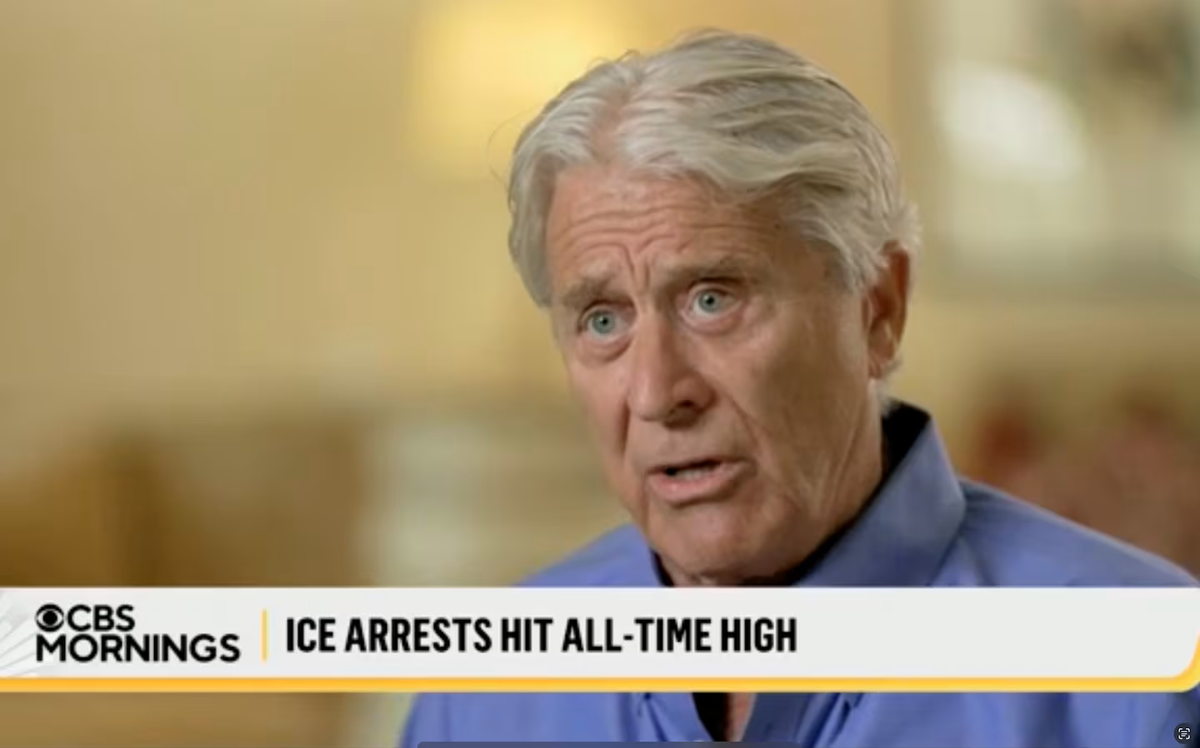
Read all about it! Texas businessman and lifelong Republican John Gannon has his regrets, the news would like us to know.
Gannon’s a successful guy by most measures. He owns more than 1,000 billboards in the U.S., so we know he really contributes to society in meaningful ways. In addition, he owns multiple establishments in Mexico, including a hotel and a restaurant. Gannon said he and his fiancée, Yasmin Carolina Suarez Reyes (who holds dual citizenship in Venezuela and Spain), were on their way to a Vegas furniture convention in early August when she was detained at George Bush Intercontinental Airport. ICE claims that Suarez was overstaying her original authorization filed under the Visa Waiver Program. Anne Kennedy, who is Suarez’s immigration attorney, points out in the stories that Suarez was using the approved methods to petition for asylum and was here in perfectly above-board and legal fashion. As far as I can tell, Kennedy is correct about that. As far as I can tell, the response of ICE to this is lol, lmao, fuck you, we’re ICE.
So those are the facts. Here’s the direct experience of it, per John Gannon.
“Eight officers ICE agents swarmed Yasmin, detained her, didn’t tell us why, and wrestled her off into a car. No explanation was given.”
This is a disturbing story, but unfortunately a very familiar one, just meat n’ potatoes for this Republican-controlled nation and its fascist goon squads of white supremacist kidnapping and murdering pedophiles and sex offenders. The news probably wouldn’t have brought the story to our attention at all if they didn’t have a hook, which they do. It’s one of their very favorite hooks: White Republican Guy Has Regrets About Trump.
Here’s a sampler platter of quotes from an occasionally-tearful John Gannon (who, I reiterate for no specific reason, owes no small part of his prosperity in no small part to property he owns in Mexico):
“I voted for Trump …. I wouldn’t do that again, not after this fiasco. I would never have thought the United States would act this way. Go after the criminals, we’re all for that. But leave the mom and pops and the kids alone. …. This was like the Gestapo …. I didn’t vote for that. I voted for ‘get the criminals out.’ They are picking up law abiding citizens … they are destroying families.”
And yes, they sure are! ICE and the rest of our authoritarian apparatus has absolutely 100% been destroying law-abiding families for years and years now, for decades, which they've done by casting them not as our friends and neighbors and family but as dangerous criminals, in a process that is called, in no small part thanks to the news, “border security.” Also thanks in no small part to the news, we now know also how John Gannon feels about the destruction of his own particular family, in a way that we don’t get to learn about most of the other millions of people affected. You’ll never guess it, but John Gannon is regretful.
“How do I feel? I feel totally betrayed. I mean, you never thing or I never thought that a guy like me would be involved in anything like this … I was just in total disbelief … nothing like this has ever happened to me; you know, I have several businesses, I’m law abiding, and I pay a lot of tax.”
A lot of tax? Well, Jesus, John, why didn't you say so? It seems that as a big taxpayer, John Gannon didn't just support his fiancée's abduction politically; he also funded it.
Much to think about here. Much to say. Where should we start?
It seems like John Gannon should be able to learn something from this.
It also seems like he hasn’t learned much yet.
We could start with all the usual responses to the stories. You know the ones. I thought them while writing this, and I bet you thought them while reading it. Poor John Gannon is one. Fuck John Gannon is another.
We could run those scripts. I'm not saying they don't have their places, situationally speaking.
I’d rather disrupt scripts.
How about we start with what this story is really saying?
It's not the end of the essay! It's only a quick reminder that The Reframe is me, A.R. Moxon, an independent writer. Some readers voluntarily support my work with a paid subscription. They pay what they want—as little as $1/month, which is more than the nothing they have to pay. It really helps.
First think I notice is that this is a story about something that has happened to John Gannon, not a story about something that is happening to Yasmin Carolina Suarez. My search for Suarez’s current status didn’t return much, which suggests that there isn’t as much media curiosity on that score as there is on whether or not an anti-immigrant Texan who is a Mexican businessman still supports Trump after Trump deported his loved one. I found one update from later in August that she’s still in custody. Many are. The media doesn’t have stories about that, though, because the only affected party in our dominant supremacist and exceptionalist national script is John Gannon.
Venezuelan asylum-seeker got herself abducted for excessive Venezuelan-ness? Not a story.
Poor little John Gannon had his fiancée torn away from him? Hot damn!
The media is not alone in applying this lens. John Gannon clearly sees himself as the party most aggrieved. In his own telling this is something that has happened, not first and foremost to his abducted fiancée, but to him, a guy, a white guy, a white guy with white hair, a white guy with white hair who makes a lot of money (a lot of it in Mexico) and pays a lot of tax. In what country does he pay a lot of tax? How much does he pay? The answers exist, but they are not published. That’s not part of the story. One suspects the questions never even occurred to those who might have asked. He’s a person who deserves rights, is the point of the story, and that’s an increasingly rare thing in the United States.
The story is clear: John Gannon is not the kind of person who is supposed to have his loved ones torn away from him by the sort of cruel and racist authoritarian apparatus that people like John Gannon support. That sort of treatment is for most everyone else, but not for him, and so he is now regretful, which actually means he is retributive: He has not gotten what he feels he was promised in the political transaction, so he no longer supports Donald Trump, the man who promised to do exactly what he just did, to people exactly like Yasmin Carolina Suarez. And Trump is a man who John Gannon should not be able to vote for again, Constitutionally speaking—provided laws still exist that can check a Republican—so Gannon’s withdrawal of support is largely abstract. But almost all elected Republicans support what is happening to dozens, hundreds, thousands, of people like Yasmin every day. Will Gannon stop supporting all Republicans, or is he going all-in for Marco Rubio or JD Vance or whoever the next authoritarian nightmare is the American fascist project runs? The answer surely exists, but it isn’t published. Not part of the story. One suspects the question never even occurred to those who might have asked.
The story is about how the terrible things, which usually happen to the people who deserve the terrible things, somehow happened to one of the people who do not deserve the terrible things, according to one of the sorts of people who get to decide what people deserve.
Gannon’s billboard is the same as the national one: THIS SHOULDN’T HAPPEN, NOT TO ME.
And now that John Gannon has had the experience he intended to come to others, John Gannon feels sorry for himself; now that the supremacist narrative has come for him, he feels betrayed by the narrative. He can’t understand how this country would behave in exactly the way he wanted it to behave. He can’t believe that the lawless goon squads he wanted to terrorize the country with mass deportations are mass deporting in such a lawless fashion, and that it is so terrifying. And we are invited to feel sorry for him too; otherwise, we are invited to note certain obvious and infuriating hypocrisies and complacencies and points of meticulously cultivated ignorances, and be infuriated by them. Which response is expected of us depends largely on the publications and the reader.
Here are the scripts: Poor guy, I really empathize with him, this learning moment is a chance to bring him into the fold and help him heal, etc. etc.
Versus:
Go peddle your pathetic pity party in private provinces, Pete, you fucked around and now you found out, you joined the leopards-eating-faces party and leopards ate your face, etc etc.
These are simplifications, maybe. But these are the scripts. I reckon you recognize them. I suspect I’ve given you a sense of which of these scripts I’m sympathetic to, and which I’m more likely to run, but I’m less interested today in running the scripts and more interested in breaking down the story.
The story that John Gannon is pretty clearly telling himself about himself is: I am one of the Good Ones. It’s a very common story, and very popular. Is it good to think of yourself as good? I think it can be. Certainly I can see how thinking yourself bad isn’t psychologically healthy. I would like to draw a distinction, though, between thinking yourself good, and thinking yourself to be one of the Good Ones.
You see the difference, right?
“I’m good” is a story you are telling about yourself—a Me story. And for sure, let’s hope that you are a principled person with moral and intellectual rigor who tests your perceived goodness against a standard of goodness, and let’s hope that those underlying principles respect the personhood of all other people, and let’s hope that part of that goodness is aspirational because you understand that you have areas where you could improve and intend to work at improving those areas, because if you aren’t then you might think yourself good for being harmful and abusive, and there are many such cases, many such people. However, either way, what you’re engaging with is a belief about yourself, the protagonist of your Me story: I’m good, I’m OK. I’m not perfect but I’m working on it. I’m trying. I’m no worse than the next guy.
But when you believe that you are one of the Good Ones? … well, that’s a story about everybody else. That’s an Us story of sorts—we are the Good Ones—but really it’s a Them story, because it depends not so much on being a certain kind of person that belongs to Us but rather on establishing that you’re not any of the other types of people who make up a Them—everybody else. You cannot be one of the Good ones, after all, without everyone else being one of the Bad Ones. I’m One of the Good Ones is a story that says I’m good because I am goodness; the things I did are good because I do them; the things I do are well-intentioned because my intentions cannot be bad any more than my actions can; badness cannot apply to me because to apply to me is to be good and to not apply to me is to be not-good. Bad things that happen to bad people are their own fault, not because they made bad choices, but simply because bad things are meant to come to them. Bad things that happen to me are somebody else’s fault, not because I haven’t made bad choices, but simply because bad things are not meant to come to me.
There’s a certain strength to this, a certain power, and fascists know it and harness it. When you’re not just good but goodness itself, then you’re a hero, or at least you’re on a team of heroes, without having to do anything heroic. We defeated the Nazis. We stormed the beach at Normandy. We freed the slaves. We established the world’s greatest economy, the world’s oldest democracy. We spread freedom around the planet. We're part of a winning team, the best team, who only does things that are justified, who only acts for the best for everyone who matters, and so we do not have to do the work necessary to test ourself against shared standards and improve, because when one is already exceptionally good, there is nothing to improve.
If we're the Good Ones, then every good thing we have has come to us because we deserve it, and we deserve it because we are us. And, if you are one of the Good Ones, then you get to decide who else is one of the Good Ones, to lend your goodness to somebody who would not enjoy goodness without the reflection of your innate and inerrant goodness. If you fall in love with an asylum seeker, for example, and really get to know her—even though she clearly falls into the category of people you voted to round up and detain and export—you can unilaterally make an exception for her because you are exceptional. And, if she gets detained and brutalized and deported as promised, you get to announce that you didn’t vote for that, because clearly you only meant that sort of thing to happen to people not protected by the exceptions of your exceptionalism.
That’s a powerful story. I have noticed it’s very hard to break somebody out of it. It takes quite a shock—something like having your fiancée abducted by authoritarian goons doesn’t even always do it.
There’s a great weakness to the story, too, which is that if you are goodness itself, then you cannot ever be to blame for anything, and so any suggestion of fault becomes an existential peril. If there is nothing to improve, then you can’t improve, not unless you let go of your exceptionalism, and doing that would mean leaving your winning team, of no longer being one of the Good Ones. If you make yourself resistant to improvement in this way, it becomes less and less likely that you will even be regular-good, much less exceptionally so. And, if it turns out you aren’t exceptionally good, and your intentions aren’t unquestionably well-meaning; if it turns out instead that you are actually an entitled morally and intellectually lazy hypocrite indoctrinated by a lifetime of interlocking bigotries into supporting a human-consuming ideology, then reality is eventually going to intrude, at least if you are a human, and do not like being consumed.
It’s probably existentially terrifying to believe you are one of the Good Ones, only to discover that some of the other self-authorized Good Ones disagree with you about that. It’s probably disorienting to believe yourself unilaterally authorized to decide who is a Good One only to discover that that authority isn’t yours any more. It’s probably earth-shaking to consider yourself exceptional only to discover a place where you can’t make exceptions, to belong to a story that exists to afford humanity only to a shrinking preferred in-class and suddenly find yourself on the outside of it, unprotected by the bubble, blasted by the icy wind.
At times like that, you can see the world's disenfranchised supremacists instinctively reach for the empty place their exceptionalism used to be. Delusions punctured by harsh reality, you’re likely to hear something from them very much like what John Gannon said: This isn’t us.
And you’re likely to hear back, from people directly harmed and abused by exceptionalist delusions: Oh yes it is you, it’s exactly you, it’s what you’ve always been all along.
And this too is terrifying to hear, not only because it is harsh and disorienting, but because it happens to be true, and dealing with the truth of that is going to involve a lot of psychological work, which the person encountering it has made themselves exceptionally ill-equipped to do.
This still happens to me sometimes, you know. I still say this isn’t us and hear back yes it is. It’s not pleasant to hear these things. Hearing these things is also exactly how I changed myself from somebody who still unquestioningly internalized myths of exceptionalism and supremacy into somebody who interrogates and deconstructions it. So I know from first-hand experience that change is possible.
I mention that because a lot of people are talking about how we might persuade, if not John Gannon specifically, all the Johns Gannon out there—comfortable and complacent people who thought themselves exceptional exceptions, suddenly shocked into reality by incontrovertible evidence of a worldview that exists to abuse and consume human beings, including, all of a sudden, them.
Improvement is better than stagnation or decline, so I think we should help persuade the Gannons of the world to be better Gannons, if we can.
But maybe, like me, you get hung up on that word, persuasion, for all the ways it is misused.
We should be clear who we mean by that we, or we’ll just scold the people harmed by the world’s Gannons for not being conciliatory enough and respectable enough to the world’s Gannons to deserve to not be harmed by them; we’ll engage in the traditional supremacist trap of expecting the people who live in the midst of the mess we made to clean up the mess for us, and to do it to the exacting standards we demand. We’d better avoid that trap, if we would truly oppose the exceptionalist story, if we would stop forcing the most vulnerable people into the most vulnerable positions in order to serve our own exceptional ease.
And we should also be sure of what it is, exactly, we are persuading the Gannons of. Are we simply persuading them that they are the ones who deserve everyone’s first empathy? We can save our energy, if so. We have an entire media apparatus doing that job, and they’re doing it very well. Are we actually persuading them to improve? That would be better. I don’t know how we do that, though, if we don’t persuade them first that there is something that needs improving—the exact belief their worldview most protects them from, in other words.
How the hell do we pull that one off?
Let me start with a few ideas that I find helpful.
The first idea I offer is this: Our primary opposition is for the worldview, not the individual.
As I see it, we are in contention, first and foremost, with a terrible anti-human worldview. It’s a worldview that puts us in frequent but secondary contention with the actual human beings who ascribe to it and promote it, literally all of whom would be better off free of it. So, we would do well to realize the difference between individual stories of Me and collective stories of Us. We’d do best to save our empathy (where appropriate) for individuals, while being ruthless with worldviews.
Can we imagine an improved John Gannon? I don't see one yet, but I can imagine one. He’s had a terrible shock, and he’s not alone. A lot of people have recently been faced with the incontrovertible evidence that they belong to a system that exists to abuse and consume human beings.
An improved John Gannon would have to be somebody who sees this story as something that has been done to other people, not to himself. Does he extend the sympathy he shows himself to his fiancée? He might. It’s not clear in the story that he does, but that might just be the story’s framing. Does he extend it to others? That seems less likely still.
This would be a good place to begin. We might do well to ask, as the news media did, “how did you feel?” but we’d do far better if we progressed to “how do you suppose Yasmin felt?” and best of all if we progressed to “how do you suppose the tens of thousands of other families this has happened to feel?”
We might do well to ask, as the news media has, if he regrets what he has done. But we’d do better to ask “what do you now intend to do?” We might do well to ask if his support for the authoritarian has changed. But we’d do far better to ask “How has this changed you?”
These are questions that do not seem to have occurred to our news media. They may well not have occurred to John Gannon, or the legion of Gannons out there.
Many of them will never ask that question of themselves, and will resist any suggestion they ought to. But some—some—might, especially if they are asked.
Asking might plant a seed in their mind.
The second idea I offer is this: Stay open to the uncomfortable challenge.
I wrote last week about the power of saying “that isn’t who we are” in challenge to manifestations of our dominant and exclusionary supremacist story of Us, in order to create a more expansive collective story. And I still believe we bear a responsibility to challenge the contracting and exclusionary exceptionalist and supremacist story of Us, by locating the larger and expansive Us and promoting that story.
So yes, we ought to say “this isn’t us,” to call attention to the places that need improvement, and to announce our intention to improve.
But—because our dominant story was and is supremacy—we ought to be ready to hear back “no, this is you.” I don’t think we can be people who improve and change if we’re not open to hearing this, particularly from people who have been directly targeted for supremacy’s harms and abuses, who have direct experiential knowledge and understanding of those abuses, who know very well that when supremacists and exceptionalists say "we" and “us,” it does not include them.
What I’ve noticed is how frequently “this isn’t us” is issued, not as an aspiration to improve but as a denial of responsibility and blame—as just another way of staying exceptional, just another way of demanding first sympathy for a situation we have helped bring about, a way of demanding empathy as our exclusive right. I can certainly understand why people with direct experience of the exceptionalist and supremacist story of Us—well acquainted with these ahistorical exceptionalist displays of self-pity—feel compelled to issue a correction. I don’t really blame them for not being polite about it. I don’t feel particularly interested in scolding them for their tone. There’s a boundary that needs to be defended there, so that the burden of responsibility for correcting the abuses they suffer are no longer placed on their shoulders.
We might do better to say “that shouldn’t be who we are” or “we ought to be better than that.”
I also think that, to the degree that each of us has benefited from the exceptionalist supremacist story rather than suffered from it, we should take care before we ourselves answer somebody’s “this isn’t who we are” with “this is exactly who you are.”
What I’ve noticed is how frequently those of us who have benefitted from exceptionalist and supremacist narratives issue “no, this is exactly who you are,” not to tell the truth about the historical record, but as another way of re-establishing ourselves as one of the Good Ones—no longer in denial of supremacist exceptionalism, but in denial of our responsibility for it; not culpable in the same way as the John Gannons of the world are, and therefore not culpable at all. Frequently, those of us who do this are just claiming the moral clarity of those who have suffered supremacist abuses for ourselves; it's just another exceptionalist way of taking a space and a position that belongs to others, just another way of engaging in the old exceptionalist blame-dodge shuffle.
Can we imagine an improved John Gannon? I can. He’s had a terrible shock, and he’s not alone. A lot of people have recently been faced with the incontrovertible evidence that they belong to a system that exists to abuse and consume human beings.
An improved and improving John Gannon would have to be a John Gannon capable of hearing “yes this is you.” This doesn’t seem likely, but he is going to hear it, because it is the truth. Rather than scolding the people telling him the truth, we’d do better to let him know, if we are one of those he might hear, “Yes, a lot of people have been hurt in the same way as you have been, because of a lot of people who have supported this, like you have. Just as you don’t support the person responsible for your pain, neither do they support you.”
Will he hear that? I admit it's unlikely. But I don't see how he'll improve until he realizes there's something to improve.
Also unlikely, but perhaps slightly more likely: Rather than "yes, this is you," he might be open to hear “Yes, this is us.”
Instead of “this is exactly who you are,” those of us who have benefitted from exceptionalist and supremacist narratives might do better to enter into the larger We; to say “actually, I have learned that this is who we have been, and it’s who we still are in many ways. I’ve been trying to be better. Would you be interested in learning more about that?”
The answer will likely be no.
Every so often, it might be yes.
And it might plant a seed. Seeds grow, sometimes.
Last idea for now: You are responsible for your own improvement, not that of others.
Can we imagine an improved John Gannon? I can. He’s had a terrible shock, and he’s not alone. A lot of people have recently been faced with the incontrovertible evidence that they belong to a system that exists to abuse and consume human beings.
An improved and improving John Gannon would have to be a John Gannon capable of thinking “who is affected more than me?” and capable of hearing “yes actually this is who we are.”
How could we get John Gannon there? is the usual question, but I don’t think it’s the right question. I think the right question is: Is there anyone who might do something that might help him get himself there?
I am not going to change John Gannon specifically. He’s just an example. I don’t know John Gannon and he doesn’t know me, and I doubt he knows you, either. We hold no influence over him, you and I; John Gannon isn’t our specific responsibility. But he’s definitely somebody’s responsibility. First of all, somebody who knows better probably knows him, and they ought to have a challenging “this isn’t who we ought to be” conversation with him. And we each probably have a John Gannon of some kind in our lives. Several, probably.
And you might say "I know that person, and they are not my responsibility."
I agree.
I know John Gannon is for sure somebody’s responsibility, because John Gannon is responsible for himself. We could say we are personally responsible for his improvement, but to me that’s just another face of exceptionalist thinking, just another way of taking onto ourselves a responsibility that isn’t ours, just another way of believing that we can control other minds, or believing that we need the permission of and approval from supremacists before we pursue anti-supremacy. The work of improvement will involve seeking help, and if we are positioned to provide it, we’d do well to provide it, but in the final tally, if John Gannon is going to improve, he’s going to have to be the one who does the work.
This is frustrating, but it’s also freeing in a way.
First, it frees you to work on your greatest responsibility, which is getting yourself more and more free of our traditional dominant narrative of American exceptionalism and supremacy. Part of that work might be recognizing that, while you are not responsible for John Gannon, you bear some responsiblity for changing the dominant supremacist narrative.
Second, it turns you into the sort of person who can be much more effective at talking to people like John Gannon about improvement and freedom from exceptionalism and moving from being one of the Good Ones to actually becoming good, because you can talk about your own journey, your own lessons, your own paths—you can provide the example of yourself, and you can chart the journey with authority, because you have taken it.
You can hear John Gannon’s tale of woe, and instead of feeling the need to force him to face every one of his many hypocrisies and incoherencies, force him to admit his wrongs, force empathy into the unconditioned vessel of his heart like you're shoving a wet towel into a Coke bottle, simply ask him “and what have you learned from this?”
You can hear his response, and say “would you be interested in knowing what I’ve learned?”
Will he be interested?
That’s up to him. If he is, you can tell him. You might have a chance to plant a seed that helps him do the work he needs to do on himself, helps transform his mind into a vessel more conducive to receiving empathy and responsibility and truth. You may never know the impact you had.
If he’s not interested, you can move along.
If he won’t do his work, we have plenty of other work to do—on ourselves and the world around us.
The Reframe is totally free, supported voluntarily by its readership.
If you liked what you read, and only if you can afford to, please consider becoming a paid sponsor for as little as $1/month. If you'd like to be a patron of my work, there's a Founding Member level that comes with a free signed copy of one of my books, and thanks by name in the acknowledgement section of any book I publish while you are a member.
Looking for a tip jar but don't want to subscribe?
Venmo is here and Paypal is here.
A.R. Moxon is the author of the novel The Revisionaries (2019) and the essay collections Very Fine People (2024) and Fighting in the Dark (2026), which are available in most of the usual places, and some of the unusual places. You can get his books right here for example. He heard it from his friends about the things you said, but they know him better than that.


Comments ()