
The Cost of Doing Business
A modest proposal: Abolish the death penalty for humans. Institute it for corporations.

In the small town of Saline, MI, the governor of my state stood next to a man who says he wants to sell human intelligence back to humans as if it were on a meter, and smiled for the cameras. The governor’s name is Gretchen Whitmer, and she’s done some good things in Michigan, but she’s certainly also done this. The fellow who wants to meter human intelligence is named Sam Altman, the rather alarming billionaire CEO of OpenAI, which is the company behind ChatGPT, which is one of the more influential large language models. And AI is a tool that does a lot of things, including run on massive water-gulping data centers that pose significant environmental risks and livability challenges to any people living nearby , whether they pronounce “saline” as sah-LEEN or the normal way.
Michigan’s got a lot of water, as you might have heard. Holy shit it’s all over the place here. Whitmer’s predecessor was a guy named Rick Snyder, and he had a pretty bad track record on water-ish matters. You may have heard about the way he abandoned the entire city of Flint (whose population just so happens to be mostly Black) to suffer the toxic effects of toxic water the state under his government sent through their soon-to-be-corroded pipes. He was charged with criminal negligence for that one, though the judge dismissed the charges. Maybe you heard about how he licensed Michigan’s aquifer to Nestlé for $200 a year (not $200 thousand, not $200 million, no—two hundred smackers), which Nestlé uses to extract 576,000 gallons every day. Nestlé is a corporation infamous among opponents of child slave labor for highly credible accusations of utilizing child slave labor—a practice for which it faced a lawsuit that was eventually blocked by the U.S. Supreme Court, who deployed one of their trademark specious rationales. It's also a corporation whose former board chairman once announced that he found the idea that water is a human right to be extreme, and shared his belief that water as a global concern would be much better managed by public corporations like Nestlé, perhaps because they understand the proper application of slave labor. If you’re somebody whose body needs water, this sort of thing might interest you whether or not your state’s aquifers were or were not sold away by Rick Snyder. (Governor Whitmer campaigned on reversing this situation, but while she has done other good things for the state, she did not do that.)
Anyway, the people of Saline, MI did not want significant environmental risks and livability concerns, so they voted down the data center. “Voting” is the way the people express their collective will, in case you didn’t know. It makes sense to me that you wouldn’t want significant environmental risks and livability challenges, so that vote makes sense to me.
What happened next is sort of funny, if you find infuriating things funny. OpenAI sued the city of Saline, because they knew that Saline didn’t have the budget available to fight them in court, while OpenAI easily could afford it as part of the cost of doing business. And so Saline did not fight in court, and now they get a data center, and all the significant environmental risks and livability concerns that go with it, and also the fifteen jobs that it will eventually bring to run it, in offset of however many jobs it will eradicate; and they also get the governor of their state, who won in part on promises to protect Michigan water, wielding a grin and a ceremonial groundbreaking shovel in a photo op that to my eye looks like nothing more than a bunch of corporate executives digging the mass grave of some Nestlé child slaves.
It seems the voice of the people is nothing next to the desires of a single man who by any rational observation seems driven by a desire to consume humanity.
It seems justice and democracy are also things like water and human intelligence: something you have to be able to afford, or you can just go ahead and do without, and die if that's what that means for you, according to somebody who has amassed enough wealth to be able to tell you to go ahead and die, and to actually kill you if that's what he wants, secure in the knowledge he will face no consequences either way, because "legal consequence to billionaires" is not something anyone can afford except maybe other billionaires.
And a story from Pro Publica just hit my inbox. It’s about the people whose lives were destroyed by the opioid epidemic that was manufactured by Purdue Pharma corporation in order to turn massive profits for its billionaire family and their shareholders. Now, opioids are awfully good at reducing pain for people who suffer from pain, and in a medical setting and under proper regulation, judicious application, and mindful monitoring by medical professionals, they can and do effect wonderous things to lessen human suffering. The problem is that proper regulation, judicious application, and mindful monitoring do not lead to never-ending double-digit growth of revenues, and never-ending double-digit growth of revenues is what corporations require under increasingly unregulated capitalism. So the billionaires at the helm of Purdue Pharma urged over-prescription and under-regulation and pushed misinformation in their claims regarding the addictive properties of their product, and boy oh boy did the profits come in. And millions of people have died. Hundreds of people are still dying every day. Families have been demolished. Marriages have crumbled. Addicts sit in prisons contemplating their addiction-fueled crimes. And incidentally now it's much much harder for people who deal with pain and suffering to get the medicine that would help them manage their suffering. Hey, it’s just the cost of doing business.
That’s something that my heart insists upon recognizing as mass murder, even if courts won’t.
But maybe the courts will! Now there have been enough lawsuits that Purdue Pharma actually went under. They reached a bankruptcy settlement potentially worth $8.3 billion, a settlement that extracted from Purdue an admission that it "knowingly and intentionally conspired and agreed with others to aid and abet" doctors dispensing medication "without a legitimate medical purpose."
There appears to be something about our system that wants never-ending double-digit growth of revenue, and while it puts safeguards of sorts in place to deter perverse, corrupt, malicious, abusive, and even murderous behavior in pursuit of those ends, at the end of the day the systems that administer those safeguards exist to protect not humanity but the never-ending double-digit growth, and will rarely if ever extract any consequence greater than the gain. It seems that the consequence of legal penalty is like the consequence of thousands or millions of human lives: just another cost of doing business.
The billionaire owners of Purdue had to pay out a few hundred million bucks to resolve potential claims, of which there are many. They’re still billionaires. Along with all the facts pertinent to the whole affair that I have listed above, Wikipedia tells me they have consistently maintained they did nothing wrong and have never faced criminal prosecution for the company's actions. And sure enough there are other pharmaceutical companies who participated in the opioid bonanza, which are still in operation. One of them is Mundipharma, a United Kingdom-based pharmaceutical company which manufactures similar opioids to those originally designed by Purdue, with which the billionaire owners of Purdue are also involved.
Did the consequences of the crimes of Purdue Pharma outpace the costs? I guess it depends on what dollar value the courts place upon human lives in the end. The opioid deaths keep happening. The suffering for many survivors and family members is forever. Profits are still expected to be never-ending and double-digit no matter what, per shareholder demands.
Anyway, remember that story from Pro Publica that just hit my inbox? It tells me that among the handful of people who managed to receive a settlement from all this, many of them probably won’t ever see a penny. So there you go. The cost of doing murderous business is getting lower.
This has me thinking about corporations, and the billionaires who use them, and the way that both corporations and billionaires really seem to live in consequence-free and humanity-resistant bubbles.
Also the death penalty.
And then a modest proposal.
Its not the end of the essay! It's only a quick reminder that The Reframe is me, A.R. Moxon, an independent writer. Some readers voluntarily support my work with a paid subscription. They pay what they want—as little as $1/month, which is more than the nothing they have to pay. It really helps.
If you'd like to be a patron of my work, there's a Founding Member level that comes with a free signed copy of my upcoming book, Fighting in the Dark.
Let’s start with corporations. Corporations are massively successful tools for generating revenues. We might wonder whether corporations are a tool that could operate in a world where corporations did not need to be in pursuit of never-ending double-digit growth, but that would be speculatory, because a world where corporations must be in pursuit of never-ending double-digit growth is the world within which corporations operate, and thus it's the world we all have to live with—live, if we are one of the lucky ones. Not all of these corporations have committed what my heart insists on recognizing as mass murder on a global scale, I suppose, but a whole bunch of them have.
Now, around the same time that the billionaire owners of Purdue Pharma were mass-murdering hundreds of thousands of people in pursuit of never-ending double-digit growth, a conservative nonprofit organization sued in order to gain corporations the same protections under the law that human beings enjoy. The conservative project, as far as I can tell, is dedicated to the acquisition of power in order to consume human beings for profit, which it achieves by dividing the citizens of the United States with vile bigoted lies. The conservative nonprofit is called Citizens United, and as far as I can tell, it is in no way misaligned with that conservative goal. Anyway, Citizens United got what it wanted from our most supreme of courts, and corporations were deemed to be people under the law, and conservatives like Citizens United used this protection the way they intended to use it: They engaged the massive power of corporations and the massive wealth of billionaires to capture our political system even further than they already had, and then they used the influence this gained them to divide citizens and eradicate human rights in pursuit of profits and outright smash-and-grab theft, right until this very day.
So that’s corporations. Billionaires next.
When you’re a billionaire it’s almost impossible to stop being a billionaire. Your wealth gives you the ability to buy assets and then borrow against them, and then use that money to buy more assets and borrow against the appreciation to pay off the previous loans, and use that money to buy more assets, and none of it ever gets taxed because we don’t tax assets unless they are sold, and you get to use your loans that you use to buy things as a debt and a tax write-off, and then when you die your family inherits your wealth with an adjustment in basis that wipes all of the gain off the table from a point of taxability. It's called borrow-buy-die. Isn't it neat?
When you’re a billionaire, it seems it’s not about money anymore. You reach a place that’s above money, above tax, above consequence or even the possibility of consequence. You achieve orbit above human concerns, then find yourself free of the gravity of shared humanity, free of the need or expectation to care about the fate of others, with the power to end as much humanity as you can if you want to; you seem to develop the belief that if you do end as much humanity as you can, you’re perfectly within your rights to do so. You own the water, the land, the air, human intelligence and all the concepts it has ever generated. Your feet no longer touch the ground. Your success is yours because it is yours and it is deserved because you are you.
I am reminded that two of our most wealthy people look at the world around them and can’t imagine anything to do with it except pursue space exploration. One of these used his wealth to acquire and demolish one of the more effective communication platforms on the planet, and then to swing the 2024 presidential election in favor of a fascist pretend-billionaire, and then exchanged that influence in order to seize control of the U.S. government in order to steal massive databases of our personal data, and then to demolish and sabotage the public sector, much of which acts as his primary competition. He did this along the lines of his own racial bigotries, and his destruction of USAID alone is estimated to eventually cause 14 million deaths globally, mostly among the Black and brown people who this billionaire—who is as far as I can see an open Nazi—must be presumed to have wanted to see die.
My heart insists on viewing this man as a mass murderer on the scale of any other mass murderer who ever lived. But he’s not being treated as a mass murderer. Instead, he’s being treated as an honored and respected captain of industry: his lies believed, his murders unseen, his cars on the roads. His space company just got a $1.75 trillion dollar valuation based on his claims about what he can accomplish, despite the fact that most of his claims have been proved to be lies, despite the fact that his rockets keep exploding.
This is the point of becoming a billionaire, it seems. To no longer have to be something so base as a human. To be a god instead, free to do with humans as you please, free to go on being worshipped by human institutions no matter how many of them you destroy.
It seems like a humanity-eradicating thing to be, of both other humans and of the billionaire themselves.
So anyway, that’s billionaires. Now the death penalty.
The thing about the death penalty is I’m against it. Going into this at the length it deserves can be and is the subject of many an essay and many a book, but I don’t think the state should have the right to kill a person, the end. My opposition has its basis in numerous broad reasons, foremost among them my belief that our nation is founded in horrible unsustainable lies of supremacy, most notably patriarchy and white supremacy (though there are multifarious others), and that one of the pillars of that foundation is our carceral state and a punitive human spirit. Downriver of this is the fact that the application is observably racist, and we have executed people whose guilt was not only in doubt but generally disbelieved.
But even deeper than that is a moral objection. Even if the guilt of every person executed could be proved beyond doubt, I do not believe that the state should have the right to murder—even if it were effective (it is not). I do not believe that is a consequence that should be on the table for human beings, even ones who have committed terrible crimes.
I will be told this is impossibly naïve. I will be told that the death penalty must (contra evidence) be an option in order to discourage high crimes. I will be told that the pro-death-penalty position is the moral one, because human life is so sacred that those who take it must be subjected to death themselves, or the sacredness of the lives that were taken will not have been honored with an appropriate punishment. I will be told that the death penalty is God’s will, per the book that also says “vengeance is mine”—a passage that will be ignored until it is convenient to remember. I will be told that some people are animals who have deserved death, though I recall history’s lessons of those who would name their fellow humans animals and subject them to death for the crime of being animals, and the unimaginably dark places the urge to do so leads.
Here’s what I've noticed. The death penalty is only on the table for certain people. If you killed somebody during commission of a robbery, for example, or if you murdered a series of people, you should face consequence—on that I think everyone is agreed. But the death penalty is only for those deemed human beings under the law who are actually human beings, and if you are a human being who belongs to a group unfavored by white supremacy, it is for you most of all.
But for those deemed human beings under the law who are actually corporations, the death penalty is a rare and partial option. Even if a court ruling forces bankruptcy, shareholders will only lose their investment, not their lives. Even if the assets are redistributed, they still go somewhere and continue to exist, and the fight to extract them drags on into infinity. Nobody dies except the victims.
And if you are a human being who is a billionaire—one who gained vast wealth to escape the constraints and responsibilities of humanity, and who used your vast wealth to install a proto-dictator and murder 14 million people, the death penalty isn’t even an option. Hell, consequence isn’t even an option. Failure to further reward is seen as an unacceptable level of punishment. Levying the death penalty against one of our new human gods is as unreachable a goal for us as establishing a human colony on Mars is for them.
This brings me to my modest proposal.
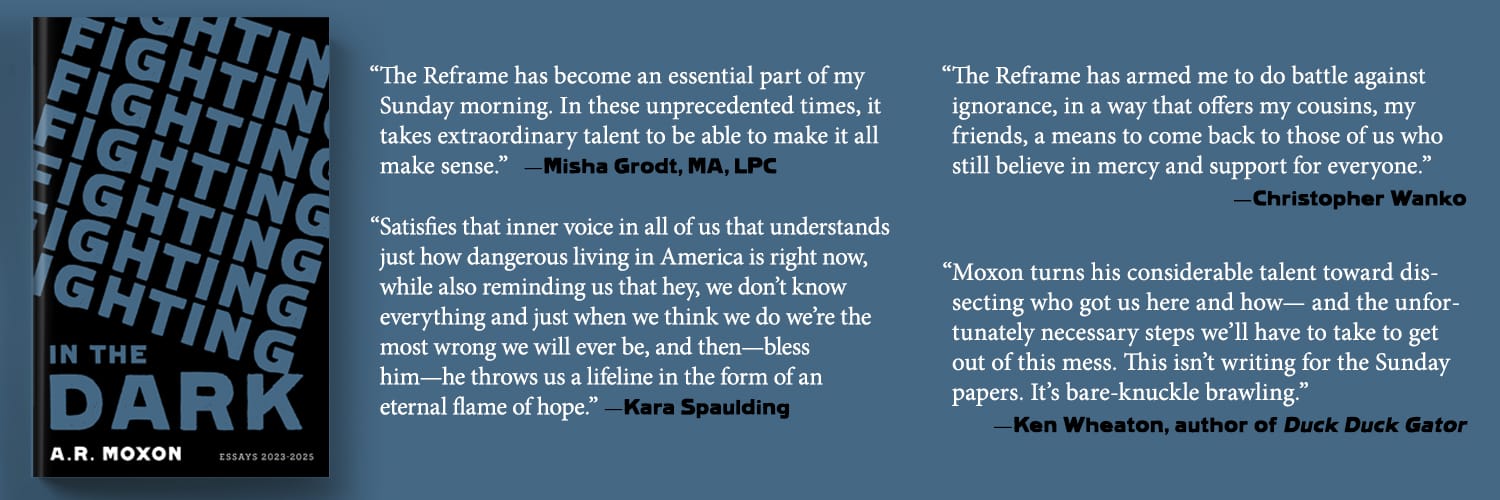
Hey! My next book comes out on August 4! Nothing helps an author more than preorders, so click the button below and learn all about how to get it!
It’s become a pretty common thing to say that billionaires are a policy decision, and that we shouldn’t have them anymore. I believe it's common because it's pretty obviously true, once you see what a billionaire is and how a billionaire becomes a billionaire. If you’re the sort of person who says that kind of thing, you already know that you’ll be told that getting rid of billionaires is terribly unrealistic, because of a long list of reasons that equate to “all of our systems of government, law, and commerce are organized for the benefit of billionaires.”
This is true. I’d say, though, that this points not toward the impossibility of making a billionaire a thing that doesn’t exist, but the need to revolutionize the organization of our systems of government, law, and commerce. So we could restructure our tax code for income and asset recognition and estates and rewrite all our corporate laws, and chase out of the halls of government and platforms of influence those who think we shouldn’t do that. These are steps I really think we ought to take, and the sooner the better.
But if you’re the sort of person who points that out, then you probably already know that you’ll be told that even changing our systems of government, law and commerce won’t work, because the billionaires are so powerful that they will be able to adjust to any change we throw at them.
Maybe that’s true, too, although I will note there are many different ways to worship gods, and while they enjoy reverence, they seem to really like fear—so those who say that billionaires can’t be stopped because of their malicious infinite power might have more in common than they realize with those who say billionaires shouldn’t be stopped because of their beneficent superiority.
But maybe the skeptics are right. Maybe the billionaires really have put themselves so far above our systems of government, law and commerce. that no change we make could reach them.
If so, maybe we could make a single adjustment. A modest proposal.
Let me just say it like this: No to the death penalty as a possibility for humans; yes to the death penalty as a possibility for corporations and billionaires. Let's introduce a cost of doing business that exceeds the gain to be realized—and, since the gain that can be realized appears nearly as infinite as the desire to acquire is within the hearts and souls of billionaires, the cost will have to be everything.
Proposed: For those deemed human beings under the law who are actual individual human beings, the death penalty should be absolutely impossible, but the death penalty should be possible for those deemed human beings under the law who are corporations—and by this, I mean human beings who are majority shareholders of those corporations. The death penalty is on the table for billionaires—individual human beings who have decided to amass such wealth that they have chosen to leave their humanity behind.
I think the case is pretty solid here.
As for corporations: If corporations are to be people under the law, then they should be people in all ways. They shouldn’t just get the same benefits and rights; they should operate under the same legal consequences. If a corporation—which has the ability to kill many thousands or even millions of times as many people as any human being—takes an action with motive and premeditation, or with such gross negligence and recklessness for human life that malice must be assumed, and that action results in the death of a single person, then the shareholders with board seats are subject to being sentenced not to loss of investment or fines that are less than the gain, but to the death penalty.
Let’s see what that does to corporate priorities!
As for billionaires … well.
I’ve already laid out the reasons for my belief that being a billionaire is a humanity-shredding thing. It’s not good for anyone, not even the billionaire. And, while the billionaire gets the very last of my sympathies, I would say it’s good even for billionaires if billionaires stopped being an option on the table for human beings. We'd do well to prevent it. They'd do well if we could prevent it.
But we know that the desire to become a billionaire is in people. Some people have that strange desire to acquire and acquire long after any real material improvement could possibly be made to one’s own life, or even the lives of one’s great-great-great grandchildren. An unhealthy need to create a boodle of wealth as indestructible as a continent, and then, having achieved it, to be unsatisfied unless you can have even more, and more, and more—not because you want money, but because you want to put yourself as far above humanity as you can.
That moment of escape from the gravity of human responsibility—when does it happen? There must be some point … it’s probably more than a billion dollars. I feel as if a billion is a place where you’re still a satellite, orbiting humanity from an almost impossible high place, but tethered nevertheless to some human realities. In any case, it seems to me inescapably true that we no longer need any gods who would use the rest of us as toys, so it would be good to draw the line long before that orbit turns into escape velocity, and a billion U.S. dollars seems as good a place as any to draw that line.
So, lets say this: If somebody has amassed $999,999,999 and 99 cents, and they would not like to be subjected to the possibility of the death penalty, then they can cease their amassing. They can accept things like laws that would tax them at 100%, above that level, and many of the other changes that we would have to make to our systems of law and commerce and government to protect them from the possibility of state execution, and to protect us from the possibility of them.
Or they could continue to amass their frankly ridiculous wealth past the established threshold, at which time they would be delivered the following letter from humanity:
Congratulations! You have amassed a billion smackeroos, with all the influence and power that attends that achievement! You’re a new god among us, with the power to decide the fates of those beneath you. You are no longer deemed an individual human being under the law! You are now deemed a billionaire! Well done!
This means the following things:
1) You now have over 1 billion U.S. dollars! Keep getting more if you want to! Thrive and grow your empire, you mighty Emperor of Men!
2) If you kill even a single one of us, we will find you and capture you and put an end to your life and give all your money to public libraries and single mothers on welfare.
3) You no longer have any right to any court of appeal.
4) Your descendants no longer have any right of inheritance.
If you don't like this arrangement, please cut a check to public libraries and single mothers on welfare sufficient to liquidate your wealth below $1 billion. Or, if you prefer, our auditors can set up an appointment to figure out how much of your money needs to go to your victims in order to become a human being under the law once again.
Thank you for your attention to this matter!
Love,
-The Human Beings of Earth, Who Don’t Need Gods That Walk Among Us
P.S. We can all tell those are hair plugs.
Will this work? Look, I don’t know. I’m not one of the smartest people in the world, or I’d probably be a billionaire like all the other smartest people on earth. But I think it might finally create something that proponents of the death penalty insist it creates: a genuine deterrent.
Would it be perverse to support state executions of billionaires and corporations while opposing the state execution of any other type of human? No more perverse than the opposite, which is our current state of affairs—and, I would argue, far less.
Would I feel great about the first execution? I don’t know. As I said, I’m against the execution by the state of human beings, and while billionaires very clearly have exhibited a contempt for not only our humanity but their own, I do recognize that, as damaged in the soul as they are, they are still human beings. Maybe we could do something that would make it fun and silly instead of terrible and somber—like using a trebuchet to fling them into a gigantic lake of tapioca pudding. We could even use their own money to build the lake and the trebuchet. And then afterward we could all enjoy a delicious bowl of tapioca.
So yes, maybe there are these problems and many more with my modest proposal. No doubt somebody will tell me so.
You know what I say to that? Something that I know billionaires and corporations are comfortable saying.
I think we just have to chalk it all up to the cost of doing business.
The Reframe is totally free, supported voluntarily by its readership.
If you liked what you read, and only if you can afford to, please consider becoming a paid sponsor for as little as $1/month. If you'd like to be a patron of my work, there's a Founding Member level that comes with a free signed copy of my upcoming book, Fighting in the Dark, and thanks by name in the acknowledgement section of any books I publish while you are subscribed.
Looking for a tip jar but don't want to subscribe?
Venmo is here and Paypal is here.
A.R. Moxon is the author of the novel The Revisionaries and the essay collection Very Fine People, which are available in most of the usual places, and some of the unusual places. You can get his books right here for example. His upcoming essay collection is Fighting in the Dark. When he dies he'll turn into a tiny ball of energy.

Comments ()