
The Submerged Story
Want to win the story game? First, know whose story you're really telling.

Elon Musk isn’t a trillionaire anymore. So I’ve heard. It was fun while it lasted, provided that you find corruption fun. Many do. Apparently the obviously bogus SpaceX stock valuation was a bit bogus, and there’s been a big selloff. Some rich people got rich, and anybody who was still holding paid the cost. World’s richest man and Nazi genocidaire Musk now only has $941b to give one recent count, so he might have to work for a living for a change. I’m not doing the math to figure out whether it all means he’s net up or down on the whole SpaceX shebang. Unless something radical changes, the game will go on. The rich will get richer, and the poor will get the bill, and even though this state of affairs doesn’t help anyone, changing any of the systems that authorize and operationalize this state of affairs is apparently disreputably radical and even the suggestion of any systemic change makes powerful people very uncomfortable and reactive.
Speaking of the comfort of powerful people, we have plenty of ethnic-cleansing concentration camps being filled up with brown people, who have been arrested by kidnapping squads for the crime of being brown people, and a few people who resisted this horrific state of affairs down Texas way were just given draconian sentences for even the most tertiary involvement with said resistance. These concentration camps are a natural inevitable outgrowth of a national prison industrial complex that profits off of human incarceration, and the kidnap squads are a natural and inevitable outgrowth of a nationwide policing state that sucks up over half of many municipalities' budgets and delivers mostly brutality and authoritarianism. Anyway, this ruling was framed by the judge as a warning to all anti-fascists, and is being celebrated by Republicans and other types of fascists as a validation of Donald Trump’s 2026 Counterterrorism strategy—a chillingly authoritarian document that brands as terrorists anyone who is left-wing or anti-fascist. Naming anti-fascists as your enemy does seem to be a bit of a giveaway when it comes to fascism, but it seems clear that even the suggestion of anti-fascism makes powerful people very uncomfortable and violent, and so there is a vigorous empowered attempt to make “anti-fascist” an increasingly high-cost and disreputable thing to be.
And this week we’ve heard the most vile and base gutter racism from the likes of Nancy Mace, Ted Cruz, Tom Emmer, and Megyn Kelly. Over the decades I've been told that it's good when racist things are said out loud, because when people are exposed as malicious bigots, public opinion turns against them, and then they lose their reputations and their jobs. The word is that bigotry is a sort of self-cleaning operation, but I do notice that nobody has lost their job. Well, not nobody. An Indiana college professor who pointed out that the Republican party represents a white supremacist movement was recently fired, so it would seem the truth is opposite of the tale: Gutter bigotry is celebrated and low-cost, but exposing it is increasingly high-cost and disreputable.
At the same time that gutter bigotry and authoritarianism is openly promoted and celebrated, the fascists doing the celebrating also praise themselves for opposing what they claim is the fascist menace of anti-fascists. At the same time that heroic resistance to authoritarian bigotry is criminalized and vilified and suppressed by authoritarian bigots, the fascist bigots doing the criminalizing and vilification also celebrate themselves for their brave resistance against oppressive authoritarianism and fascism. Racist fascists and bigots are very proud of their racism and fascism and bigotry, yet at the same time they are violently opposed to being called racists or fascists or bigots. In fact, they craft narratives to prove that they are in fact the heroes, the resistance, and they do it with genocidal rhetoric from a position of autocratic imperial power, while billionaires pose as populist men of the very people they crush. These are people who very much want to be permitted to be as they are without paying the cost of being seen as they are, and they appear willing to threaten and persecute and harm and kill anyone committing the crime of perceiving them accurately. Musk recently threatened to sue U.S. Representative Ro Khanna for pointing out that Musk is a racist mass murder—which he absolutely is. Pointing out racist mass murder carries a high cost these days. Committing racist mass murder? That’s just capitalism, baby! That's what makes you the trillions with the trippy-T.
While all of this sort of suppression and oppression is leaking out from the halls of power and influence, there seems to be a general public awareness that our institutions—and those who currently control them, and those who associate with them—deserve to pay reputational costs. Trump’s special big-boy birthday party was supposed to be a star-studded event, but all the stars dropped out one by one, leaving only the stud (Vanilla Ice), and Trump was forced to cancel. Clean comic with a nice-guy image Nate Bargatze had to do damage control after he attended the grotesque spectacle of the UFC fight on the White House lawn, and realized that despite the story he had been telling himself, you can’t attend a fascist party and pass it off as apolitical, which appears to have surprised him—apparently that's a new development. Longtime Nazi apologists Tucker Carlson and Marjorie Taylor Green, two grifters who always know exactly where their Wonderbread is buttered, have recently distanced themselves from the Republican Party. Just a few examples from recent weeks.
It's a strange cross-current. Our halls of power and influence are using oppression and suppression to raise the reputational cost of basic human decency and moral bravery, while lowering the costs of white supremacy and cruelty. Meanwhile our collective society seems to be reacting by raising the reputational cost of involvement with our halls of power and influence and those who run them. And even though people desperately need systemic change to solve pressing problems, and systemic change is by nature radical, people who want to actually radically change the system in order to benefit people are in disrepute, as are the needed solutions.
Yikes! What is happening?
I believe it’s something I’m calling the story game.
Every story needs stakes. Let's set some.
As I see it, we’re dealing with a struggle between people with oppositional world views, waged by people who care about their varying world views over the persuadable hearts and minds of people who (for various reasons) seem to not care. It’s a struggle over which story is going to hold sway. This tug-of-war I’m talking about is a human game, which I believe means it is a spiritual game, which means I believe it to be a story game. I believe this because I believe people are spiritual beings who operate on institutional, collective, and personal story.
The oppositional worldviews? Let's call them progressive humanism and regressive supremacy.
Progressive humanism is the belief that all people matter and deserve life, that generative human value springs from an inextricable and diverse mutually cooperative interconnectivity, and that we have a natural responsibility and moral duty to take the natural human system we have inherited and use our energies and skills to progress and improve it.
Regressive supremacy is the belief that only specific types of people matter and deserve life, and then only to the degree that they conform to specific and rigid hierarchical roles and doctrines; that all other human beings, who must earn life, get what they deserve and deserve what they get, because they are the natural property of the people who matter most.
That’s really boiling it down, but there have been millions of words written defining these topics (I’ve contributed some tens of thousands myself) and we could be here all day.
To admit to my biases up front, I very much want to see the story of progressive humanism prevail in this human story game, because it is based in deep and sustaining natural truths, while the story of regressive supremacy is based in suicidally unsustainable murderous lies. This means that if the progressive humanist story prevails, we will continue to improve and grow and learn and live—to progress, in other words. But if the regressive supremacist story prevails, we will regress, and we’ll get even more of all that comes with it than we already get: torture and murder and war and slavery and genocide and pandemic and (it appears increasingly likely) total global environmental collapse. We’ll see the destruction of human knowledge, human art, and billions and billions of human beings, a catastrophe from which regressive supremacists will in no way be spared. Maybe Elon Musk, one of the people who are most responsible for making this possibility ever more likely, will live through all the carnage, cocooned by his billions or trillions. Or maybe his guards will kill him and eat him and take his apocalypse bunkers away for themselves. We’ll never know, probably! That’s going to be up to his guards!
Anyway, that’s the choice before us.
By “us” and “we” I mean human beings globally, by the way. You and me and Kid Rock and Greta Thunberg and my fourth-grade teacher Mrs. Hondalink and all the rest of us.
So now we have conflict and we have stakes.
Let’s talk about the stories we're telling.
Its not the end of the essay! It's only a quick reminder that The Reframe is me, A.R. Moxon, an independent writer. Some readers voluntarily support my work with a paid subscription. They pay what they want—as little as $1/month, which is more than the nothing they have to pay. It really helps.
If you'd like to be a patron of my work, there's a Founding Member level that comes with a free signed copy of my upcoming book, Fighting in the Dark.
Here’s what I’ve learned about how humans use story, based on my experience of being a human: We tell stories to each other to generate the pool of stories it’s possible to tell. We tell stories to each other to reinforce or modify that pool of available stories. And—mostly from the pool of available stories—we tell stories about ourselves to ourselves to let ourselves know what sort of person we are. That's the surface level. But there are stories that lie submerged below the surface.
Let me make this a little less abstract.
Growing up, I was taught it was a shameful and indecent thing to be fascist, and very good to be antifascist. I was taught it was a shameful and indecent thing to be bigoted and cruel. I was taught it was shameful and indecent to want good only for yourself and to want harm to come to others as a result. I was taught it was a shameful and indecent thing to be indifferent to the suffering of others, much less to celebrate it. I was taught it was good to be hospitable and kind, and that good people celebrated differences in others. I was taught the best use of power and resources was to make sure that those who didn't have enough got what they needed.
I believed that story. I still believe it. It's pretty clearly not the dominant story, though, because it's not guiding our actions, collectively speaking.
I was also taught that there were no real stakes. The struggle between progressivism and supremacy was already won. We defeated white supremacy most of the way back in the 1800s with the Civil War. The story about the Civil War was that our country had gotten slavery foisted on it somehow even though nobody liked the institution, not even the wealthy landowners who owned hundreds or thousands of enslaved humans. Then we had a war that was mostly about some unrelated matter and Abraham Lincoln freed the slaves and ended the institution of slavery forever. Later, we polished fascism off for good as the unambiguous heroes of World War II, and then we polished racism off for good when Martin Luther King Jr. told white people about his dream of equality and then we all believed it and racism stopped. By the time I came along in the 1980s, all that was left was the mopping up, and that was going to be handled automatically by the long arc of history, which I was taught naturally bent towards justice. This meant that I lived in an exceptional country of justice, a beacon of freedom and democracy, which was self-evidentially and self-sustainingly good. This meant our systems of government and justice and economics were just and moral, and so therefore were our markets and prisons and police, and both of our political parties, and all of our churches. Anyone in the world who wasn't free yet just hadn't gotten enough America yet, and was presumably waiting around hoping against hope for America to come over and America them up real good.
These were the stories that were around as I grew up in the 1980s and 90s. I saw them reflected in the spoken and unspoken assumptions of the people around me, in the stories in news and media, and in TV and movies, too, where the good guys (usually white good guys) were opposed to racism, and only the bad guys would ever be racist. This meant the heroes of our movies could say the most amazingly racist stuff and not worry about being considered racist—how could they be? They were good guys, just like all of us! We were Americans—the freedom people, who had ended bigotry! The cops were good guys and solved crimes, except for maybe a few bad ones, who would be defeated at the end (the bad cops were usually not corrupt or violent; the bad cops in movies were generally the ones who used rules and regulations to hamper the good cops, who were mostly violent loners that did what needed to be done). The U.S. military spread freedom and democracy throughout the world. Capitalism was the source of all human progress and flourishing. Socialism was the cause of all human ills.
I believed that story, too, mostly. I don’t believe it anymore, but I believed it for a long time, and I believed it so deeply that even now that I don't believe it I still find there are still ways I believe it without telling myself, clinging to the edges of my worldview like the last peanut butter in the jar. I wasn't totally naive—I always considered myself progressive—but I really did buy in on more of the myth than I let myself know until much later.
I was drawing on the pool of possible available stories.
I would have no more found myself telling a story about myself and the world around me that ran counter to this available pool of stories than I would have tried to breathe underwater. Sure, you could … but why would you? If I had told such a story—terrible lies such as fascism is good! or racism is the best! or, on the other hand, deep truths like the U.S. is still fundamentally dedicated to its foundations in Christian autocracy and white supremacy or maybe even capitalism is unsustainably predatory and irreducible from fascism and slavery! or any sort of narrative premised from such beliefs—I knew instinctively that I would be telling a story that ran counter to the pool of available stories, and I could expect to pay a high social cost. If I ventured outside of the pool of available stories, I could expect to hear stories about how I was a racist, a bigot, a Commie, un-American or even anti-American as a result. I could expect to pay a high social cost. To do such a thing felt mostly impossible.
I should be clear that it isn't actually impossible to tell stories outside of the available pool, but it does require some sort of effort, and it does involve a cost that most people simply instinctively avoid. Some people did tell stories counter to the available pool of stories. There were still bigots, for example. Sometimes a fellow student or co-worker would look both ways before giving what became a familiar preamble … Look, I’m not racist, but … followed by exactly the sort of racist grotesqueries that always serves as the meal following that particular appetizer. I suspect my response to this sort of thing was often more accommodating than I’d like, but I do remember that my offended response would often draw stammered qualifications and equivocations, as the teller learned that I was not as safe a receptor as they had hoped, and such people would avoid me, and I them, so the reputational penalty was in effect.
On the other hand, there were those who knew the story of American exceptionalism was a myth, and told me about their experiences with supremacy still active in my country, invited me to peek beneath the water and look at the foundations I was standing on. They told me many truths that to my great regret I discounted—and did so easily, because their tales ran counter to the available pool of possible stories, and therefore were disreputable in ways I had no interest in exploring. I never looked beneath the surface, not for years and years.
None of this was on the surface of my awareness. It all operated beneath, submerged, foundational, and—in the way of story—it informed what I could tell myself about myself and the world around me.
A few quick observations I’ll make here and now, though I did not make them there and then:
1) Telling stories outside the pool of available stories seems to directly threaten the available stories, which we can perceive by the way telling such stories draws a threat response from those who have accepted stories from the available pool.
2) This suggests telling stories outside the available pool might actually change what stories are available, which suggests that if you want to change the available pool of stories, telling alternative stories is how you do it. More on that someday soon maybe.
3) The existing pool of available stories is defended from such change by the mostly unspoken threat of reputational cost paid for telling alternative stories.
4) Popular but disreputable stories often are submerged by tellers who would avoid paying these reputational costs … and those submerged stories often emerge again, wearing a more reputable face.
5) For this reason, if you don’t look beneath the surface, you might not realize what story you’re actually telling.
6) So we should all be careful we know what story we're telling.
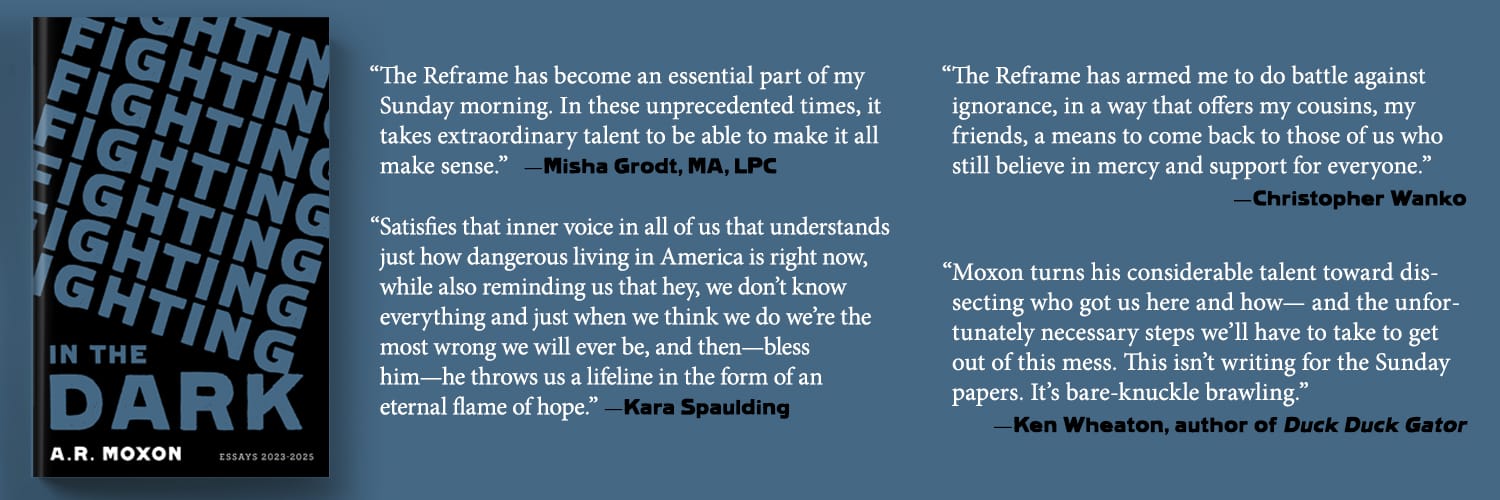
Like this essay? My next book of essays drops August 4, and a preorder really helps.
The progressive humanist story has been a rather slowly emerging one. It appears to have an advantage of natural buoyancy, because it has things to say about human beings that are interesting, positive, inspirational, and true. It results in generative good, and it appeals to the better part of human nature, and that makes it attractive, and sometimes even more attractive when opponents try to drown it beneath the surface. Its great disadvantage (about which I have more to say than I want to spend time on right now) is that it involves cost. It calls people who tell that story to partake in a greater collective responsibility to acknowledge what has been inherited and to pay the personal cost of improving it—progressing it, you could say. People tend not to want to pay costs, which can make this story easier to frame in unpopular terms.
The regressive supremacist story has no such disadvantage. It promises its adherents low costs and low responsibility, and offers a never-ending stream of enemies to force to pay its unsustainably high costs; and it promises heroism, which can be achieved by defeating those enemies. It promises you'll never have to say you're sorry, and it promises that no matter how cruel you become, you'll always be not only good, but exceptionally good—the best. Bit the disadvantage of the regressive supremacist story is that it lies in every word, which gives a sort of inevitable weight to it; when it is allowed to do what it does, it naturally creates disrepute for itself, because what it delivers is catastrophe and pain, corruption and death, and so those who associate with it tend to fall into disrepute. It tends to sink below the surface of respectability—it regresses, you could say.
Decades and decades ago, people—even openly racist people—mostly stopped proclaiming themselves as racial supremacists. They submerged. There’s been a bit of a trend back to proud open white supremacy in recent years, but I think people are starting to realize that this is a stink that won’t quite wash. I could be wrong, but even among the proud white supremacists like Tucker Carlson, I sense a new re-submersion beneath the surface, a retreat back to the old hidden foundations. Even if I’m wrong that it’s begun, I predict it will happen. It’s the way of regressive supremacy to regress beneath its own malign weight.
And what happened after submersion? Do supremacists stop being supremacist?
We know that many do not.
Some who submerge lurk in the depths. They never stopped believing in the supremacy of the white race over all others, and of men over women, and of Christianity over all religions, and on and on. They tell their little lies and laugh at those they fool.
Some submerge to the middle depth, where they can believe easier low-cost stories. They start to believe that all sides are equally bad, which allows them to cast themselves as virtuously opposed to strife without having to do so much as take a side.
Most just skim above the surface, and truly believe that the old wickedness is gone because they can’t see it any longer on the water’s surface; they never dive below, because they learn to never look at the places where dark shapes lurk.
Unfortunately, through ruthlessness and attractive lies, it’s the regressive supremacist view that has held sway over the levers of power for much of human history, and it’s certainly in the driver’s seat right now. It is the foundation of so many of our traditional structures, which, foundationally supremacist, naturally work to try to submerge our emerging story of progressive humanism below the surface through brute force of suppression and oppression—as we can see any time we read the news. Regressive supremacists have crafted new narratives of open gutter bigotry, or perhaps they've just shellacked those old narratives with a weaselly new framing to try to claim the reputational buoyancy of progressive humanism even while pursuing anti-human policy; to cast themselves as anti-bigotry while bigoted; and our foundational institutions do not point out their hypocrisies or contradict their obvious nonsense.
That's all quite distressing. But also I find it interesting that they have to do this.
I wrote last week about how open racism used to be a reputable position, but how it’s not reputable anymore. I think open white supremacist racism resulted in the catastrophe of a bloody civil war and the catastrophic strife rising from the cruel and horrific racist apartheid in the American South and the cruel and institutionalized racism of neglect in the North, among other things, and so open white supremacist racism gradually submerged as a reputable story available for people to tell from the available pool of stories … but the racist foundations remained, and it re-emerged with a new story built on the same story. The old supremacist story said that the United States was an exceptionally good and moral nation, a bastion of freedom whose institutions were naturally and perfectly just and good specifically because it codified slavery and secured a racist and white supremacist state. The new story claims that the United States is an exceptionally good nation, a bastion of freedom, whose institutions are naturally and perfectly just and good specifically because slavery has been outlawed, and racism and white supremacy have been defeated, and therefore the fight no longer had to be fought because it no longer exists.
This became a very popular story, and it still is. Again, I believed it, because I didn’t look beneath the surface. I didn’t notice what the submerged story actually did.
What does it do?
Last week I mused about why supremacy could be so disreputable but remain so popular. I mused about how progressive ends could be so popular and reputable while the actual systemic change that would bring them about could be so unpopular and disreputable. I think the answer can be found here, in the submerged story.
The core of the submerged story reaffirms the basic supremacist tenet of American exceptionalism—the idea that we are naturally and uniquely good simply because we are us. It has changed the definition of "good" from open bigotry to anti-bigotry, which has value, but it hasn't left the supremacist foundation.
The submerged story gains leverage in the struggle precisely by claiming the struggle is over, thus casting those who struggle against still-existing supremacy as troublemakers who fight without cause.
It colonizes the struggle against supremacy, allowing supremacists to pretend at being anti-supremacist, to claim—even as they fight to defend and expand supremacy—the moral heroism of those who actually pay the costs in the struggle against supremacy.
And, perhaps most crucially, it gives a lot of well-meaning but cost-averse and incurious people an easy way to align with submerged foundational traditions of supremacy without having to pay the reputational costs of beings seen as a supremacist.
The submerged story is a trick that convinces people that they are aligned with needed progressive change even as they oppose any needed progressive restructuring, convinces them that there's no cost of responsibility to pay in order to switch our foundational structures of belief or institution, because it convinces them that the foundations are already good, convinces them that it is precisely the change to our inherently unjust foundation that we most desperately need that threatens justice.
There's an advantage to making the regressive supremacist story submerge. There's a utility in making every new iteration reputationally radioactive, making proud supremacists scared to strut in the sun, making them change their framing to pretend to want good things. The supremacist submersion allows us to make progressive advances, and even to hold them for a time.
But a submerged story is not a defeated story, merely one that has fallen into disrepute, and a submerged story can remain popular. It can also rise. If we build our progressive stories on old regressive foundations, then supremacy will rise again, and in that tidal shift, they'll demolish much of what we built there—as the last ten years have taught us.
There are other foundations upon which we can build. The story of progressive humanism rests upon deep sustainable truths: that human beings are unique and irreplaceable works of art, that diversity is strength, that sustainability is safety, that all generative value comes from interactive cooperation. We can build on such a foundation. If we would, we must tell that story, so that the pool of available possible stories expands from that foundation.
The more of us who do this, the more the pool changes, and the more other people will be persuaded to change the story they tell themselves—to truly change it, not just shift to a more reputable version of the old submerged supremacist tale.
I want to be careful whenI say persuaded, because there are many missteps in this area. The notion that seeking progress requires securing regressive permission is a terrible trap that gives away the entire game. The notion that we must spend our time in endless debate with unconvinceable people is designed to rob us of our time and energy. The notion that we need to work out the redemption of people who have shown no interest in redemptive work is a narcissistic enablement designed to keep us centered on people who demand to be made the center and to have everyone do their work for them.
We're not talking about any of that.
With unconvinceable supremacists and fascists and bigots, all we can do is tell the stories of their disrepute until they are forced to pay the costs of disrepute or submerge once again, to spin new stories and plot their next rise—that, and to prepare for their next rise so that next time we are better prepared.
But some people who have believed in the submerged story change their beliefs—really change them. Some really do stop believing the submerged story, start to peek beneath the surface, and start to think about new foundations to build upon.
I know this, because I have changed.
If you’ve changed too, then you know it too.
So that's what I want to talk about next.
The Reframe is totally free, supported voluntarily by its readership.
If you liked what you read, and only if you can afford to, please consider becoming a paid sponsor for as little as $1/month. If you'd like to be a patron of my work, there's a Founding Member level that comes with a free signed copy of my upcoming book, Fighting in the Dark, and thanks by name in the acknowledgement section of any books I publish.
Looking for a tip jar but don't want to subscribe?
Venmo is here and Paypal is here.
A.R. Moxon's upcoming essay collection is Fighting in the Dark. He is also the author of the novel The Revisionaries and the essay collection Very Fine People, which are available in most of the usual places, and some of the unusual places. You can get his books right here for example. For every season that has passed, he prayed a prayer into the tide.



Comments ()