
Winning the Story Game
When we need radical change, we should all be radicals. Negotiating the discomforts and costs of disrepute.
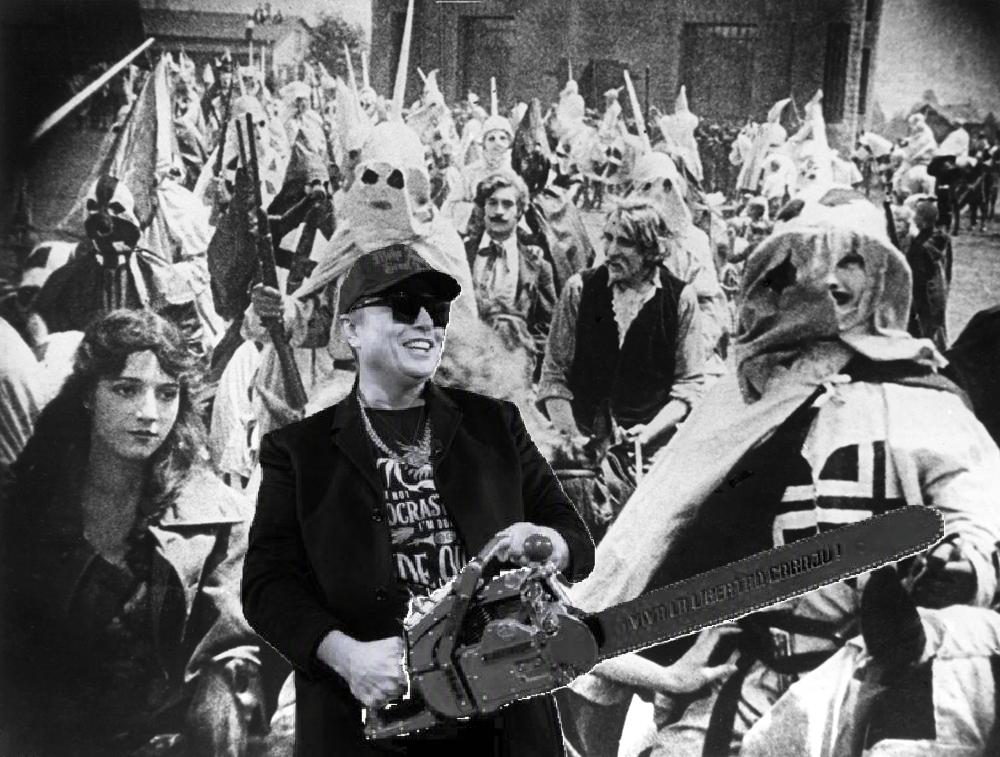
So Elon Musk is about to become the planet’s first trillionaire, I’ve learned. Or he already is one? It’s hard to tell once you’ve reached such levels of cartoon villainy and pretend money. I say “cartoon villainy” because you don’t get a trillion dollars by providing value to humanity, and I hope we’re all savvy enough by now to know that. You get a trillion dollars first by capturing the mechanisms of power and influence that decide what value is and how it is counted, and then by pointing those mechanisms right toward yourself while cutting off as many avenues that don't point toward you as you can. Corruption and exploitation, in other words.
That’s my belief—n = 1, after all—but as the only trillionaire we have, Musk certainly seems to provide ample evidence for this theory that corruption and exploitation are how one becomes a trillionaire, rising as he has mostly by telling lies to the market about what his technology will do and when it will do it, then reaping the rewards of the market’s credulity for his grandiose claims, deploying all the reputation he fraudulently gained in order to hoover up government contracts, using the wealth he gained to acquire genuinely valuable things that other people have actually created, and finally corrupting those things to his own benefit and enrichment, all the while never paying any penalty for his mendacity as he simply keeps moving out the delivery dates on the technologic miracles he was obviously never able to deliver, and indeed rarely seems interested in even looking like he is bothering to try. Musk got his final boost into trillionairism on the strength of what sure seems like a fraudulent or at least bogus valuation for the recent IPO of his SpaceX company, propped up on typically grandiose and specious claims, unaccountable market credulity, captured government contracts, and rules changes favoring specious-to-fraudulent valuations, including loosened regulation and mandatory purchases by index funds. Index funds are where most of our retirement accounts are, by the way, so if Musk and his shareholders want to dip out with all their gains, it will be everyone else left holding the bag. This sort of thing is why I say something like “pretend money.” Being a billionaire means money has stopped being practical for you, something you exchange for goods and services, and more something you use as leverage to get even more of everyone else’s real money, and making everyone else pay the costs.
Lest I forget to mention it, Musk is also an open Nazi and a genocidal mass murderer, one who last week was instigating a racist pogrom in Northern Ireland. You’d think the fact that Musk is a Nazi genocidaire would be a central part of any framing of any story about him, but it’s usually minimized or equivocated, and is certainly not much present in stories about him becoming the world’s first trillionaire, as he sucks up all the funds and resources that might solve actual global problems and relieve real human suffering, and bestows it all to himself.
Speaking of mass murder and Nazism, temporary president Donald Trump was in France this week for the G7 summit, and he got very impatient when he was asked about the school full of little girls he’d murdered. He felt that this was something that happened far too long ago to matter, back in the far distant past of a few months ago, and anyway according to him it wasn’t on purpose, so therefore there would be no consequences and everyone should just sort of shut up about it. This sort of shocking thing has become all too common. It’s just another day in another week these days, just another sociopathic utterance that ought to end anyone’s political career made about yet another global crime against humanity which ought to see anyone who committed it in front of a global tribunal, and yet it seems that yet again nothing will happen, no action will be taken to bring him to any sort of consequence, and any suggestion that anyone should do so will inevitably be framed as dangerous and radical.
This all seems very bad in my opinion. It seems bad in a lot of people’s opinion. Musk used to be an extremely popular fellow, a sort of real-world Tony Stark. He even cameoed in an Iron Man movie, and he and Robert Downy Jr. toasted each other onscreen, two pretend geniuses and pretend inventors, except that most people believed that one of them was a real genius and a real inventor. Trump was popular, too. Before he was temporary president, he was a pretend billionaire on TV, where he was one of his networks biggest stars, and has obviously enjoyed enough popularity enough in recent times to win the presidency twice. Yet while both men enjoy a sort of indestructible worshipfulness from a small subset of emotionally stunted mostly white mostly men, they are—as a result of their sociopathic behavior and constant bullshittery and murderous damage and open corruption and their allegiances to every sort of bigotry—increasingly in disrepute, with popularity down in the 30s and threatening to sink further.
Yet this disrepute doesn’t impact the way our systems of government and finance and influence deal with them. Trump and Musk’s next grandiose claims—about the end of the conflict in Iran, say, or about putting a colony on Mars—will be reported as if they were actually news, without the context of their long history of lies, without the assumption that these are just the latest lies. The markets will respond to the claims as if they are based in reality. The justice system will go on ignoring their crimes. The money will keep flowing to them, and to other billionaires, too. And billionaires as a class are increasingly in disrepute, yet the money keeps flowing to them, even as more and more people struggle to survive, even as billionaires get more and more open about their intention to control our bodies and lives, to enslave most of us and devour the rest.
Fewer and fewer people want this, it seems, and yet more and more of us are getting it. There seems to be a fundamental disconnection between the will of the people and the will of our systems of government and finance and influence. This tells me that whatever changes we need to make, they need to be systematic and fundamental—radical, in other words.
And yet so many people still resist systemic and fundamental change. So many want change but only as long as it doesn't change the system or threaten to make any fundamental modifications. In fact, those of us who want systemic and fundamental change are called “radical." In one sense I suppose we are radical, since fundamental systemic change is radical, and radical change is what is needed—particularly when we live in a time when a Nazi billionaire can take a chainsaw to democracy and the public good, murdering hundreds of thousands of people in the meantime, and the result is that he becomes a Nazi trillionaire.
If we need radical change, we should all be radicals. Yet for most people, radicals are still in disrepute.
It makes me wonder why this should be.
Its not the end of the essay! It's only a quick reminder that The Reframe is me, A.R. Moxon, an independent writer. Some readers voluntarily support my work with a paid subscription. They pay what they want—as little as $1/month, which is more than the nothing they have to pay. It really helps.
If you'd like to be a patron of my work, there's a Founding Member level that comes with a free signed copy of my upcoming book, Fighting in the Dark.
It’s notable to me that Musk appeared in an Iron Man movie—the second one, I'm pretty sure. Superhero movies have been a major mode of storytelling over the last decade or so—some would say the dominant mode. We’ve had superheroes my whole life, you know; they used to mostly be consigned to the less reputable neighborhood of comic books, but they were effective morality plays. Captain America punches Nazis. Spider Man struggles to make ends meet but still saves the day. Superman uses his godlike power to serve those he could easily rule. These are the stories. Power in service not of yourself but of others. Doing the right thing even though it costs you, because you have the power to do the right thing and that means you have the responsibility. Standing up for the powerless.
Iron Man aka Tony Stark was a central hero of these dominant stories we told ourselves. He was a capitalist genius billionaire arms dealer who saves the world by single-handedly developing increasingly autonomous mechanized weapons over which he has an ever-increasingly level of personal control, which he deploys throughout the world however he sees fit. I remember when this would describe the villain of most stories, but over the last two decades of our dominant mode of storytelling, Tony Stark was one of our primary ways of understanding heroes. His wealth was proof of his goodness; his development of technology was proof of his right to use it; his genius enabled him to make, all by himself, the marvels that brought salvation to the universe, and the creation of those marvels bestowed upon him license to decide how those marvels should be best used. It shouldn’t perhaps surprise us that after a decade or so of this we wound up with Donald Trump and Elon Musk.
I’ve said more often than I’ve said almost anything that I think what must change more than policy or attitudes or actions is the human spirit—our collective belief in what is and should be and can be, which governs the scope of what is possible. And usually when I say that I mention that I think what moves the human spirit more than anything else is story. There’s even scientific evidence for this, which I hope to get to in the near future, but I first arrived at these beliefs based on my experience of being a human, and noticing how I operate and how those around me seem to operate. I operate on story. People around me seem to operate in similar fashion.
I believe the stories we tell ourselves and each other—about ourselves, about our world, about what is good and virtuous and true, about what our challenges are—are what govern what our world can be, which even governs what we can be.
We have different stories we tell ourselves. There’s been an increasingly popular humanist story emerging over the last 10,000 years or so about an interconnected inheritance of a global human family—a natural, generative, sustainable system of magnificent diversity—and a responsibility to take what we have inherited and pay the natural costs of improving it. There’s also been a popular and empowered story about the natural goodness of domination and supremacy, about might making right, about brutality and authority bringing safety and order, about the natural right of gods and kings; a story that insists that the inequalities we see are real, actually, but are natural and good and should be increased; a story that says that supremacist dominance is proof that those who dominate deserve to dominate, that those who dominate are owed our loyalty, and the suffering of those who suffer the abuses of this domination are proof that their suffering is deserved. This story says that life must be earned and that therefore those who die must have deserved death, and you are justified for bringing it, or allowing it to be brought, or for being indifferent to it.
It’s a popular story, supremacist domination. It’s the story that’s held power in my country for my whole life. It's guided our decades of supremacist global colonialism and militarism, of intervention and exploitation and domination.
But … it’s not a particularly reputable story.
It used to be very reputable to be an open supremacist, you know. The first mega-blockbuster movie was D.W. Griffith's racist epic Birth of a Nation, a big enough national hit to be screened at the White House for U.S. president Woodrow Wilson, who praised it effusively. It is about how the heroic Ku Klux Klan defended white supremacy by terrorizing the villains: Black people who were voting. The triumphant end comes when the KKK ride in on horseback and run off Black voters from voting lines. I’m not kidding. This was the most popular movie of the 1910s and it resulted in the re-emergence of the actual Klan. At the end of the 1930s, Gone with the Wind gave us a more modulated version of the same thing: an elegy for the “lost” cause of Southern white supremacy—“lost” in quotes, because usually it is the winner who gets to tell the story, and it was the white supremacist story being told, and Hattie McDaniel was segregated from her white co-stars when she won her Oscar, and decades later she was not allowed to be buried in the same cemetery as her white co-stars, so I must wonder which story “lost,” really. Both films were on the 1997 American Film Institute’s list of 100 greatest films of all time. And Republicans still focus pretty heavily on telling the South’s side, converting the War to Preserve and Expand Slavery into a War of Northern Aggression.
But also notice … they have to convert it. Confederates seceded with an open defense of their right to slavery, but their modern defenders have discovered they can’t tell the story they defend on its own terms without paying a cost in reputation. Southern scions of human slavers don’t like being thought of as scions of slavers, these days, and those who serve as Confederate apologists don't like being thought of as apologists for slavery. These days most racists don’t like being called racists and most supremacists don’t like being understood as supremacists, and most fascists don’t like being called fascists. Instead, they try to cast their critics as the real racists, and those who try to resist their oppression and suppression as the real supremacists, and antifascists are the real fascists. There seems to be a reputational cost that attends their actual beliefs, one they’d rather make others pay, and they seem to know it. And, crucially, the benefits of reputation and costs of disrepute seem inevitably tied to the stories they tell about themselves and the stories they want to see told in society. They seem to understand on some deep level that story appears to be the staging ground of human spirit, and human spirit governs the limits and vistas of what is possible.
What happened? I’d say reality happened, and reality started informing the stories we told each other, which started governing the ways we think of ourselves and each other.
Which is what story does.
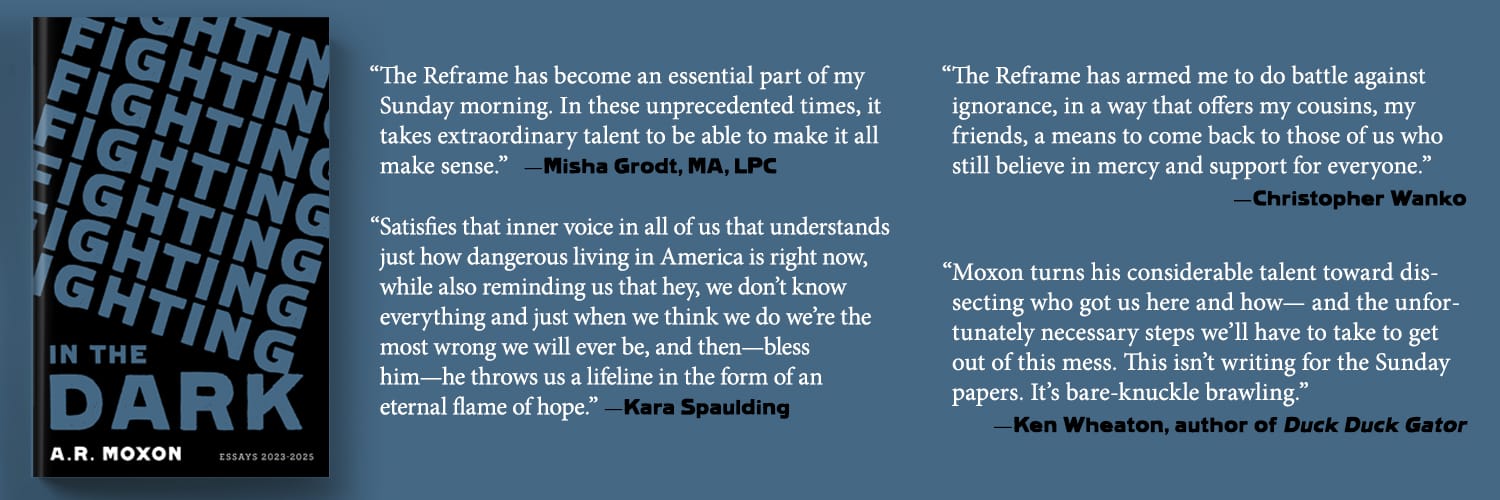
Like this essay? My next book of essays drops Aug 4, and a preorder really helps.
I think what happened was what always happens with supremacy, which is a lot of bloody war and massacre and corruption and theft. The great disadvantage of the supremacist stories, in my opinion, is that they are all founded upon unsustainable doomed lies; all of them protect and create systems that devour human beings, and inevitably a system that devours human beings will get around to devouring you, if it is allowed to operate long enough, and if you are a human being. Like Elon Musk or Donald Trump, supremacist stories promise things they will never be able to deliver. It’s much harder to promise low costs, or advantages of looting and pillaging, to people who are being actively devoured by your higher costs while you keep all the loot and pillage for yourself. It’s hard to keep telling a story about how brutality and massacre are good, actually, when the brutality and massacre keep escalating and harming more and more of our family, friends, and neighbors.
So over time, and at least for a time, our stories stopped being about how supremacists and bigots are heroes, and started being about how supremacists and bigots are people who have aligned themselves with malignant unsustainable lies, aligned with cruelty and abuse and theft and murder. Movies and plays and shows have been produced—some of them clumsy, some of them deft—about the harms of bigotry, about the value and generative strength of human inclusivity and the natural right of all people to experience equality under the law. And, in fits and starts, sometimes clumsily, sometimes deftly, many stories started smuggling these sorts of messages into the unexpressed subtext, presenting previously marginalized communities as included, not through some sort of special dispensation or allowance, but as a natural part of the stories we tell. When you cast a Black actress in a silly Disney movie about little mermaids, you don’t have to have a character overtly say “Black girls can be little mermaids, too,” because you already are saying it in every frame.
And over time, those who depend upon their bigotry for identity and fortune discovered they couldn’t tell a story about how they were a bigot without paying external and internal costs of disrepute. They had to find other stories to justify themselves. So these days racists complain about a Disney movie casting a Black actress to play a little mermaid, but it’s not because they think Black people are lesser, noooo … it’s because they respect the source material. They hate a female Ghostbuster, but it’s not because they hate women, noooo … it’s because they resent having something aggressively forced on them. They aren’t bigoted against trans people, they’re just concerned about children. Even in the stories they seem to be telling themselves about themselves, they don’t seem to want to pay the cost of disrepute—and, even as they embrace the supremacist story, they recognize that supremacy is something they don’t want said about themselves. It seems to me than many don’t even want to think it of themselves.
And so they told those newer stories, and as these stories were accommodated, they used the accommodation to further the rise of supremacy and fascism, and to create even more cultural space to tell increasingly harmful versions of these stories. And now, as those stories have led—as supremacy always will—to bloody war, corruption, theft, and massacre, it seems to me that these newer, slyer supremacist stories are starting, here and there, to fall into disrepute. Musk keeps lying and people have noticed, even if banks and governments and media are loathe to follow suit. In between bouts of popularity leading to each Trump presidency has come the actuality of the Trump presidency, which has led to embarrassing failure, corruption, and destruction … and massive Trump unpopularity. There are signs that Trump’s white supremacist fascist MAGA movement, which enjoyed a season in the sun as it created a sort of reality-distorting gravitational field of popularity, may become something that will not be tolerable in the stories we tell, will rightly earn the same automatic equation with bigoted evil as does the KKK. There is even some hope in my mind that this reputational collapse might befall organizations that have long been more respectable bastions of white supremacy and fascism and supremacist bigotry, such as white nationalist evangelical Christianity, or the Republican Party.
“But hold on a minute!” you might say, if you are somebody like me. “Supremacy is still extremely popular—even open supremacy. No matter what people might say about themselves, what they actually are shows in their actions, undeniably. There are limits to story.” And it’s certainly true that in the last decade people have been telling white supremacist narratives in the open that would have seemed unthinkable in decades past. One of these people is now and once again president, and many others are cabinet members or congresspeople or judges or sheriffs or generals. For a time now, prominent people have been giving Nazi salutes in public without consequence. One of them just became a trillionaire. This would seem to demonstrate that the supremacist story is still very much in power. And I started this essay by wondering about this strange thing, whereby even though our systems have fallen into disrepute through adherence to the premises of the supremacist story and the evidence therefore points to a need for systemic radical change, being a radical is still disreputable.
As often happens at The Reframe, one thing leads to another leads to another. There’s so much more to say.
I want to close for now with a few observations.
First, this struggle we’re in is a human struggle, which means it is a spiritual struggle, which means it is a story struggle. The game we're playing is a story game, and I think we’d better win it, so I think we’d better learn as much as we can about how story works, and what it does, and what stories we currently tell.
Second, story seems to have both a collective aspect, which is the stories we all tell each other about ourselves, and a personal aspect, which is the stories we each tell ourselves about ourselves—and both of these aspects of story seem intimately intertwined with managing reputation and negotiating the discomforts and costs of disrepute. This suggests to me that we'd do well to get good at understanding how reputation and disrepute play into stories we tell.
Finally, there seems to be something cyclical in nature, an almost tidal return, as the reputation of supremacy’s story rises and falls, which suggests to me that when supremacy loses reputation, it has been very good at finding new stories to give its adherents to tell about itself, which allows supremacy to remain popular even while its traditional expressions have become disreputable, to maintain its sway over hearts and minds and its grip on power even as it engages in the most unpopular and disreputable actions, while casting as disreputable those who would engage in the vital and necessary work of making radical changes to those systems.
And that suggests to me that, if we are interested in progressing a humanist story of universal connection and cooperation, we ought to get very good at crafting alternative stories, and spreading them into the culture at large. We ought to get very good at detecting the people who might be opening themselves to the possibility of hearing those alternative stories, and detecting the people who aren't open to it, so we spend our energies well. And we ought to get very good at telling those stories.
These are all things I want to try to expand upon over the coming weeks.
I'd like to start winning the story game.
The Reframe is totally free, supported voluntarily by its readership.
If you liked what you read, and only if you can afford to, please consider becoming a paid sponsor for as little as $1/month. If you'd like to be a patron of my work, there's a Founding Member level that comes with a free signed copy of my upcoming book, Fighting in the Dark, and thanks by name in the acknowledgement section of any books I publish.
Looking for a tip jar but don't want to subscribe?
Venmo is here and Paypal is here.
A.R. Moxon's upcoming essay collection is Fighting in the Dark. He is also the author of the novel The Revisionaries and the essay collection Very Fine People, which are available in most of the usual places, and some of the unusual places. You can get his books right here for example. He walks along darkened corridors, and he walks along darkened corridors.
Note: This essay has been corrected. Elon Musk instigated a racist pogrom in Northern Ireland, not Scotland. Hattie McDaniel was allowed to attend the 1939 Oscars at a segregated table.

Comments ()